



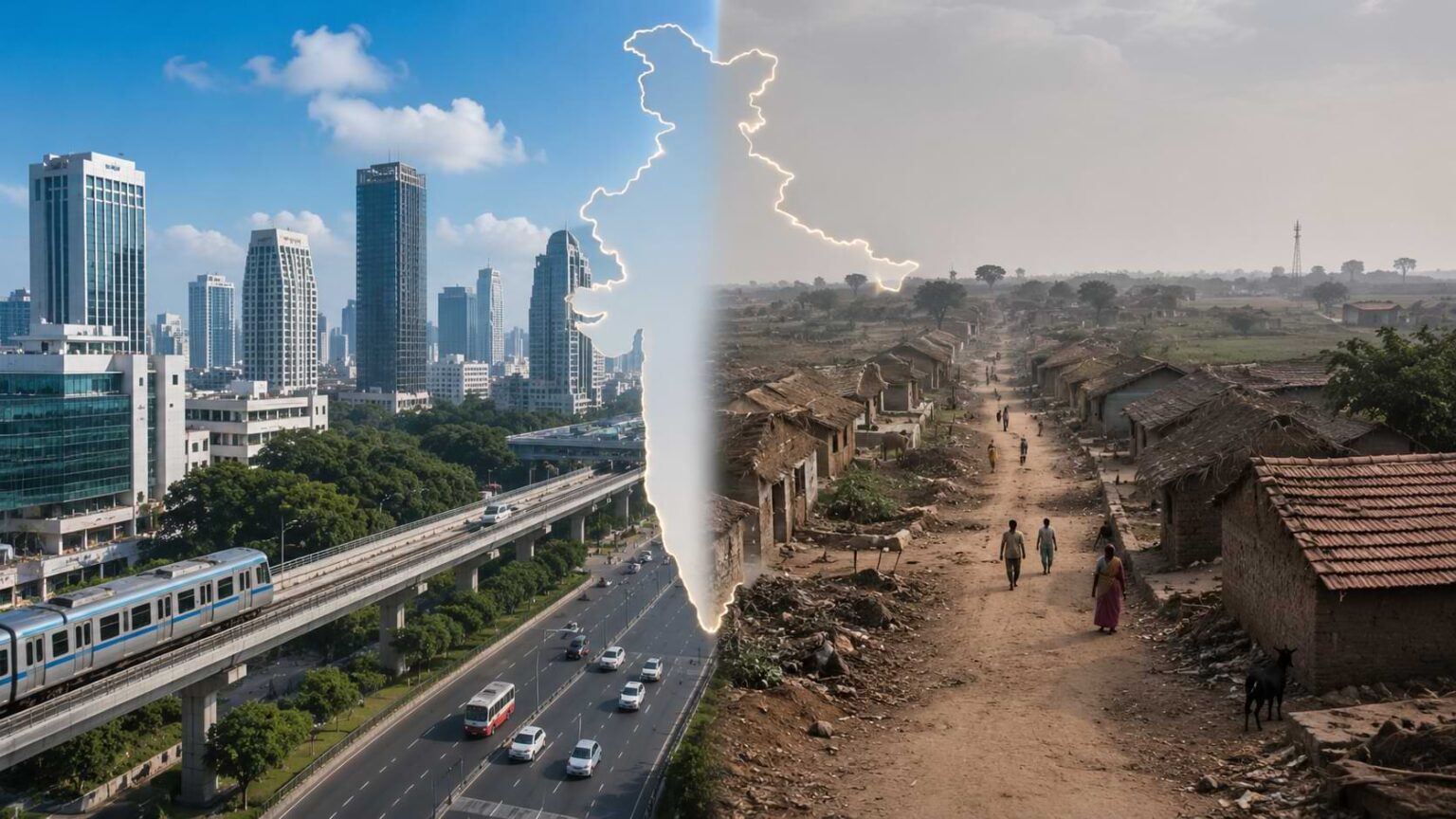

The Indian subcontinent can be thought of as one state, but where the economy and social development are concerned, there exist disparities between the South and the North of the country. The states in the South, such as Tamil Nadu, Karnataka, Telangana, Andhra Pradesh, and Kerala, have managed to earn higher incomes, grow industries, receive better education, and benefit from improved health care services. These disparities are becoming a topic of concern in terms of the fairness of resource allocation and taxes in the country.
Even though South India has a relatively smaller population when compared to North India, the region makes significant contributions of over 31% of India’s GDP for the financial year FY2025. Southern states produce better per capita economic production and have evolved into industrial, technological, and service centers.
Important States in Terms of Economic Performance
Tamil Nadu represents the second largest state economy in India and retains one of India’s major manufacturing centers. Karnataka is recognized as the technology hub in India, owing to the booming technology industry in Bengaluru. The state of Telangana has experienced fast economic growth because of the development of its information technology and pharma industries, whereas Andhra Pradesh has further enhanced its economy with regard to industrialization and infrastructure development. Kerala, although having small industries, performs very well in terms of its emphasis on education, healthcare, and human development.
The economic development of the southern states is obvious from its growth rates. Growth rate at its peak has been registered by the state of Karnataka, which stands at 7.8%. The second highest growth rate was that of Telangana, which was 7.1%. The third on the list is Andhra Pradesh with a growth rate of 6.9%, and then follows Tamil Nadu with a growth rate of 6.8%.
The prime reason for such growth rates is that these states are ahead of the states of Northern India in terms of production and income levels. Though the states of North India have their significance in terms of contributing to the economy of the country on account of having a huge number of people, yet, in terms of their contribution to the economy, they fall short.
Technological Advancement and Innovation in Bangalore and Hyderabad
An important factor responsible for the success of the South region of India is knowledge based industry.
Bangalore – Silicon Valley of India
Bangalore is considered to be technologically the most advanced city of India as it has:
International IT giants
Innovative startups and research facilities
Aerospace companies
Firms working in biotechnology
Investment, skilled labor, and global business presence have turned Karnataka into one of India’s fastest-growing regions.
Hyderabad has grown into one of India’s key centers of:
- Pharmaceutical production
- Medical research
- Information technology
- Foreign investment
The strong industry infrastructure of this city has made Telangana one of India’s economic engines.
Technological and pharmaceutical industries generate:
Well-paid employment opportunities, Income from exports, foreign investments and development of skilled labor force
In most of the North Indian states, the concentration is on traditional sectors such as agriculture and low value added industries.
Textiles and Engineering Industry
Cities such as Coimbatore & Tiruppur are famous for:
Manufacture of textiles
Export of garments
Engineering goods
Production of electronics
Tamil Nadu is now one of the leading states in:
Electronic goods manufacture
Manufacturing of auto parts
Advanced manufacturing
Around 33% of Tamil Nadu’s GDP comes from manufacturing industries, while other northern states have far lesser contribution.
Excellent infrastructure
High-quality skilled labor force
Friendly investment policies
Good industrial planning
Human Development Model of Kerala
As most states concentrate on economic development, Kerala has emerged as the finest model of human development in India.
- High rates of literacy
- Improved health care facilities
- High life expectancy
- Social welfare programs
Comparison of HDI
Region HDI Index
Kerala 0.804
Tamil Nadu 0.734
Karnataka 0.715
India’s Average 0.685
The above example shows that human development doesn’t depend on industrialization and other economic factors but on the educational and public health systems.
Discussion on Tax Contribution and Allocation of Resources
One of the major political issues between the North and the South is tax contributions and revenue allocation.
Most leaders from the southern region claim that their regions contribute heavily to the country’s budget, but they are not compensated adequately.
Major Issues Brought Up by Leaders of the Southern States
Lesser amount of money allocated even when they contribute more.
More money allocated to less developed northern states.
Limited financial independence for state governments.
Fears of centralization.
The leaders of states like Karnataka and Tamil Nadu feel that the best performing regions should not be penalized for doing so well. However, those in favor of the current arrangement insist that the better-off regions should contribute to the lesser developed regions of the nation to create a balanced development strategy for the entire nation.
Why South India Performs Better
The explanation for the better performance by South India is due to the fact that there have been numerous years of investment in different areas such as the education, health, and industrial sectors. Some of the states that form South India. These states have great educational institutions like schools and colleges. They have also improved the health care sector in the region while developing a highly skilled labor force that can help boost their industries. The favorable business environment in the region makes it attractive to investors from other countries as well as tech and manufacturing companies.
On the other hand, northern states still have issues like higher population size, high poverty ratio, low literacy rate, high dependency on agricultural sector, and slow pace of industrialization. This increasing disparity has various effects on the development of India in the coming days because southern India is excelling in terms of average per capita income, development of people, and industries, while the north region enjoys a huge labor force and a vast domestic market. For achieving well-balanced growth, there needs to be emphasis on improving education and healthcare facilities in lagging states and industrializing all the states and ensuring equal sharing of resources among both the regions.
Conclusion
The term “Two Indias in One” signifies the widening gap between the rapidly developing south and the backward northern regions. Southern States were successful because of the considerable investments in education, medicine, technology, and industry; thus, providing them with a high standard of living.
However, addressing inequality among various regions is crucial for India’s future progress and stability. In that case, India would find it possible to ensure a balanced development rewarding successful regions while helping backward regions develop further.
