




Let me start with a number, 1 crore rupees. Now, this is what is lost every single day in fuel alone due to congestion on the Bhor Ghat section. Not annually, not monthly. Every day. And that figure captures only fuel. It excludes the hours lost, the accidents, the freight delays, the logistic penalties, the missed business commitments. When you aggregate all of that, what you have is not a traffic problem. What you have is an economic wound that Maharashtra has been bleeding from for over two decades now.
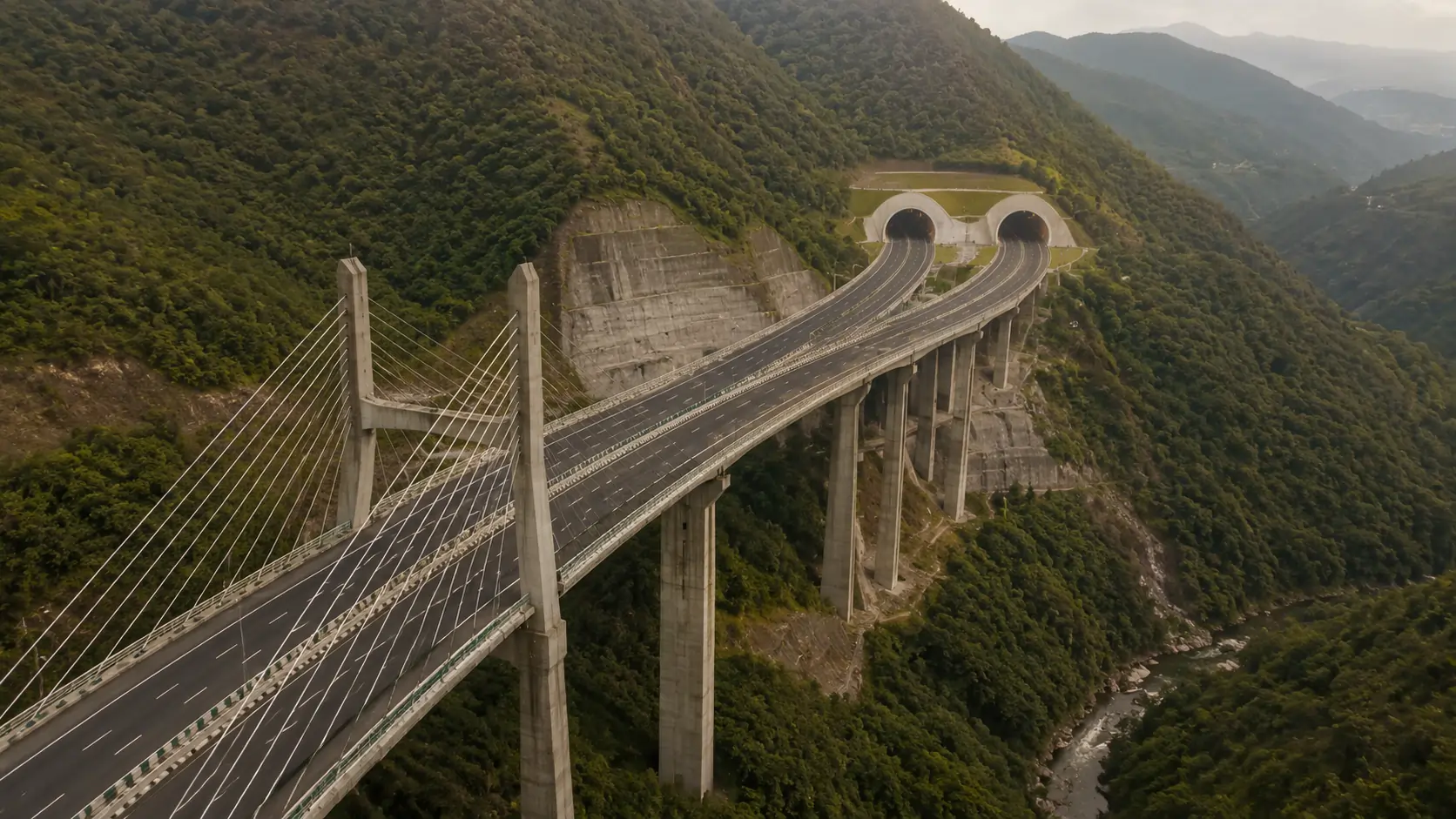
The Mumbai-Pune Missing Link project is the answer to that wound. The project, consisting of a tunnel so long that it is among Asia’s longest road tunnels, looking at the potential of being included in the Guinness Book of World Records.
Why This Corridor Matters
Now, why does this corridor matter? The Mumbai-Pune Expressway is not merely a road. It is the single most economically productive highway corridor in India.
Consider what exists along this 95 km of stretch. Mumbai, well, this is the financial capital of the country. It is home to BSE, the Reserve Bank of India headquarters, the country’s largest port, and a metropolitan economy that would rank among the world’s top 20 if measured as a standalone nation.
And what about Pune? It is India’s fastest-growing major city, the country’s second-largest IT hub after Bengaluru, home to over 4,000 manufacturing units, a city where population has grown from 25 lakh in 1991 to over 70 lakh today.
Traffic Volume and Economic Importance
Now, between these two cities moves an extraordinary volume of traffic every day. Now, let’s look at the daily vehicular traffic. Around 55,000 to 60,000 vehicles move in this corridor.
Of them, the light vehicles, which are the cars and the buses, form 70% of the total volume. The heavy vehicles, which is the truck and the tankers, form 30% of the total volume.
This corridor underpins the IT sector, the automobile manufacturing cluster at Chakan and at Talegaon, the pharmaceutical belt, and one of the largest logistics network in Western India. When the
Expressway opened in 2002 as India’s first access-controlled highway, it did not merely connect two cities. It created an economic region.
The Problem: Bhor Ghat Bottleneck
And at its center is the most critical and most vulnerable point. That is the Bhor Ghat.
Now, what’s the problem about Bhor Ghat? Bhor Ghat is a mountain pass in the Sahyadri range, rising approximately 625 m above the sea level. It has been the primary crossing point between the Deccan Plateau and the Konkan coast for over a century now.
On the Expressway, its defining structural failure is this: 10 lanes of converging traffic funnels into six lanes. This is the bottleneck. This is where one of India’s finest roads becomes its own worst enemy.
Consequences of the Bottleneck
The measurable consequences? Well, travel time inflated by 20 to 30 minutes under normal conditions. And during peak weekends, festival seasons, or monsoon disruptions, delays of up to 2 to 3 hours are routine.
The accident rates disproportionately higher due to sharper gradients, blind curves, and dangerous interaction between heavy vehicles and passenger cars on steep descents.
There’s also the issue of monsoon vulnerability every year where one lane on the Mumbai-bound side is closed due to landslide risk, further compressing an already constrained corridor.
The Ghat is not a design flaw. It’s a geographical constraint that no amount of lane widening can resolve. The only solution is to bypass it entirely or more precisely, to go through it.
The Missing Link Project Overview
In 2002, the Mumbai-Pune Expressway changed what was possible between these two cities. In 2026, the Missing Link completes that transformation.
The project cost is 6,695 crore rupees. The total length is 19.84 km. The construction duration has been over 7 years through one of India’s most challenging geographies.
The tunnels, well, two of Asia’s widest tunnel roads are looking at Guinness Book application. The bridge height is 184 m, cable-stayed, internationally designed. Daily beneficiaries, 55,000 plus vehicles as anticipated.
Project Structure and Components
Now, the infrastructure at this scale is not about concrete and steel. It is about what people do with the time, the safety, the economic opportunity that better connectivity creates.
Let’s try and understand the Missing Link project. Now, this project creates a total of 19.84 km alignment that bypasses the Bhor Ghat, connecting Khopoli exit to Kusgaon.
The project has two components.
The first component is the widening of Khalapur to Khopoli, which is a 5.86 km component. The existing six-lane road is upgraded to eight lanes, including three major bridges, one minor bridge, and two underpasses.
The second component is the new alignment from Khopoli to Kusgaon, which is 13.3 km long, an entirely new road through the Sahyadri range.
Technical Specifications
Now, of the total length of 19.84 km, the road width of which is 100 m, the lane configuration is 4 + 4 lanes, which is a total of eight lanes. The design speed is 120 km, and the project cost is 6,695.37 crore rupees.
The inauguration date is 1st of May, 2026.
Now, there are two parallel tunnels on this road. The first tunnel is 1.64 km long and 23.50 m wide. The second tunnel, it 8.92 km long and 23.50 m wide.
The 8.92 km tunnel is among Asia’s longest road tunnels. At 23.5 m in width, accommodating four lanes of traffic, it is potentially the widest road tunnel in Asia.
Bridges and Engineering Marvels
Now, there are two major viaducts. The first viaduct is 900 m long and 60 m high. The second viaduct, which is a cable-stayed bridge, is 650 m long, 184 m high.
The main span is 305 m. The cable-stayed bridge’s pylon rises 180 m from the valley floor, taller than most of the high-rises or the buildings in Mumbai.
Environmental and Construction Challenges
Over 58% of the total 128 hectares land required was protected forest land, which was 74.71 hectares, creating complex legal compliance requirements at every stage of construction.
Oxygen supply management for workers operating continuously inside almost 9 km of enclosed tunnel space required dedicated ventilation engineering from day one.
Reasons for Project Delays
Now, of course, there have been delays in the project. The project was approved in 2018. Construction began in February-March 2019.
But four primary factors caused extended timelines.
One was the COVID lockdown. Second was the international testing bottleneck during COVID. The third was the complex regulatory approvals like forest clearance and environmental approvals. And fourth was the geological and meteorological constraints.
Through all these challenges, the construction has finally been completed.
Impact After Completion
But what will be the impact? What changes on May 1st?
Now, the distance will reduce, which will be 6 km shorter between Khopoli exit and Kusgaon.
What does it mean? It means saving of time for 20 to 30 minutes under normal conditions.
The fuel saving is 1 crore rupees every day, which means a 365 crore rupees annually.
Accident reduction, near-zero target on the Ghat stretch.
Toll impact, well, the good news is no increase at Khalapur or Talegaon toll plazas.
The phase one access will be for light vehicles and buses from day one.
Time and Economic Benefits
Now, the annual time returned to users will be over 1 billion person minutes. Yes, you heard it right
It is based on the calculation of 55,000 vehicles passing from there every day into 30 minutes saved per person into 365 days.
Strategic Significance
The strategic significance, of course, the missing link is not a standalone project. It is the completion of the original vision of the Mumbai-Pune Expressway.
When the Expressway was opened in 2002, the ghat section was always understood as a temporary compromise. This project closes that gap after a whopping 23 years.
