



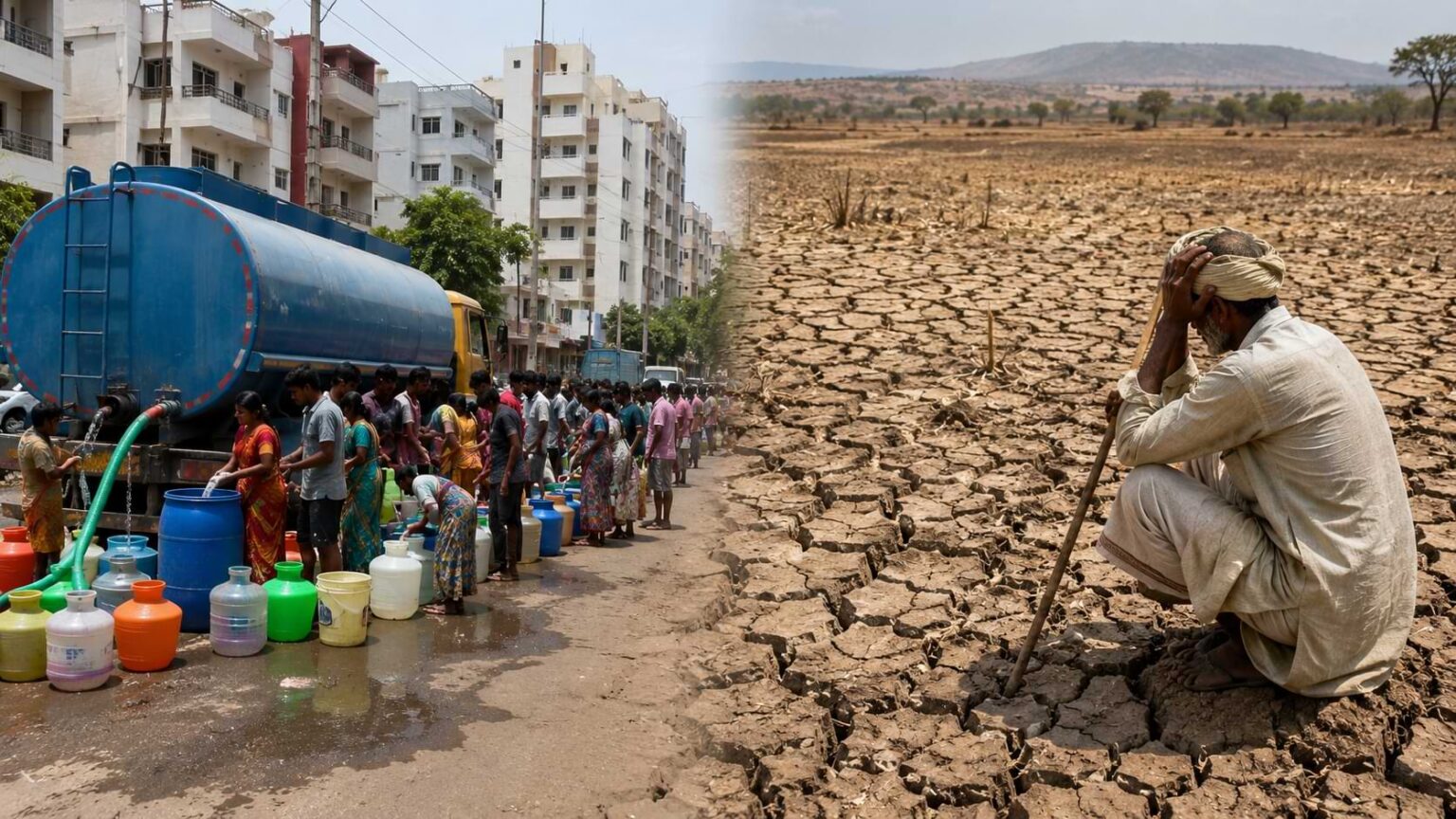

Every year during the summer, Karnataka finds itself having to have the same old discussion: Is there going to be enough water? In Bengaluru, that comes across in the guise of private water tankers, dried-up bore wells, skyrocketing rates, and apartment notices requesting a cutback in consumption. In rural Karnataka, it comes in another form – failing harvests, drained farm ponds, exhausted cattle, and people awaiting their turn to get water. While these seem like two different issues, there is one common denominator between them. Karnataka’s water crisis is no longer about being in shortage of water due to inadequate rains; it is now a crisis created due to poor water storage, distribution, and use.
The best case-in-point for this statement is none other than Bengaluru itself. Despite all its technological advances and being the center of investment and modern development, it is not self-reliant in terms of water. In contrast to the traditional portions of the city, where citizens receive piped water, the newer areas rely on bore wells and water tankers for their needs. As such, they face the challenge of having access to water from private companies at an inflated rate. When borewells dry up, the tanker economy becomes not a backup option but the main water system for thousands of households.
The bigger problem, however, was that Bengaluru developed much faster than its water systems. The construction of housing complexes, IT parks, layouts, and industrial areas happened at a fast pace, but the lakes, stormwater drainages, ground recharging sites, and sewage facilities were not provided the necessary protection. Lakes which used to act as natural storage facilities have either been encroached upon, polluted, or separated from their natural water channels. Water, which could have percolated into the ground and stored underground, instead finds its way out through drainage facilities made of concrete or floods the roads for a while and is lost forever. This is the reason behind the occurrence of waterlogging and lack of water in summer season in Bengaluru. Lack of water is thus not only the problem here, but water mismanagement is the main cause.
For rural folks, the problem takes a different turn. Villages in dry areas of Karnataka rely almost entirely on the monsoons for survival. Delayed monsoon rains, scanty rainfall, or inadequate rains bring about crop failures, farmers drilling deeper wells, farmers falling into debt trap, and ultimately migration. A failed agricultural season can force young people to move to cities in search of work, increasing pressure on urban centres like Bengaluru. In this way, rural drought and urban water stress feed into each other.
The unpredictability due to climate change only makes the situation worse. What Karnataka needs are not simply more rains; it needs timely rain, adequate rain, and rain in the correct locations. Torrential rains over just a few days can never be equated to rains occurring over several weeks in the monsoon season. The former may flood all the drains and streets, but in case there are dirty lakes and choked recharge zones, all this water will simply be wasted. Drought conditions do not just mean a lack of rains. This comes from bad planning, over-extraction of groundwater resources, and poor use of stored water resources.
Any long-term solution to the problem will have to take into consideration these aspects of water scarcity and plan a strategy around them. Tankers may prove useful for emergency situations but not for securing a reliable water supply for future generations. Karnataka must plan out its future water security on the foundations of conservation, recharge, and reuse. Rainwater harvesting must be made mandatory for building approval in Bengaluru, the lakes must be kept alive as live sources of water and not as wasteland areas ready for development. Treated wastewater should be reused for industries, construction, gardening, and lake rejuvenation so that fresh water is reserved for drinking and essential domestic needs.
The rural parts of Karnataka should also receive attention equally. Farm ponds, watershed management, soil-moisture management, and tanks can decrease the dependency on deep borewells. The farmers will need assistance to move towards crops that are better suited for rainfall in their locality rather than growing water-intensive crops in dry regions. Budgeting the usage of water at the village level can also enable the villages to assess their supply, demand, and wastage.
This is not something that needs to be addressed by just the government. Citizens, construction agencies, industries, resident welfare associations, and farmers alike all play their part. However, the initiative for this needs to come from our policies as water cannot be managed only when there is a visible crisis on the TV screen.
Karnataka’s water crisis is a warning. It tells us that development without ecological planning creates fragile cities and vulnerable villages. Bengaluru’s tanker lines and drought-hit farms are two sides of the same story. The state does not lack intelligence, technology, or resources. What it needs is the will to treat water not as an emergency commodity, but as a shared public lifeline. If Karnataka acts now, it can still turn crisis into reform. If it delays, the next summer will not bring a new problem—it will only expose the same structural failure again.
