




As the most recent spat over perceived corruption in donations to the Ayodhya temples makes clear, once more the RSS and the BJP find themselves under close scrutiny due to allegations of corruption and lack of accountability. With Karnataka Minister Priyank Kharge’s plea for transparency, the bigger picture of the connection between politics, religion, and Hindutva is now being questioned.
It is not a question of money but of the increasing trend to employ religious symbols and institutions for political purposes, which has become evident over the past decade when critics claim that the BJP and other organizations connected with the Sangh Parivar have confused governance and ideological nationalism.
Emergence of Hindutva Ideology
This ideology, which was first expressed by Vinayak Damodar Savarkar at the beginning of the twentieth century, defines India largely in terms of its being a nation-state based on a Hindu civilization. While Hindutva is presented as a culture-based and nationalist ideology by its proponents, its detractors feel that this ideology has an adverse impact on India’s secular and plural constitution.
RSS, formed in 1925, is considered to be the main ideological wing of the BJP party. Its vast organizational strength has made it instrumental in constructing a homogeneous national identity based on Hindu symbols and has created fears for religious minorities and linguistic groups.
It is further alleged that this ideological enterprise transcends the religious sphere to include issues of education, language, and culture as well. The issue of revision of textbooks, the promotion of Hindi, and changing names of cities and institutions are all seen as parts of the larger project to construct India’s heterogeneous identity into a homogenized Hindu national one.
Symbolism of the Ayodhya Temple in Politics
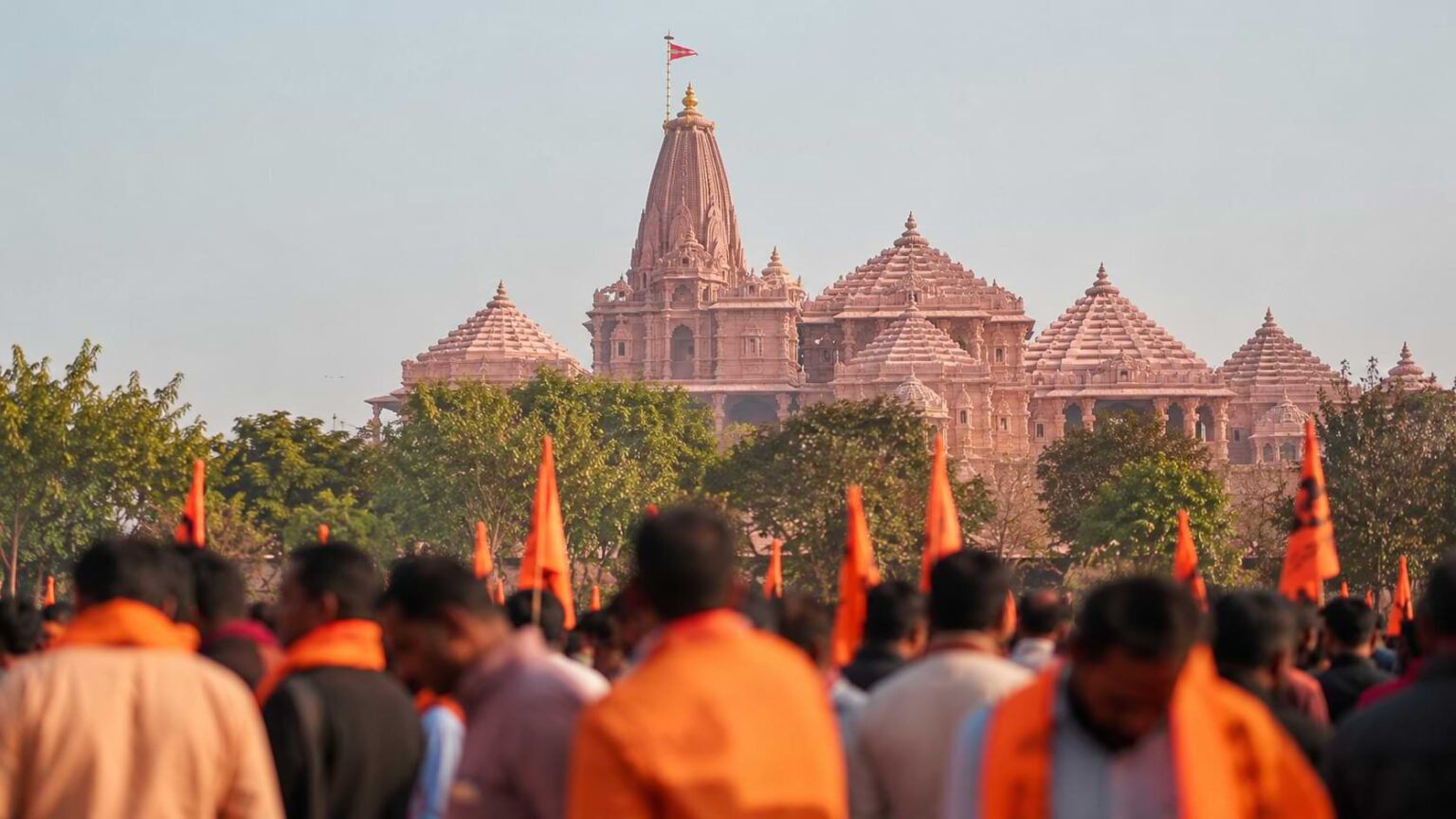
It seems impossible to find another topic which would demonstrate the connection of religion and politics in such a way as the campaign for the construction of Ram Temple in Ayodhya. The movement has evolved from its religious aspect into one of the strongest politically motivated campaigns in India. The destruction of Babri Masjid in 1992 has brought about the total transformation of politics in India, creating the grounds for the emergence of Hindu nationalism elements which eventually led to the dominance of BJP in Indian politics.
Millions of believers were involved in the inauguration of the Ram temple in January 2024. However, the critics as well as the constitutional lawyers doubt the evident political significance of the ceremony, saying that the government interfered in the religious ritual.
Donation Schemes in Ayodhya: Recent Issues and Concerns
In light of recent accusations surrounding the irregularities and alleged embezzlement associated with the Ayodhya-related funds, it appears that yet another issue of transparency has come up. While ongoing investigations and lawsuits suggest that the claims are contested, one cannot deny the fact that every organisation receiving the funds from the public in the name of religion must be fully transparent with regard to finances.
The problem also brings back into discussion the role played by the Vishva Hindu Parishad (VHP) and its connection with the entire Sangh Parivar group. Political adversaries state that those organizations which promote cultural nationalism should be subject to the same degree of scrutiny as all other public institutions. Symbolically speaking, there appears to be a larger issue at hand as far as the problem of using religion for political legitimization goes.
Ayodhya Cash Row Uncovers Hindutva Politics”: Priyank Kharge Asks Rss To Apologize Publicly
With the controversy of alleged misappropriation of donations collected for Ayodhya, the political backlash against RSS and Sangh Parivar has started again with Priyank Kharge, a minister from Karnataka, criticizing the organization in a very aggressive manner regarding its transparency and accountability. After RSS Prachar Pramukh Sunil Ambekar’s remarks, Priyank Kharge said, “Ask them to apologize in public. They are experts in apologizing. This is their history… Savarkar apologized so many times. Tell them to do so too.” Kharge also raised his doubts about the RSS and its connection with the VHP, and even asked RSS chief Mohan Bhagwat to put all the related documents into public view, and said, “Just throw those papers in front of me and silence me. Register RSS and keep my mouth shut.”
It has also been felt strongly in the Southern parts of the country, where political parties have long been opposing any further spread of Hindutva politics and the preservation of regional identities, language plurality, and the secular nature of the Constitution. It is believed by many political figures from South India that the organisations belonging to the Sangh Parivar try to impose a Northern Indian cultural pattern based on Hindi and Hindu values on the South with its own language and social-political traditions. The case of Ayodhya should therefore be seen as not only an economic one, but as part of a bigger discussion on the increasing role of the Hindutva ideology in the life of a federative and pluralistic India.
BJP, RSS, and the Issue of Cultural Diversity in India
India’s constitutional structure is rooted in secularism, federalism, and cultural diversity. The criticism against BJP and RSS ideology states that any attempts at creating one common cultural identity threaten the very foundation of the Indian state system.
The discussion of language policies, education changes, and citizenship legislation is accompanied by growing accusations on the part of opposition towards the establishment of a narrative that excludes certain social groups and makes them peripheral in the context of cultural nationalism.
BJP and RSS supporters refute these charges and claim that the policies of the party are aimed at restoring the heritage of the country. However, the ongoing discussions prove that the issue of religion, nationalism, and constitutionality is a matter of controversy.
Conclusion
The recent Ayodhya donations scandal has thrown the spotlight once more on the interconnection between religion and politics in India. Apart from specific allegations, it has also revived more general discussions concerning transparency and accountability, as well as the increasing role of Hindutva in shaping the nation’s political life.
In dealing with its complicated identity, India must face the problem of how to reconcile cultural heritage with constitutional values of pluralism and tolerance. It is essential for the future development of Indian democracy.
