



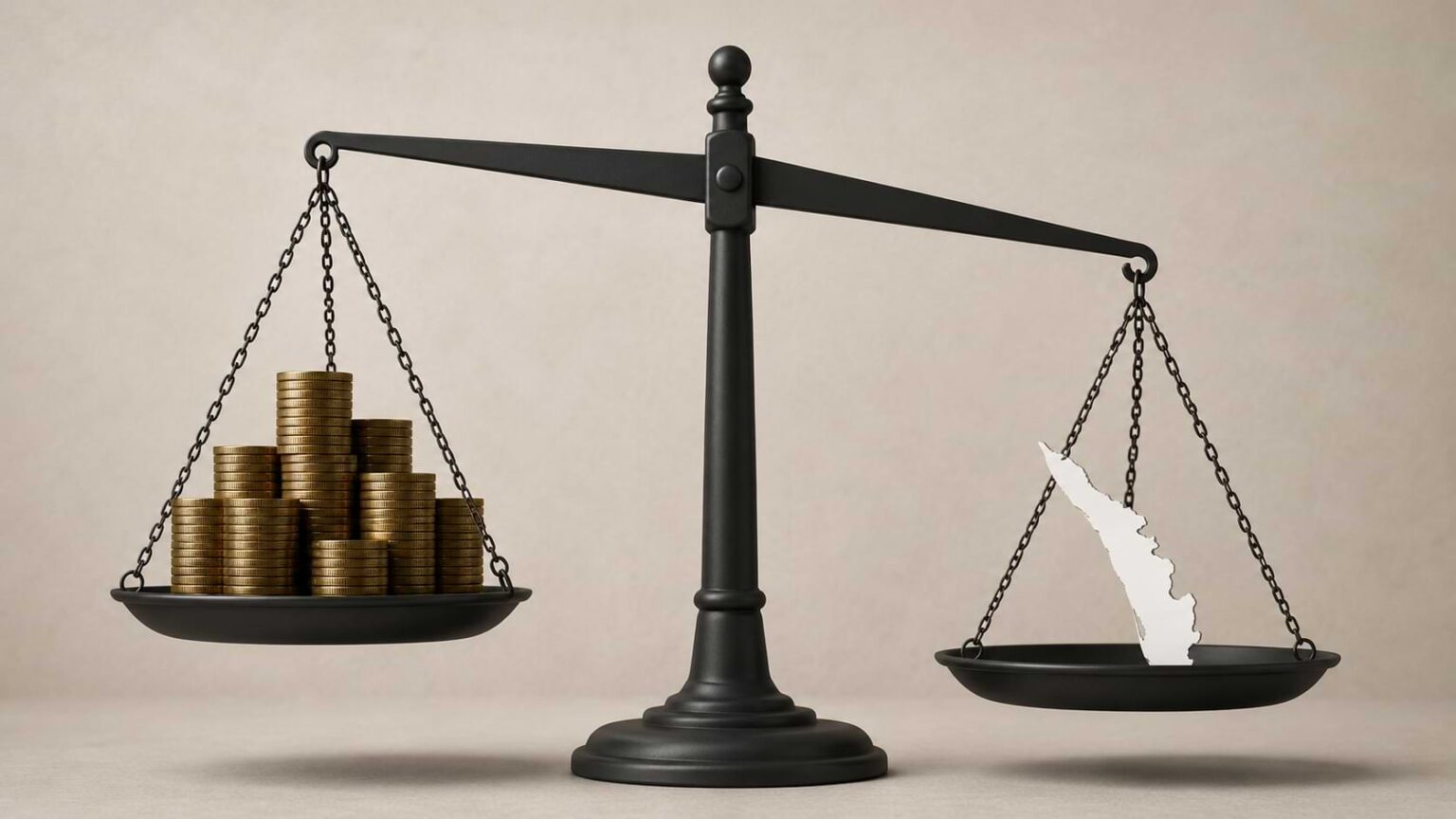

The Modi government starves Kerala of its own tax revenues by practicing fiscal discrimination against states that have performed well on socio-economic metrics. Although Kerala contributes greatly to the nation’s tax revenues, it gets very little back.
Interpretation of Tax Devolution in India.
Tax devolution is the process of sharing of central taxes with states, as recommended by the Finance Commission. The 16th Finance Commission tabled in February 2026 maintained the same percentage (41%) that was maintained by the previous Finance Commission for the states. The southern states, like Kerala, had demanded 50% due to increased obligations.
The Modi government, however, turned down this plea. This trend has been seen before as high revenue-generating states continue to lose out.
Key Points:
Kerala is among the most tax-efficient states.
It is well-endowed with regards to its human development status and is heavily indebted.
Its percentage share in the divisible pool has drastically fallen from 3.82% (10th FC) to about 1.95% (15th FC).
Surcharges Ladder.
Of the many forms of fiscal discrimination against South India, the growing tendency towards levying cesses and surcharges emerges as one of the most important. These are not included within the divisible pool and benefit the Centre alone.Cesses and surcharges today account for almost 20-25% of the gross tax collection.
The actual amount available for distribution among the states becomes less as a consequence of this.
Bare reality: Funds collected from the people of Kerala through such cesses like fuel cess, education access, and surcharges on income tax largely remain with the Central Government.
High Concession, But Low Yield in Kerala.
Kerala always contributes more than it gets back. Effective tax collection systems and high levels of GST contribution help the state contribute more. Despite being criticized for its debt, the state gets low per capita allocation from the centre compared to a number of northern states.
Comparison: The total share of tax devolution for southern states is on the decline.
States such as Kerala, Tamil Nadu, and Karnataka are penalized due to effective demography management and slower population growth.
This leads to a vicious circle, with Kerala borrowing more to keep their welfare structure intact.
16th Finance Commission Recommendation 2026A pertinent recent case would be the acceptance of recommendations of 16th Finance Commission in the Union Budget 2026. Despite objection from the states of Kerala and Karnataka, the government stuck to 41% devolution and continued to exclude cesses and surcharges.
The finance minister of Kerala, K. N. Balagopal, condemned this policy stating that reduced grants for revenue deficit and increasing dependency on non-sharable revenues have harmed Kerala. Even a small increase in horizontal share allocation made little difference. Effective fiscal space in Kerala is getting increasingly reduced.This was at a time when Kerala was contesting a case in the Supreme Court concerning its borrowing ceilings.
Effect of Modi’s Government on the Development of Kerala.
Modi Government is Starving Kerala of Its Own Tax Money has made it necessary for the state to:
Suspend welfare programs.
Collect more taxes and make loans.
The development model followed by Kerala needs constant support in terms of finances. By starving the state of its due money, its very development model is threatened.
Why This Is an Instance of Fiscal Discrimination Against South India
Punishment for success: States that perform well in governance and have effective population control policies get smaller allocations.
Politically motivated: Southern states run by opposition parties are discriminated against in favor of BJP-ruled states in disbursements.
Federalism under threat: More cesses and restrictions on borrowing make states less autonomous.
It has been claimed that the southern states contribute significantly to the country’s economy without getting much in return.
Roadmap for the Future of Kerala & Southern India
The state of Kerala needs to keep moving forward in:
Placing ceilings on cess and surcharge.
Increasing the devolution percentage.
Improving the horizontal distribution formula.
Fiscal discrimination against the southern states is more than a matter of economics; it is politics. With the south rallying behind their cause and with the Modi government failing to acknowledge their concerns, a chasm is bound to develop.
