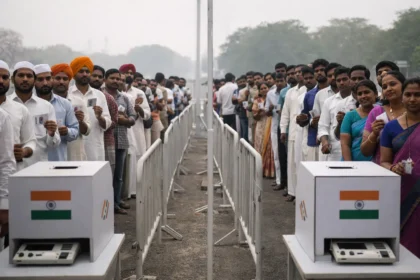



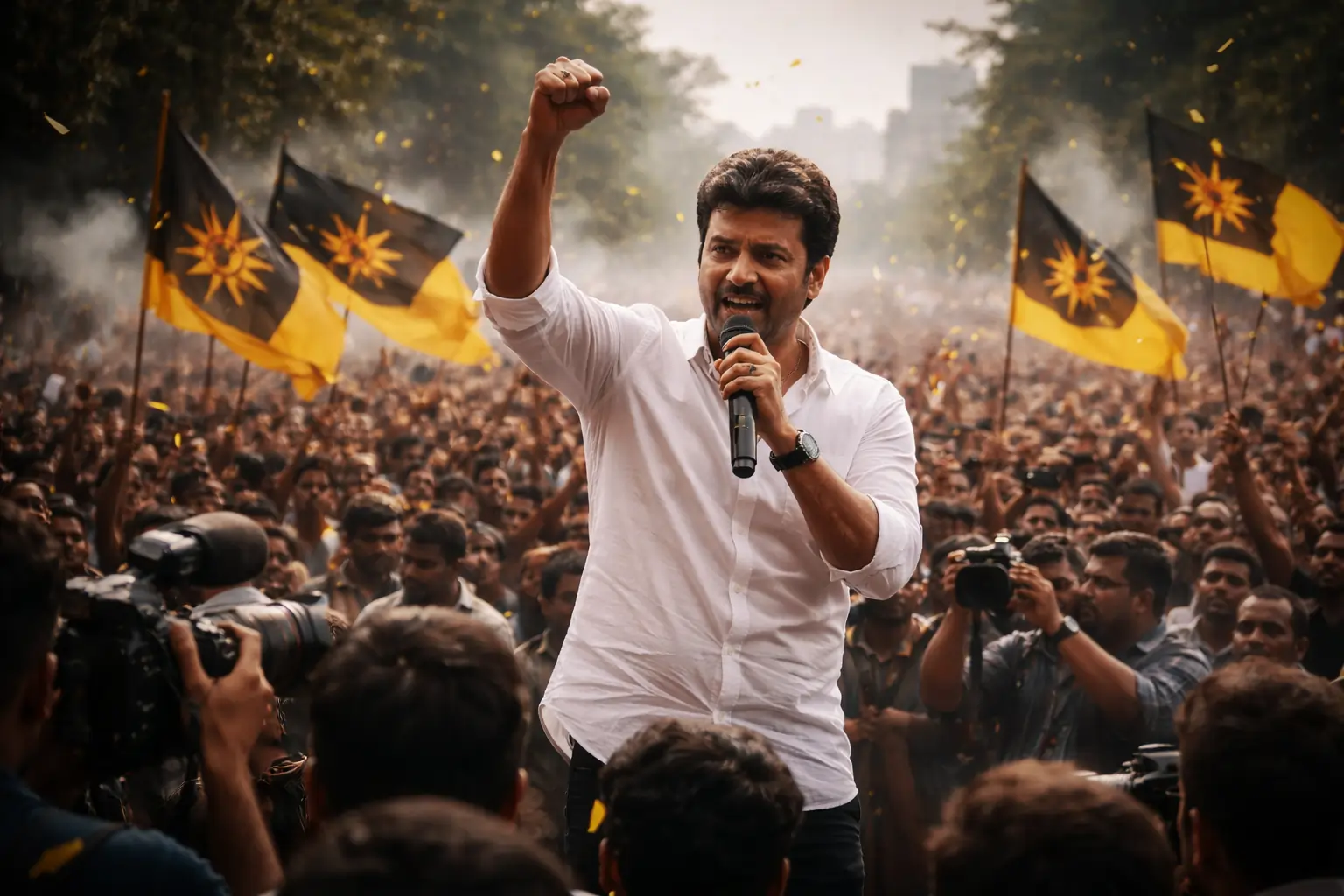

The Tamil Nadu Legislative Elections, which are slated for 2026, have witnessed a historic shift in the state’s politics. An actor who has been active for four decades on the silver screen has managed to transform the frustration among the youth into a revolution, thus breaking the Dravidian hegemony. Thalapathy Vijay’s Tamilaga Vetri Kazhagam (TVK) is no longer a fan club experiment; it is a political revolution poised to capture a whopping 13.6% to 14.8% of the votes, according to various pre-poll surveys.
How Vijay Channelized Youth Discontent
Tamil Nadu politics has been dominated by the Dravidian parties DMK and AIADMK for decades. However, the allegations of corruption, dynastic politics, and governance issues created a power vacuum. Vijay filled this vacuum not as a politician but a revolutionary.
Launched in February 2024, TVK has now become a movement with over 1.5 Crore members. What makes this movement different is that it is comprised of first-time voters, Gen Z, and young urban professionals who have grown up watching Vijay’s films. These are people who have traditionally abhorred politics, which to them is a “hotbed of self- serving, corrupt individuals”. But Vijay has given them permission to care about politics again.
The North-South Divide: Language as Battlefield
The ascension of Vijay cannot be analyzed unless understood in relation to the prevailing divide between the North and South in India. In India, the northern states are struggling to rise from a poverty rate of 23%+ (in Bihar), whereas in Tamil Nadu, the multidimensional poverty rate is a paltry 2.2%. What is the difference? A two-language policy, instead of a three-language policy, focusing on Tamil and English, rather than Hindi.
In February 2026, a firestorm was ignited when Tamil Nadu’s Agriculture Minister, MRK Panneerselvam, said, “North Indians, after learning only Hindi, come to Tamil Nadu in search of jobs such as cleaning tables and selling pani puri. Tamilians get jobs in US and London because of their knowledge of English.” A spokesperson for the DMK party said, “We have nothing against Hindi speakers. What we are opposed to is the three-language policy of the Centre.” NDTV
Breaking the Dravidian Duopoly
The politics of Tamil Nadu has been a two-party affair for the past 59 years: DMK vs. AIADMK. But Vijay has changed all that. He is contesting from two constituencies: Perambur in Chennai and Tiruchirapalli East. The strategy is to directly take on the CM MK Stalin.
The DMK stronghold of Chennai has all 16 seats. But TVK has identified Chennai as its key area for the elections. TVK has put up strong candidates in T Nagar, Villivakkam, Egmore, and Kolathur constituencies, where Stalin is also contesting. The message to the youth: TVK is not afraid to take on the establishment in its own den. India Today
What Vijay Promises the Youth
The TVK manifesto has a section on the youth with a number of aggressive promises:
- Collateral-free loans of up to 20 lakh rupees for education
- Veti Entrepreneurship Scheme with loans of up to 25 lakh rupees
- Unemployment allowance of 4,000 rupees per month for graduates, 2,500 rupees per month for diploma holders above the age of 29
- Internshipsqwre for 5 lakh youth with a stipend of 10,000 rupees per month
Requiring 75% of the workforce to be Tamil under a Tamil employment credit system. These are not the kinds of promises that are made on the basis of ideology. They are the kinds of promises that are made because the youth of Tamil Nadu are frustrated with the system that is letting their northern counterparts struggle with a system that does not allow for the development of skills.
The Coalition Question: A New Era for Tamil Nadu?
Political commentators are speculating that Vijay’s performance could usher in a first genuine coalition government in Tamil Nadu since the Dravidian majors took over. If that happens, then TVK could play a kingmaker role, a situation that would grant identity politics in the region unprecedented strength against centralizing forces from Delhi.
A Moneycontrol report points out that both DMK and AIADMK have been “allergic to coalitions” over the years. However, Vijay’s arrival could ensure that at least one of them has to accept a coalition. For a party that rode to power on youth angst and regional pride, that in itself would be a victory.
Will Stardom Translate to Seats?
The example set by other actors, Sivaji Ganesan, Kamal Haasan, and even Rajinikanth, is a lesson to be heeded. Stardom in cinema does not necessarily translate to success at the polls. Years of groundwork by Vijayakant’s DMDK, which secured 29 seats in the 2011 election, preceded the actor’s entry into politics. Moneycontrol
Vijay is trying something new. He is using social media to mobilize support. The Parawheel survey, which covered over 70 lakh voters, found that TVK’s strength was in the urban areas. But will the young vote, and persuade their families to vote too?
The Bigger Picture: A Southern Awakening
In a nutshell, irrespective of the outcome of the election, Vijay has already achieved something remarkable. He has demonstrated that a political movement based on Tamil regional identity, secular social justice, and resistance to Hindi imposition has been able to mobilize millions of people within a span of two years.
The divide between the South and the North is not merely economic. It is civilizational. The South has better health outcomes, lower poverty rates, higher literacy rates, and better institutional quality. At the same time, they are looking at a future where their representation could be diminished through delimitation, their language could be supplanted by Hindi through education, and their tax rupees could be spent on the North.
Vijay’s TVK is a political manifestation of a southern frustration. Irrespective of whether he wins or loses on April 23, the message from Tamil Nadu’s youth is clear. We will not be ruled by a northern agenda. We will define our language, our identity, and our future from Chennai, not Delhi.