



The political war is on in the Tamil Nadu legislative assembly.
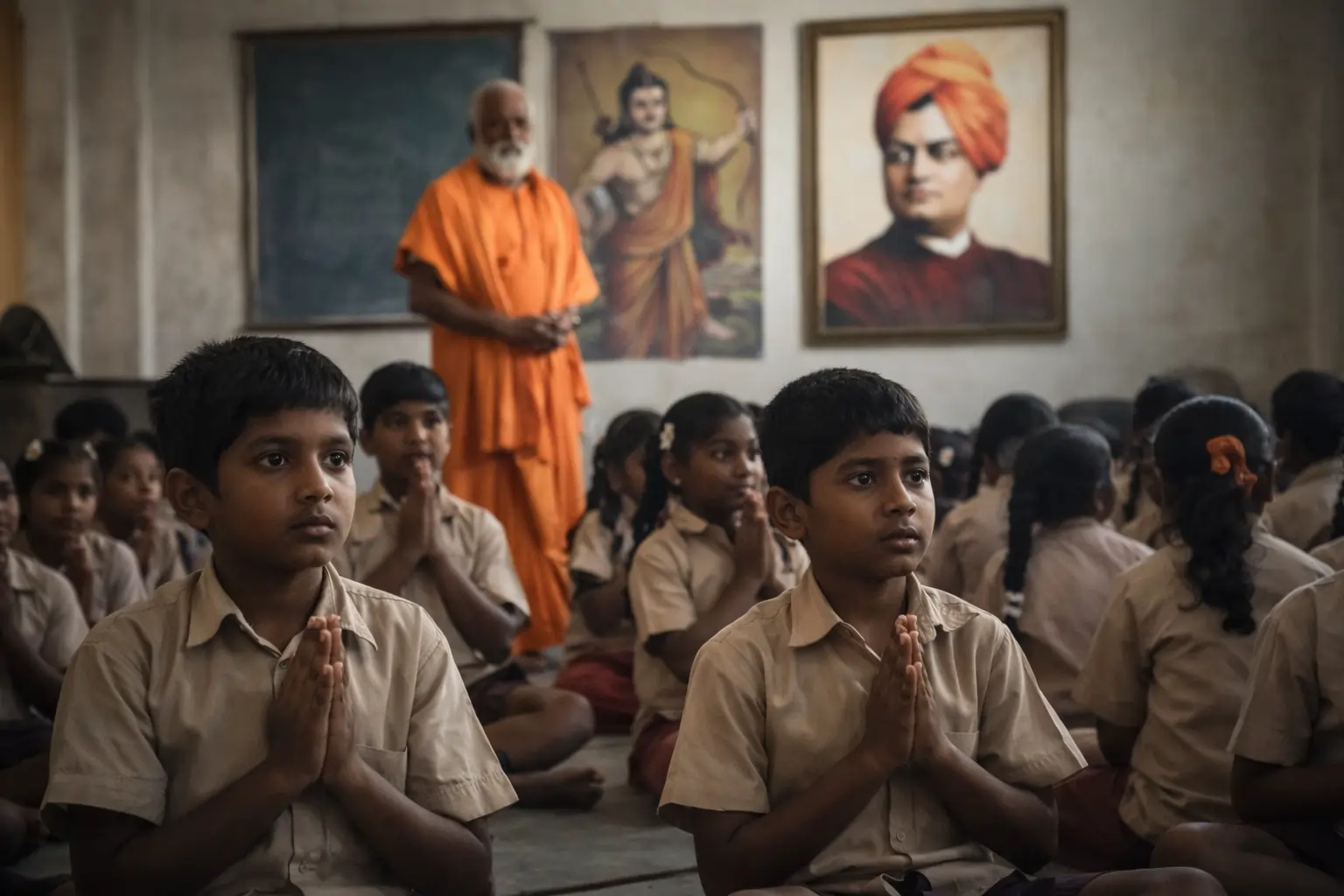
Meanwhile, another war is going on in the classrooms. The Rashtriya Swayamsevak Sangh (RSS), through Vidya Bharati, is silently laying down the foundation, which will change the face of Tamil Nadu’s culture in the next few decades. It is not about the elections in 2026. It is about the elections in 2040.
It is about the next few decades. It is about changing the face of India, changing the face of Tamil Nadu, changing the face of the future, changing the face of the next generation.
The Scale: 8,000 Schools, 3 Million Students
Vidya Bharati operates 8,000 schools with over 3 million students as of
2025. This makes them the largest private school network in India. Their motto is clearly declared: “To create a generation committed to Hindutva and infused with patriotic fervor.” It is noteworthy that Vidya Bharati has established schools in places like Kerala and Tamil Nadu, where the RSS influence is minimal. This is not a coincidence but a design. Political weakness presents an opportunity that requires groundwork for the future
A report by Peoples Democracy states that in the state of Tamil Nadu alone, there are 76 RSS-related organizations. This is in line with the expansion drive that the RSS has been on recently. This is in contrast to the number of such organizations in Uttar Pradesh, where there are 280, and in Maharashtra, where there are 259. This is an area that is not being held but an area that is being sought to be captured.
The Ekalavya and Saraswati Shishu Mandir model
RSS has several brands, including Saraswati Shishu Mandir, Saraswati Vidya Mandir, Adarsh Vidya Mandir, as well as Ekal Vidyalayas (single- teacher schools) and Sanskar Kendras (cultural centers).
Formal RSS-affiliated schools offer primary education up to Class 4. The early intervention is by design, as revealed by Outlook India: “Most Vidya Bharati schools cater to class four. However, this leaves a lifelong impression.”
The RSS education is designed to include academic as well as sanskar (cultural) education. The daily school assembly starts with Sanskrit prayers, patriotic songs, and cultural events, including Hindu festivals. Vidya Bharati admits: “The virtual absence of non-Hindu children leads to a collective sense of Hindu identity.
Targeting Tamil Nadu’s Tribal Communities
“RSS Tamil Nadu plan is to target the tribal and economically disadvantaged sections of the population-the most susceptible to the impact of the ‘education gap’ and least politicized along the lines of Dravidian ideology.”
“Vidya Bharati’s objective is to cater to the ‘underdeveloped regions and tribal communities.” In Tamil Nadu, these areas will be the Nilgiris, Dharmapuri, Salem, and the Western Ghats regions inhabited by Irulas, Todas, and Kurumbas.
According to PRS India data, there is no central Ashram school in Tamil Nadu for the education of tribals-a gap that RSS schools will fill. Where the state fails to provide, ideological organizations will fill the vacuum.
Ekal Vidyalayas will be the most effective tool for penetration into Tamil Nadu. Single-teacher schools will be established in the remotest areas with minimal infrastructure requirements and will be culturally sensitive while promoting Hindutva ideology throught story and songs
The Curriculum: Historical Revisionism
An examination of the Vidya Bharati textbooks by Newslaundry reveals the alarming level of revisionism in the curriculum.
The textbooks refer to the Arabian Sea as the “Sindhu Sea” and the Indian Ocean as the “Hindu Ocean.” The textbooks state: “Hindu culture prevailed all over Jambudweep… The whole of Egypt, Saudi Arabia, Iraq, Iran, Kazakhstan, Israel, Russia, Mongolia, China, Myanmar, Indonesia, Malaysia, Java, Sumatra, India, Bangladesh, Nepal, Bhutan, Pakistan, and Afghanistan were part of it.”
The curriculum is criticized for the anti-Muslim rhetoric and cultural indoctrination that is part of the Hindutvadised history. For the state of Tamil Nadu, where there has been a century-long rationalist movement spearheaded by Periyar, the curriculum is an example of the ideological war that is masquerading as education. The region has an explicit identity that rejects Brahminical Hinduism.
The Long Game Works
The RSS is not in the game for immediate political gains. The game is long-term. Children in school at the tender age of 5 will be voters in 2040 with a worldview that is vastly different from the traditional Tamil worldview.
The impact of Vidya Bharati is not limited to the schools they run. “Vidya Bharati has actively contributed to National Education Policy 2020 and has participated in NCERT focus groups for the National Curriculum Framework.”
The ideology of the RSS is not limited to the schools they run; it is penetrating the education system, including the government schools that follow the NCERT curriculum.
Why Tamil Nadu Should Worry
Tamil Nadu’s political stability in the face of the BJP is breeding complacency. The DMK won in 2021. The BJP remains electorally irrelevant. Tamil Nadu’s electorate remains firmly against Hindutva.
However, there is a different timescale in education infrastructure. The 76 RSS-affiliated organizations today will be 150 tomorrow. Each of these Ekal Vidyalayas in tribal villages, each of these Saraswati Shishu Mandirs in small towns, is a node in an ever-expanding ideological web.
The RSS has studied their failures in Kerala and Bengal, realizing that political confrontation is a non-starter in states with Dravidian political traditions. The new plan is to win young minds before they ever think in political terms, to deliver services in areas where the state has failed, and to wait.
State Failure Creates the Opportunity
Tribals in Tamil Nadu have lower literacy rates than the state average. Government schools in the area are in disarray. Parents are desperate for better education and will place their children anywhere they can get quality education, including ideological indoctrination.
The RSS provides the solution through service, not coercion. Free education? Teachers who are dedicated? Programming that makes the children feel special? Who wouldn’t be grateful?
The Battle for Tamil Identity
The RSS plan for the school sector isn’t about 2026 or 2029. It’s about 2040, 2050, and beyond. It’s about Tamil youth who identify first as Hindus within the Indian Hindutva movement, not as Tamils within the Dravidian cultural movement.
While the DMK and AIADMK fight for vote share, the RSS is developing a parallel education sector that could reshape the ideological landscape in Tamil Nadu in two decades.
What Tamil Nadu’s political class must understand is that this is a threat. The antidote to this threat is not to close RSS-run schools-as unconstitutional as that would be. It is to strengthen government-run schools, especially in tribal areas, to provide quality education that is Tamil-centric and rationalist in ideology.
The classroom is the battleground for the voting booth. Tamil Nadu cannot afford to lose the war that is being fought in silence.