


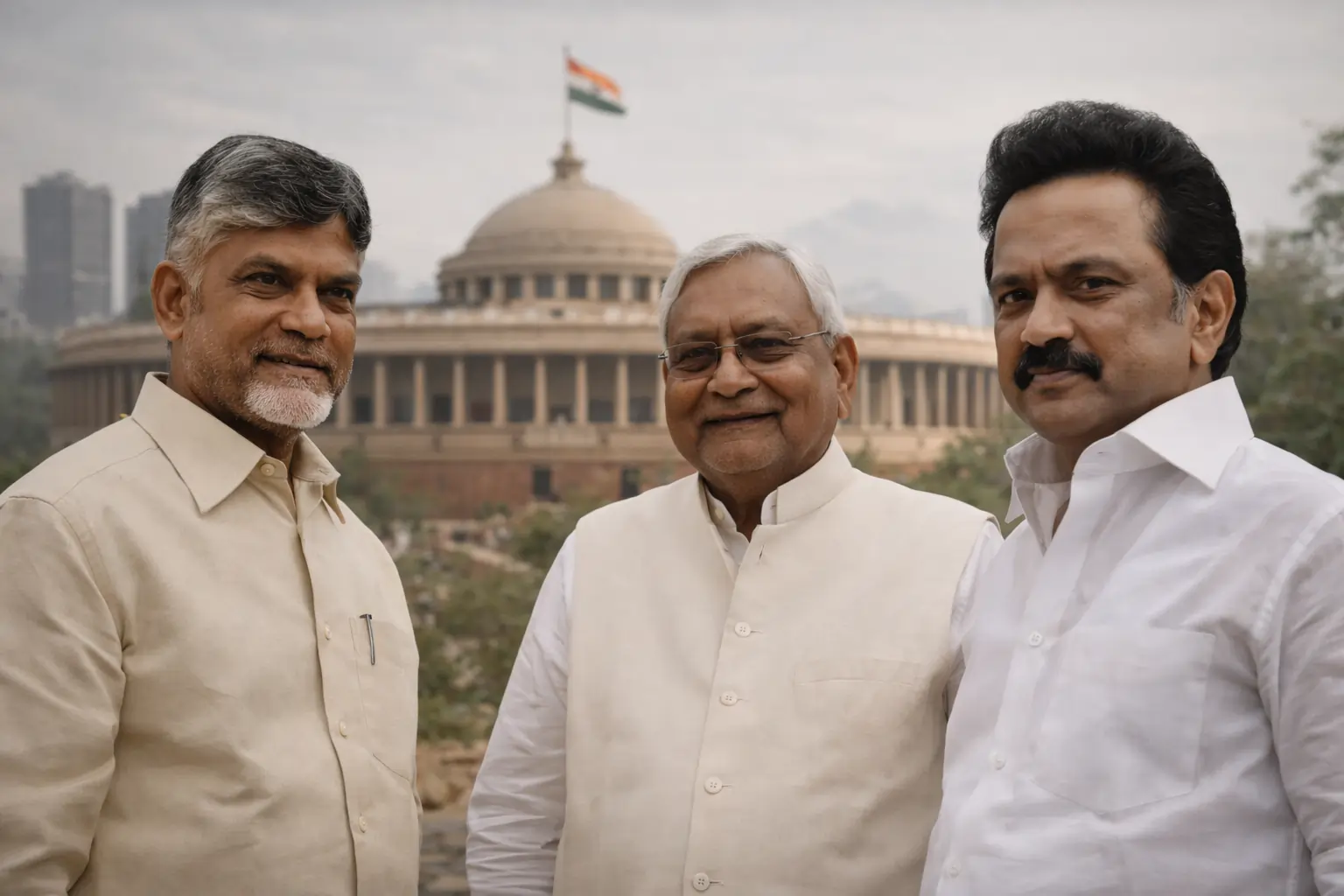

Something quite interesting has happened in the Lok Sabha elections of 2024. For the first time in a decade, the BJP failed to form a government by itself. They won 240 seats, which is just 32 seats short of the majority. Who helped them out? Two regional parties from South and East India: Chandrababu Naidu’s Telugu Desam Party, who won 16 seats, and Nitish Kumar’s Janata Dal (United), who won 12 seats. It’s not just a political resurgence. It’s a wake-up call that regional parties are still important in Indian politics, and South Indian parties are at the forefront of this movement.
The Numbers Speak a Story
Let’s examine the numbers. In the 2024 elections, the total number of Lok Sabha seats won by regional parties is approximately one-third of the total Lok Sabha seats. That’s humongous. The DMK, a regional party in Tamil Nadu, won 22 seats, the third-largest party in parliament after BJP and Congress. The TDP won 16 seats in Andhra Pradesh. Even smaller parties like Jana Sena won 2 seats and JD(S) won 2 seats in Karnataka. Compare this to the last two decades when the BJP and Congress dominated elections together. In the 2024 elections, they won a combined total of just over half the national vote. The rest of the votes were captured by regional parties. This is not a passing trend but has been happening since 1996. At present, there are 6 national parties and 59 state parties in India. That’s a lot of players in the game. And the southern states of India have some of the strongest regional parties in the country.
Why South India is Different
South Indian politics has always had a different rhythm. While the North has been a BJP-Congress fight, the South has nurtured strong regional identities.
Consider Tamil Nadu. The DMK and AIADMK have been the main players in state politics since the 1960s. Congress and BJP barely manage to win a few seats. In the 2024 elections, Tamil Nadu elected 22 MPs from the DMK to Delhi. That’s more MPs than some national parties have managed to elect across the entire country.
Andhra Pradesh witnessed the TDP sweep back to power after being decimated in 2019. They went from zero seats to 16 seats in five years. That’s a political earthquake. Karnataka is a special case. It’s the only state in the South where BJP has some real presence, winning 17 out of 28 seats in 2024. But even there, they had to form an alliance with JD(S) to remain a force in state politics. Kerala continues to be a stronghold where the influence of national parties is minimal. The state has been alternating between the Left Democratic Front and the Congress-led United Democratic Front. The BJP was able to win only one seat in 2024, marking the first time they have won a seat in Kerala.
The Coalition Mathematics
This is where it gets interesting for 2026 and onwards. The BJP is currently leading a coalition government with 293 seats in the NDA. However, without the TDP’s 16 and JD(U)’s 12, they fall short of the majority requirement of 272 seats. This is a huge bargaining chip for southern regional parties. Chandrababu Naidu understands this. He was even made the leader of the NDA coalition in 2024. This is purely symbolic, but it indicates the importance of Chandrababu Naidu to Modi’s government.
The opposition INDIA alliance won 233 seats in 2024. The DMK’s 22 seats make them the fourth-largest party in this alliance. Without the DMK, the opposition would be in disarray. What does this all mean? Any government formation in 2026 or onwards will require the southern regional parties. Whether it is NDA or some future opposition alliance, no one can ignore the South anymore.
Money Talks Too
Regional parties in South India are not only winning elections, but they are also spending heavily to win those elections. According to Election Commission figures, the DMK spent Rs 161 crore in the 2024 elections, making them the fifth-highest spenders overall. The YSRCP, which lost power in Andhra Pradesh, spent a staggering Rs 328 crore. These parties have excellent money-making machines. They understand ground-level politics. They know their voters. And they are ready to spend heavily to remain in the game.
The Issues That Unite the South
What are the common factors that unite these regional parties? There are a few important issues: First, there is the language issue. None of the major South Indian parties support the imposition of Hindi. This is not merely a political stance; it is an identity issue. Tamil Nadu has a history of anti-Hindi protests that go back to the 1960s. Second, there is the issue of fiscal federalism. The South Indian states are the backbone of the Indian economy but are dissatisfied with the distribution of taxes. They feel they are contributing to the development of the North Indian states without getting proper returns. Third, there is the issue of state autonomy. The South Indian political parties have always demanded more autonomy for the states and are dissatisfied with the interference of Delhi in state affairs
Can They Reshape National Politics? The answer is: They already are.
Since 1989, no political party has been able to form a government without the help of allies. Regional parties have been part of every coalition government at the Centre. Southern parties have been crucial to every government formed by VP Singh, HD Deve Gowda, IK Gujral, and Manmohan Singh. Even Modi, who enjoys huge personal popularity, could not ignore them in 2024. He had to meet their demands, give them ministerial berths, and discuss policy points. What about 2026? The important state elections are scheduled in Tamil Nadu and West Bengal. If DMK continues to rule Tamil Nadu and strengthens its hold, they will be even more important in shaping the national politics in the 2029 general elections.
The Challenges Ahead
However, it is not all plain sailing for regional parties. They have genuine challenges. Most southern parties are restricted to individual states. DMK is strong in Tamil Nadu but has no presence in Karnataka. TDP is strong in Andhra Pradesh but is inconsequential in Kerala. This hampers their national expansion plans. Most of these parties are family-owned businesses. DMK has the Karunanidhi family, TDP has the Naidu family, and YSRCP has the Reddy family. This leads to internal party conflicts and hampers new leadership. They also find it difficult to provide a united southern platform. There are disputes over water between Tamil Nadu and Karnataka. Language pride often leads to inter-state tensions. There are differences in political ideologies – some are left-leaning, while others are center- right.
The Reality Check
Can South India change the politics of the country in 2026? Yes, but with conditions. The southern regional parties will not form a government by themselves. They do not have enough seats. Even if all the major southern parties came together (which they won’t), they would have a maximum of 60-70 seats. However, they can be kingmakers. They can choose who becomes the prime minister. They can demand policies that favor their states. They can oppose policies that favor the north. The 2024 election has shown that the era of single-party rule is over. The politics of coalitions is back. And in the politics of coalitions, every seat matters. When TDP has 16 seats and DMK has 22 seats, they are not just numbers – they are power.
What Comes Next
As we move into 2026 and beyond, southern regional parties are going to play tough. They will demand their due in ministries, favorable policies, and adherence to federal principles. The days when Delhi could call the shots in states are numbered. Regional parties have learned how to leverage their strength. They realize that no national party can afford to ignore them altogether. Will this translate into better governance? Only if regional parties learn to wield their strength for good and not for mere regional agendas. The hope is that the emergence of these parties will usher in a era of fiscal federalism and state autonomy. South India is not only changing the face of national politics – it is also reminding Delhi that India is a union of states, not a group of provinces. Regional parties are the bearers of this message. And in 2026, this message is clearer than ever before