


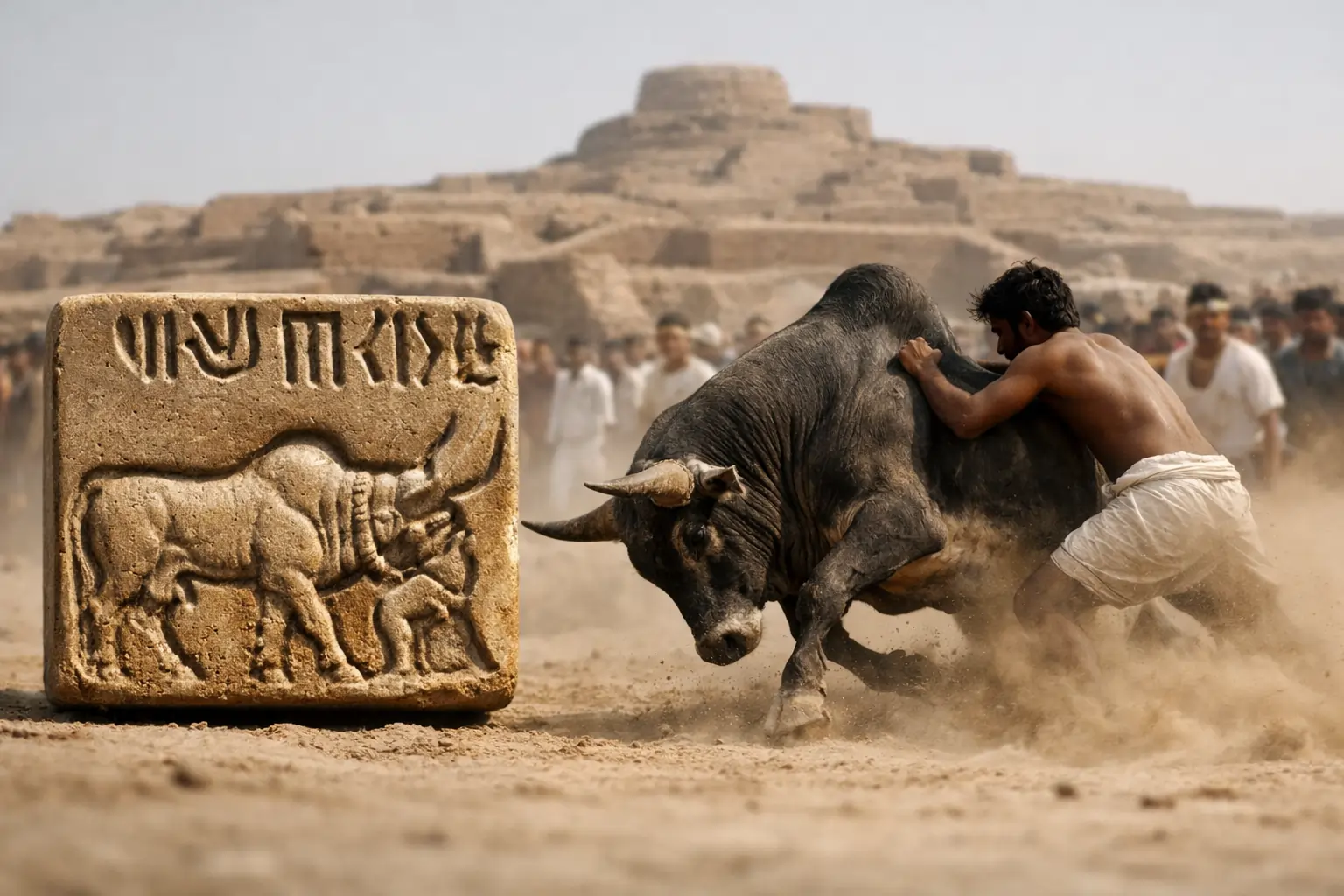

The bull lowers its horns, the muscles rippling under its painted skin, confronting a young man who dares to touch its hump. The scene might have been witnessed in contemporary Madurai in celebration of Pongal, where young men try to embrace the hump of powerful Brahmin bulls in Jallikattu, a sport played in olden days. However, this scene is engraved on a 4,500-year-old steatite seal from Mohenjo-Daro.
For nearly a century, the Indus Valley Civilization (2600-1900 BCE) has persisted as South Asia’s greatest enigma, a sophisticated urban culture with standardized weights and measures, advanced sewage systems, and a writing script still refusing to give up its mystery. However, recent advances in linguistics, archaeogenetics, and comparative cultural analysis are arriving at a revolutionary new consensus that completely overturns everything we have ever believed we knew about Indian history: The pioneers of Tamil Nadu not only saw the advent of India’s first civilization but actually built it.
A study by linguists led by Bahata Ansumali Mukhopadhyay in 2021 caused shockwaves in the academic community with their research on ultra-conserved ‘tooth words,’ or words for body parts that remain stable and unaffected by linguistic changes through the ages. The linguists were able to prove that the ancient Proto-Dravidians inhabited the Indus Valley in mature times (2600-1900 BCE). If we consider the proto-language of the Dravidians, it has systematic correspondences that go back more than 4,500 years: the word ‘tooth’ is ‘pal’ in Tamil and ‘palu’ in Telugu.
The implications are staggering. If the Proto-Dravidian speakers were the founders of the Indus Valley civilization, the continuous 4,500 years of unbroken Dravidian civilization comes before the composition of the Rigveda, comes before the Hittites, comes before the erection of the pyramids of Egypt and stretches down undisturbed into the Tamil kingdoms of the Sangam Era, 300 BCE to 300 CE. A stroll through the Indus Valley Civilization gallery at the National Museum in Delhi reveals scores of steatite seals that display an amazing level of craftsmanship. Among the unicorns, Zebu cattle, and other religious scenes, there is one image that recurs with an interesting regularity: the image of man and bull.
But now let us travel 4,000 kilometers south and jump forward 3,500 years. In the courtyard of a temple at Madurai, Meenakshi, during the Tamil month of Thai, thousands gather to see young men jump onto the humps of frenzied bulls. The sport is called Jallikattu-a bundle of money tied to a bull’s horns. Even animal rights activists have tried to ban it. The Tamilians say that the event has been an unbroken tradition since their ancestors from the Indus Valley. The continuity in archaeology is unmistakable. Indus seals show zebu bulls with big humps-the typical Bos indicus breed native to South Asia. The particular way of holding the hump, not the horns, recurs in the Indus iconography. Modern Jallikattu employs the same indigenous breeds, the same grip, the same essential confrontation between human bravery and bovine strength.
The Roman geographer Strabo wrote of an entire armada of vessels passing from Egypt to India during the reign of Augustus. In Tamil literature, we find the ‘Yavanas of gold and pepper, pearls and cotton fabric’. The Pandyas and the Cholas did not learn the art of marine trade from the Romans-they had mastered it two millennia before.
While language and culture point to continuity, genetics offer forensic proof. In keeping with this, a massive genetic study on the Indus Valley Civilization, published by Vagheesh Narasimhan and colleagues in Cell journal in 2019, extracted and analyzed DNA from the Indus site of Rakhigarhi. And the results were conclusive: the people of the Indus Valley were a unique blend of two different races: “Ancient Iranian hunter gatherers and indigenous Southeast Asian hunter gatherers known as First Indians.” Modern South Indians bear this exact trait. With the decline of the Indus Valley Cities about 1900 BCE, perhaps owing to global climate changes affecting the position of the monsoon winds, human populations did not disappear; they moved. Some populations migrated eastward towards the Gangetic Valley, while others went south with their genes, their language, and their bulls into the Indian Peninsula. This “Southward Migration Theory” helps in understanding the fact “that the highest percentage of Indus Valley genetic legacy today can be found in Tamil Nadu, Karnataka, and Andhra Pradesh, the cradle of Dravidian languages.
Indian history has, for nearly two hundred years, been understood in terms of the colonial/Migration-Aryan colonial construct: “Sanskritized” north Indian civilization as ‘primary,’ ‘Dravidian’ culture as ‘secondary. The Indus Valley Civilization was discovered in 1921, but at once saw the interpretation of the discovery in terms of the models current at the time: the excavators assumed the cities were built by people speaking Sanskrit, in the absence of the least vestige of the Vedic pastoral culture: horses, chariots, sacred Fire Altars: not seen at any single Indus site.
The Vedas did not build the first Indian cities. Dravidian speakers did. Four thousand five hundred years is a very long time to survive as a civilization. Empires and civilizations have come and gone. Languages have come and gone. Gods have come and gone. But this Dravidian tradition, from Harappa to Sangam, from Mohenjo-Daro to Chennai, is a record of unbroken continuity in human history. The Indus seals remain to be unraveled and unlocked, but perhaps they have told us the most important truth: we were there all the time