


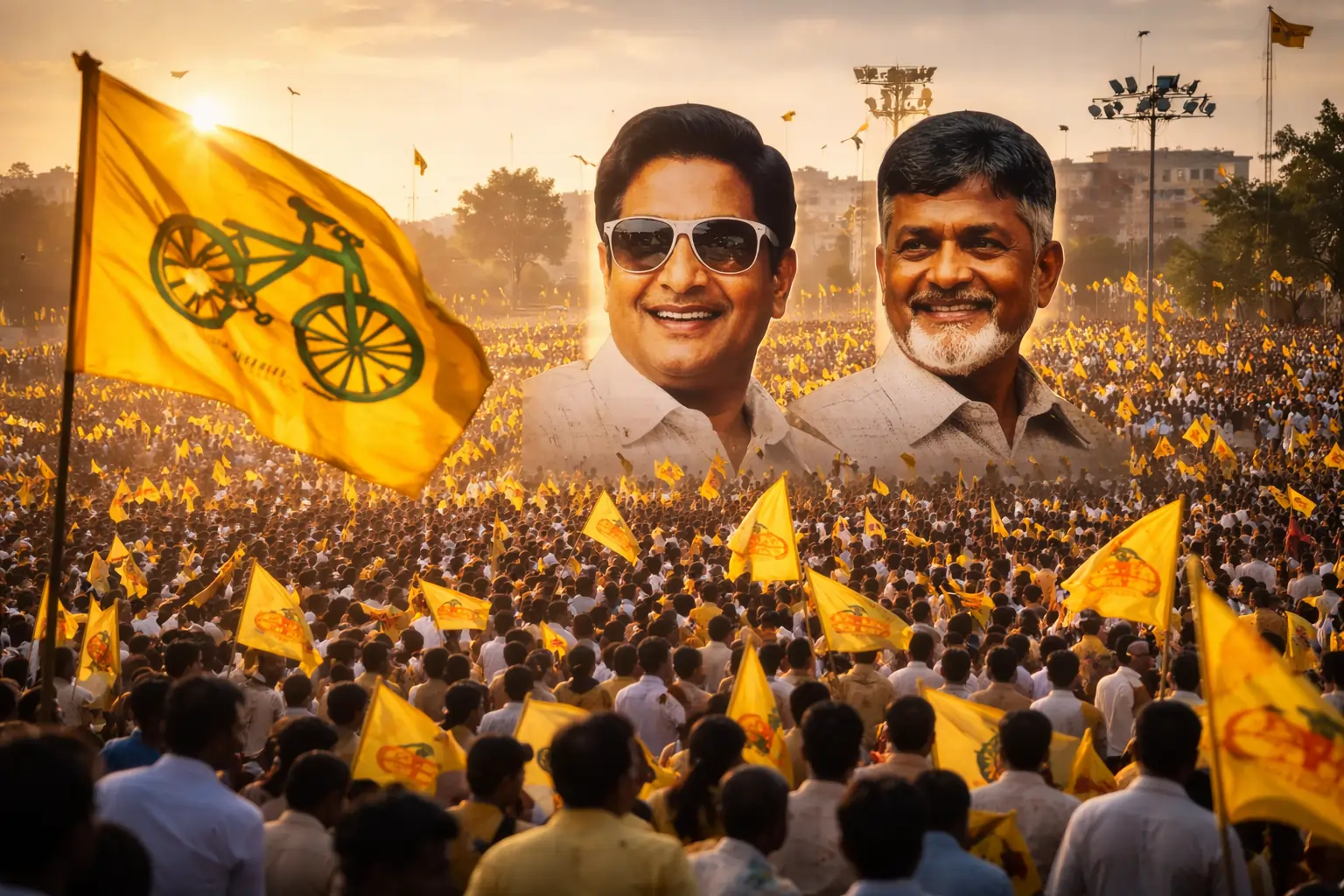

A unique form of political tragedy occurs not by way of losses, but through becoming insignificant; the Telugu Desam Party has seen examples of both types of tragedy occur within its history.
When N.T. Rama Rao (who had spent the last three decades as a film actor on movie sets portraying both Krishna and Rama) transitioned from acting into a political career in 1982, most thought it would just be a publicity gimmick. How could someone go from being worshiped as an actor in villages throughout Andhra Pradesh to claiming he would govern a state? The Congress establishment laughed. Nine months later, NTR won the biggest mandate in Andhra’s history.
That victory was never just about one man’s charisma. It was about something that had been building quietly for years — a Telugu identity that felt humiliated. Congress at the time treated Andhra Pradesh like a franchise, dispatching Delhi-appointed leaders who had little connection to the soil. Prior to NTR, the state lacked a sense of pride. According to him, pride was known as Telugu Atma Gauravam self-respect of the Telugu people. The response of Telugu voters to NTR was astonishingly powerful, leaving the national political establishment stunned.
Throughout the majority of the 1980s, the TDP ruled Andhra with a level of confidence typically seen by characters in a movie. NTR introduced the Rs. 2 per kilo rice scheme, one of India’s earliest mass welfare programs, and it worked. The poor remembered it. He clashed openly with Indira Gandhi, survived a bizarre internal coup orchestrated by his own son-in-law Nadendla Bhaskara Rao, and came back stronger. In the political imagination of Andhra Pradesh, NTR wasn’t just a leader, he was the state personified.
Then came the quieter, more complicated chapter.
Chandrababu Naidu, NTR’s other son-in-law, had always been the operator behind the curtain. Where NTR was instinct and spectacle, Naidu was spreadsheets and strategy. In 1995, Naidu engineered a palace coup of his own, splitting the party’s legislators away from NTR and taking power. NTR died months later, heartbroken by most accounts. The man who had built the party was gone. The man who had taken it from him was now chief minister.
What followed was genuinely impressive governance, and that makes the story more complicated than a simple tale of betrayal. Naidu’s Andhra in the late 1990s became a model state. Hyderabad was transformed from a sleepy city into a tech hub. World Bank loans, e-governance experiments, infrastructure investment, Naidu was on magazine covers, invited to Davos, praised by Bill Gates. For urban, educated Andhra, this was a golden period.
But Andhra is not only its cities. While Hyderabad gleamed, the countryside struggled. Farmer distress mounted. In the 2004 elections, voters in rural regions passed down what many political analysts still debate in colleges when analyzing the political landscape. Y.S. Rajasekhar Reddy achieved a significant mandate to lead with Congress and TDP was wiped out. There is a clear indication, based upon this election, that you cannot have development without welfare programs in a state where the majority of the population still derive their livelihood from farming.
Towards the end of 2014-2020, there was a resurgence and the TDP was back in control. Once again, Chandrababu Naidu had returned to power with an alliance with NDA after the bifurcation process had occurred. As a result of the bifurcation, Andhra lost its capital, significant sources of revenue, and its most developed city. Naidu promised to build a new, world-class capital city known as Amaravati from scratch; however, controversy continued over whether he was making that pledge realistically.
In 2019, Y.S. Jagan Mohan Reddy wrote the final chapter of that story. His victory wasn’t close. TDP was reduced to a rump in the assembly, and Naidu himself lost his own constituency. Jagan governed for five years, scrapping Amaravati’s original vision and building a bitterly personal rivalry with Naidu that consumed much of Andhra’s political oxygen.
In addition, in 2024, there was another reversal of fortunes for Naidu. This time, he included a younger partner, actor politician Pawan Kalyan, in his Jana Sena alliance, bringing fresh momentum to his party (TDP) and a pathway to appeal to younger voters. Jagan was defeated with as much certainty as Naidu was defeated by Jagan at one time.
So what does this all mean?
In summation, it means that the people of Andhra Pradesh vote based on a person’s performance as opposed to their loyalty to the person. TDP built that culture, ironically. NTR told voters they deserved better, and they took that message seriously, including applying it to TDP itself when it fell short. No party has successfully consolidated a permanent base. No leader has transcended the cycle.
It also means the Telugu identity question NTR raised in 1982 remains unresolved. Bifurcation reopened wounds that haven’t healed. Andhra still debates its capital, its resources, its relationship with the central government, its sense of direction.
TDP’s rise and fall isn’t really about one party. It’s a forty-year argument about what Telugu people want from their politicians, and that argument is very much still ongoing.