



Rayalaseema is a region that carries both pride and pain in its name. Located in the southern part of Andhra Pradesh, it includes the districts of Anantapur, Kurnool, Kadapa, and Chittoor. The land is dry, rocky, and harsh. Summers are intense. Rains are uncertain. Yet the people speak of their soil with deep attachment. To understand Rayalaseema, one has to look beyond headlines and cinema. Its story is older, and more layered.
Historical Foundations
Rayalaseema has historically experienced the rise and fall of great kingdoms. Among the greatest influences upon Rayalaseema during its past was the Vijayanagara Empire, which constructed many religious structures and forts, as well as left a cultural legacy of their royal patronage that is still evident today. The economy of Rayalaseema was greatly dependent upon tanks and smaller irrigation works, as unlike the deltas of the Krishna and Godavari River systems, Rayalaseema does not naturally support plentiful surface water. At the same time, these features played a major role in shaping the economic base and social organisation of the region.
Feudal Structures and Political Power
British land settlement created stronger local landlords, and as a result many of the land-owning families became the controlling political powers following independence from British rule. The feudalistic values of loyalty, honour and revenge had not suddenly died out after the British left. Many local political institutions were driven by loyalty to a particular family and as a result, political disputes arose among family members in the forms of growing violence, resulting in the emergence of factionalised politics as the media has since referred to them.
Factionalised Politics and Social Tensions
Factionalised violence in Rayalaseema has often been presented by the media as a cycle of retaliation or revenge killings. Although such killings have occurred, simplifying the history of the region into an image of a survey of individuals participating in a cycle of killing overlooks many other more fundamental contributing factors. The competition for scarce water and land has lead to increased competition and tension, while political patronage has contributed to increasing ground level tensions. The formation of political alliances has been influenced by caste identities as much as by the financial and political strength of the two or more rival parties.
In many of the villages of Rayalaseema where power has been concentrated in a few landlords, the lines between personal and political conflicts have often been blurred. Scarcity of water and land created competition. Political patronage increased tensions. Caste identities also played a role in shaping alliances. In villages where power was held in a few hands, conflicts became personal as well as political at the same time.
Cinema and Representation
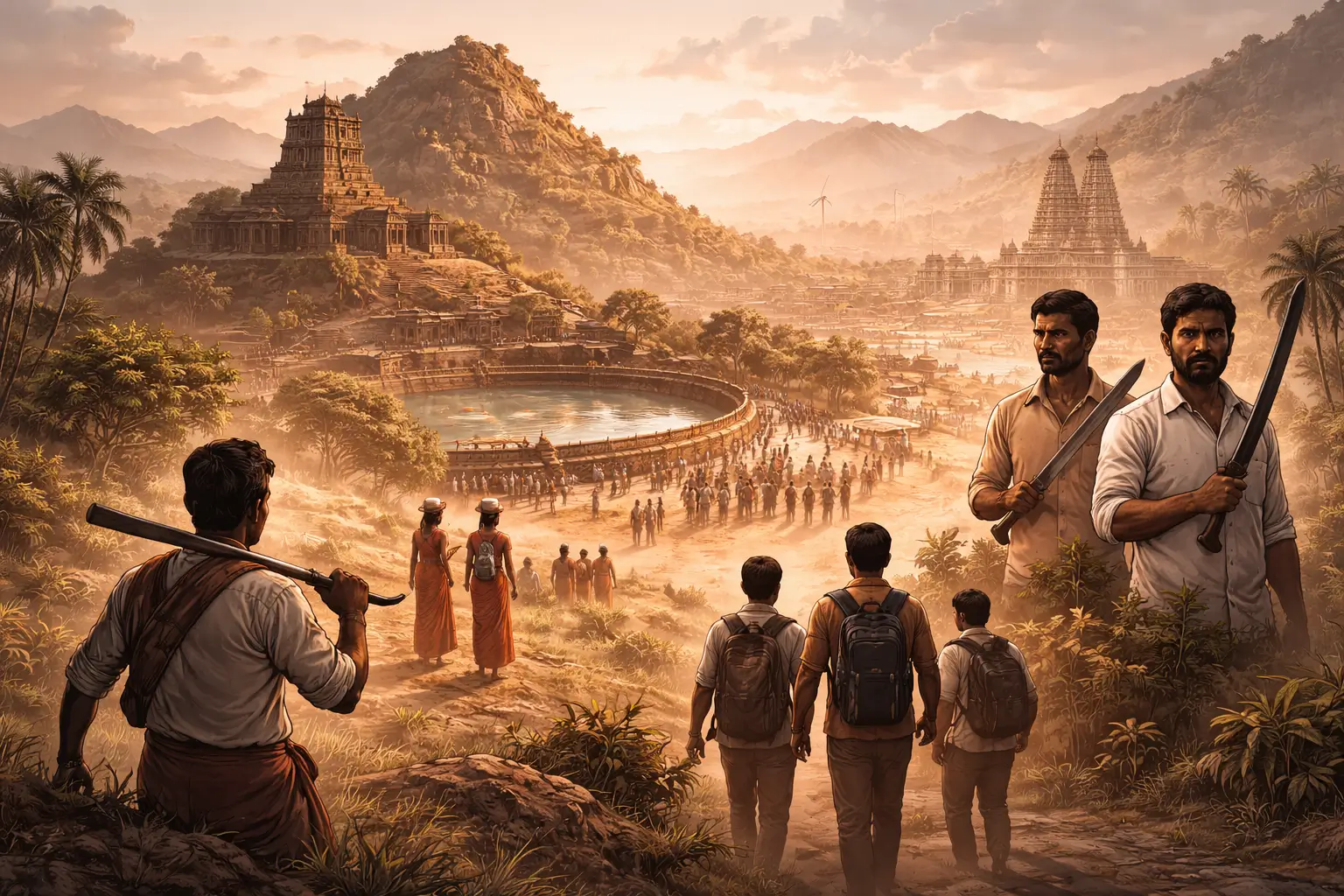
Cinema enhanced this representation. In Telugu films from the 1990s and early 2000s, Rayalaseema was depicted as a place of machete battles between clans, violent revenge, and large landholders. The ruggedly beautiful landscape symbolized virility and unbridled forcefulness. Although these films were commercially successful, they are a gross oversimplification of reality. The stories focus on the bravery of the manly hero, and there is little or no room for everyday farmers, school teachers, traders, or students.
Drought, Debt, and Migration
However, the reality is actually more nuanced than that. The majority of families in Rayalaseema have dealt with extended periods of drought throughout their history. One example would be the Anantapur district of Rayalaseema, which is frequently referred to as one of the most drought-stricken areas in all of India. Most farmers there rely almost exclusively on borewater for their irrigation. The inability to rely on borewater has caused the majority of farmers in Anantapur to take on significant amounts of debt which escalates at the same pace as drought. High levels of migration can be seen here, with a lot of young men going to major urban centres, such as Bengaluru or Hyderabad, or to foreign countries for employment opportunities. Remittances sent back to the family in Anantapur provide support for their families.
Political Leadership and Public Engagement
Additionally, Rayalaseema has historically produced a significant number of influential political leaders from Andhra Pradesh. Several significant chief ministers of Andhra Pradesh hail from Rayalaseema. Political savvy is evident throughout the region, with significant amounts of discussion occurring between villagers on local and state governance issues. Residents of Rayalaseema follow state government closely. While alliances can be very strong between leaders and their constituents, the relationship is also built around the extent to which leaders can provide essential local community infrastructure such as transportation, irrigation projects, and employment.
Religion, Tradition, and Identity
Regional identity is influenced by both religion and tradition. Millions of pilgrims travel every year to the Tirumala Temple located in Chittoor District. There are many small temples, churches, and dargahs in the area. Festivals are celebrated with much enthusiasm and excitement, as well as strong family ties and respect for elders. Hospitality is something that the area is proud of.
Changing Image and Youth Aspirations
In recent years, the region’s image has started to shift slowly. There have been many new educational institutions added, as well as improved roads and other forms of connectivity. Urban centers, such as Tirupati and Kurnool, are expanding. The younger generation is better able to connect to the rest of the world via social media and technology. Young people currently seek development rather than division. Young people are questioning old rivalries and looking for work and stability.
The Central Issue of Water
The central issue for the region is water. Despite the large irrigation projects that are designed to relieve the problem, the implementation of these projects varies widely from each project that is implemented. Each time a new irrigation project is announced, hope arises that the project will help provide water security for the agricultural community. For Rayalaseema, development is closely tied to water security. Without a reliable source of irrigation, agriculture always remains a gamble.
Resilience and the Future
Even though Rayalaseema faces an array of difficulties, it remains self-respectful. There exist many different forms of expression, but all essentially express honesty when addressing emotional matters. Besides this, the citizens of Rayalaseema place a high level of value in loyalty and bravery. Additionally, they are very much aware of the stereotypes of their homeland and, quite often, many of them feel that others do not fully understand their culture.
If you limit writing about Rayalaseema to discussing factionism and feudalism you are not only selling the area short, but you are also completely overlooking its ability to stand up against those challenges. While the history of Rayalaseema has in many instances been influenced by struggles for power and by violent events that have left behind scars, it has also been shaped by stories of courage, hope, migration success, cultural diversity, and respect for the dignity of all individuals.
Regions are not static in their progression through time; they are fluid and dynamic. Today, Rayalaseema is located at a point on the continuum of time from its past to its future hopes and dreams. As the hot winds from the dry atmosphere of Rayalaseema filter through the fields of the region, they represent not only memories of violence and destruction, but promise for the future and for change. The way that the citizens of Rayalaseema define who they are has so much more meaning than just through the definition of factionism. It is about being strong minded and resilient, while having the anticipation that their children will inherit a land that will provide many times more opportunities than it has ever provided for the continuation of old rivalries and conflicts.