


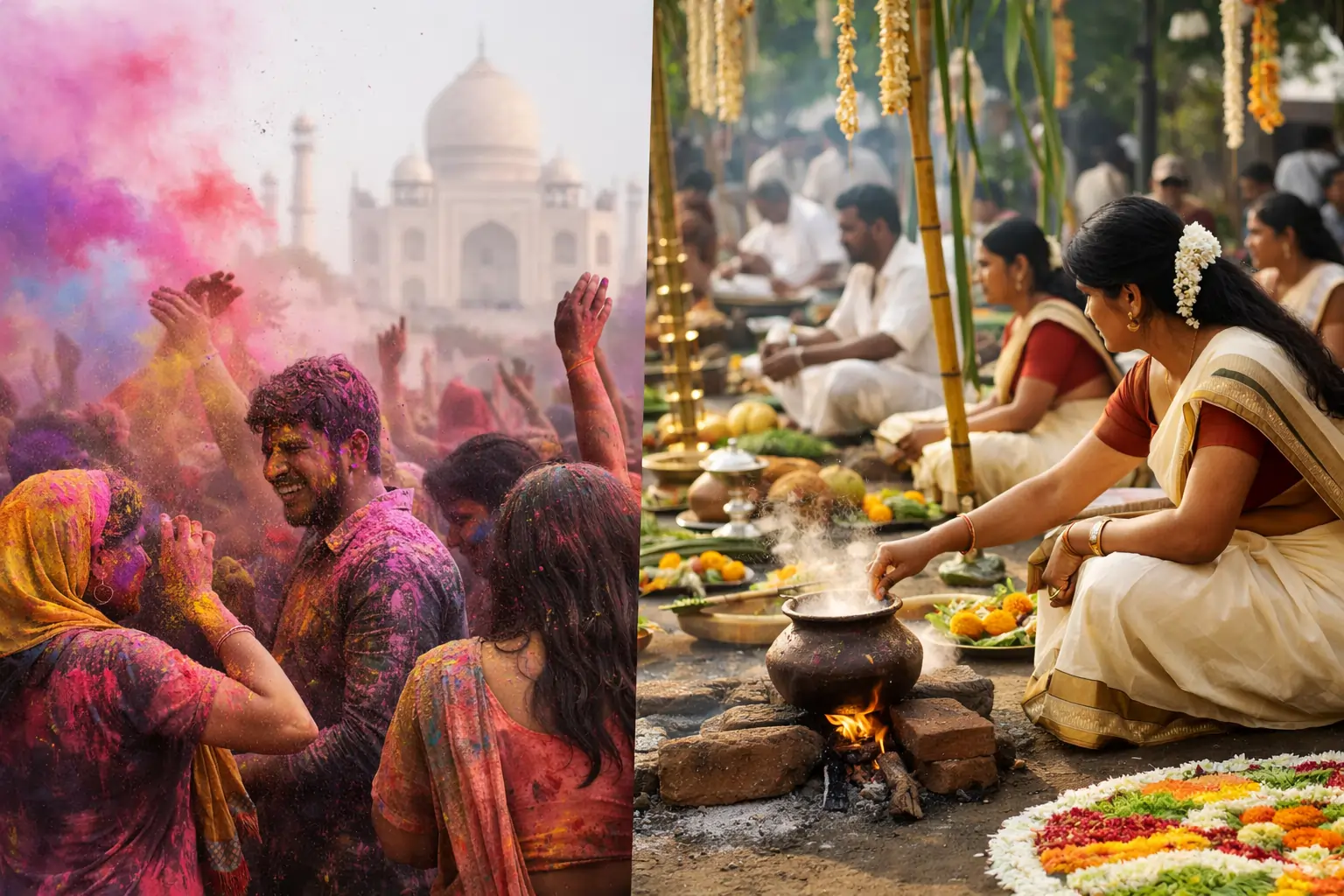

Every year, during March, a flood of colorful pictures related to the festival of Holi dominates the internet and news channels. However, the pertinent query here is whether it is a festival that can be celebrated across India as a whole. The answer to that would be no, as it remains a predominantly North Indian festival with little cultural importance in South India. According to research conducted by ‘Life of India,’ “in much of South India, Holi has historically not been a major traditional festival in the way it is in North India.”
Holi Festival True Home: The North Indian Heartland
Take a stroll down the streets of Mathura and Vrindavan during March, and you’ll realize why Holi isn’t just celebrated; it’s lived. The twin cities, which saw the birth of Lord Krishna and his childhood, don’t observe Holi for one day, they live it for weeks on end.
The spiritual home of Holi can be found across Uttar Pradesh, Rajasthan, Bihar, Madhya Pradesh, and Haryana, where Holi traditions have been passed down over generations. This is not borrowed culture; this is not modern culture; this is home.
According to India Odyssey Tours, “The festive atmosphere and colors of Holi in North India, especially in the Golden Triangle of Delhi, Jaipur, and Agra, is more alive and joyous than in the southern part of India.
Why Holi Never Caught on in South India
There are several reasons for this.
Different Krishna Worship: In South India, Krishna is worshiped as a child in temples in Guruvayur and Udupi. His worship is not as madhurya bhakti (romantic love) as in the context of Radha Krishna, which is associated with Holi.
Monastic Influence: Perhaps the Hindu monks in South India, since the rule of the Vijayanagara empire did not allow the celebration of festivals that violated caste norms as well as Brahminical restraint. Existing Festival Calendars: South Indian states already have well-established harvest festivals that meet the cultural need that Holi fulfills in North India.
“Unlike the high-energy color play in North India, Holi in South India is more ritualistic and symbolic, with emphasis on prayers and temple ceremonies rather than public gatherings.”
While in the South, in places like Karnataka’s Kamana Habba or Kerala’s Manjal Kuli, observed by the Konkani-speaking people, the festival takes on completely different characteristics. In Kerala, for example, turmeric replaces artificial colors, showing the influence of “naturalistic traditions.”
The Cultural Imposition: Media and Migration
Bollywood’s Homogenizing Effect
Holi’s global status as an Indian festival can be attributed, at least in part, to Bollywood. Songs like “Rang Barse” and “Balam Pichkari” have contributed to the visual language of Indian pop culture, irrespective of the festival’s regional character.
Why Regional Diversity Matters
If the festival of one region alone is projected as “National Culture,” then the local traditions are lost, which are essential for giving a unique identity to each state. Similar debates about cultural identity and political symbolism have emerged in Kerala as well, particularly around the proposal to rename the state from Kerala to Keralam. For deeper context, read Kerala to Keralam: Is name change a cultural heritage or political tactic by BJP?
The Festival Hierarchy Proble
National media, corporate, and government initiatives are dominated by promoting North Indian festivals. While Pongal, celebrated by Tamil people worldwide, does not receive even a fraction of the national attention
Devoted to promoting Holi, the grandeur of Onam, the importance of Ugadi, and the traditions of Vishu are relegated to regional festivals, while Holi is promoted as the “Indian” festival of colors celebrated during spring.
Commercial Dimensions
There is an economic incentive in the commercialization of Holi in terms of selling colored powders, holding parties, and “color runs” around the world. India’s tourism boards promote Holi as a “must-see” festival in India, while South India’s harvest festivals are not promoted at all
Celebrating Authentic Diversity
South Indians observing Pongal, Onam, Ugadi, and Vishu are not “missing out” on Holi. Instead, they participate in their ancestors’ traditions, which are just as beautiful, meaningful, and significant.
Real cultural pride is in embracing diversity and uniqueness, not in imposing our uniqueness and diversity as the norm. “The story of where Holi is not celebrated ultimately becomes a story of India’s pluralism. Unity does not mean uniformity.”
When we stop projecting Holi as a ‘Pan Indian’ festival and instead celebrate it as the cultural treasure that North India has, while giving the same importance to other regional festivals such as Pongal, Onam, etc., we will be strengthening the fabric of Indian culture
The Uncomfortable Truth: Cultural Imperialism Disguised as Unity
Holi is North Indian culture, period. Trying to pass it off as ‘national’ and overlooking Pongal, Onam, and Ugadi is cultural imperialism, the same attitude reflected in the promotion of Hindi and the idea of a centralized government, which is dismissive of the South. We are the backbone of the Indian economy, contributing 30% of the GDP, yet we get zero recognition for our festivals. South Indians are done with the idea of the North’s culture being the ‘Indian’ standard. Take the idea of diversity seriously, or accept the fact that this is cultural imperialism, not unity.