


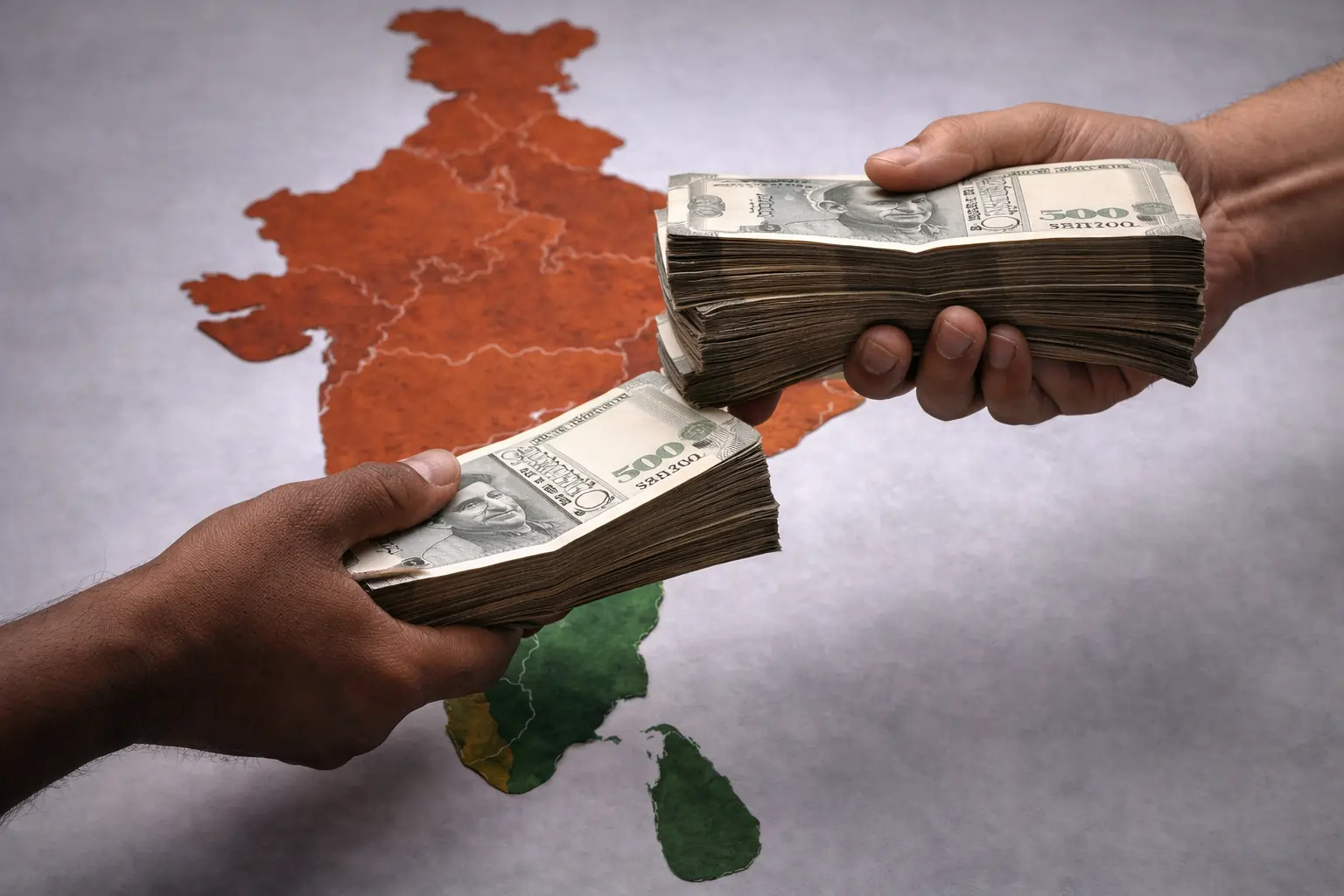

Year after year, the states in South India contribute billions of rupees to the national kitty in terms of taxes. Year after year, those billions are diverted towards the North. The Union Budget 2026-27 is a clear indicator of a fiscal trend that cannot be ignored. It is a trend in which the South creates wealth, and the North consumes it.
- The Rupee for Rupee Robbery
- When Crumbs Are Sold as Victory
- Delhi’s 59% vs States’ 41%: The Vertical Loot
- Follow The Money: Where Budget 2026 Actually Went
- The GST Con: How South Lost Its Financial Freedom
- The GST Con: How South Lost Its Financial Freedom
- The Uncomfortable Truth Nobody Wants to Say
- We are being plundered for being competent.
This is not a regional bias. This is mathematics, as presented in the Finance Commission reports.
The Rupee for Rupee Robbery
Maharashtra, which contributes 14.5% of India’s GDP, gets only 6.44% of the tax devolutions, or merely Rs. 0.35-0.40 per rupee. Tamil Nadu, which contributes 9% of India’s national output, gets only slightly more than 4%. Or Rs. 0.45-0.50 per rupee. Karnataka and Gujarat are in the same range. At the other end of the scale, Uttar Pradesh gets nearly Rs. 2 per rupee, and Bihar nearly Rs. 3. For every rupee that Tamil Nadu sends, it gets 45-50 paise in return. Bihar gets Rs. 3 for every rupee it sends.
When Crumbs Are Sold as Victory
The February 2026 report was touted as South India’s victory. The share allocated to Karnataka has gone up from 3.647% to 4.131%, adding *7,387 crore to the state’s coffers. The share allocated to Kerala has gone up from 1.93% to 2.38%, adding ₹6,975 crore. Sounds great until we realize that Tamil Nadu’s share was 7.54% in the 8th Finance Commission, now reduced to 4.1% in the 16th, while Rajasthan has gone up from 4.45% to 5.93%.
The South has grown marginally when compared to 2021. How have we fared when we compare.
Delhi’s 59% vs States’ 41%: The Vertical Loot
The 16th Finance Commission allocated the States’ share at 41 percent of shareable Central Taxes. The southern states had asked for a raise of 50 percent. The States get 41 percent as decided by the 15th Finance Commission.
The census and surcharges levied by the Centre reduced the divisible pool from 89.1 percent of total tax revenue in 2014-15 to 74-80 percent in the next five years,
The Centre collects ₹100 as taxes. Out of this, ₹ 20-26 is collected as cesses by the Centre but not shared with the States. The Centre shares census ₹74-80 with the States. The southern States asked the Centre to include cesses. This was deemed “neither permissible nor desirable”
Follow The Money: Where Budget 2026 Actually Went
Defence allocated Rs 7,84,678 crore or 15%, Road Transport 6%, Railways 5%, and Home Affairs 5%. No Chennai Metro Phase 2 breakthrough. No Bengaluru infrastructure rescue. No Kerala coastal highway completion.
But will develop East Coast Industrial Corridor with node at Durgapur, and 4,000 e-buses for Purvodaya States. North-East allocated *500 crore for ULFA cadre rehabilitation in Assam.
South India? Fiscal responsibility lectures.
The GST Con: How South Lost Its Financial Freedom
Earlier, states were getting 55% of the total tax revenue, including VAT, entry tax, and local taxes. Now, the Centre collects GST revenue and transfers it to states through the Finance Commission’s formula, making states dependent on the Union government. For the South, GST has been a disaster. We gave away taxation sovereignty in the name of efficiency. The result: GST compensation ended in 2022, and states are struggling to get the lost revenue.
Karnataka, Tamil Nadu, Telangana-are the growth engines of the country, and they are dependent on the Centre’s formula for the revenue they created.
The GST Con: How South Lost Its Financial Freedom
Earlier, states were getting 55% of the total tax revenue, including VAT, entry tax, and local taxes. Now, the Centre collects GST revenue and transfers it to states through the Finance Commission’s formula, making states dependent on the Union government.
For the South, the GST has been a disaster. We gave away taxation sovereignty in the name of efficiency. The result: GST compensation ended in 2022, and states are struggling to get the lost revenue.
Karnataka, Tamil Nadu, Telangana-are the growth engines of the country, and they are dependent on the Centre’s formula for the revenue they created.
What the Southern states want:
- Vertical devolution at 50% (we get 41%)
- Cesses in divisible pool (rejected)
- Increase in GDP contribution weight (got 10%, wanted 25%) Autonomy in taxation (denied)
We got some minor horizontal gains and lectures on gratitude.
The Uncomfortable Truth Nobody Wants to Say
The numbers all scream yes: South is subsidizing North’s failure. We contribute 30-35% of India’s GDP. We get 15-20% in return. The balance is spent on schemes in states that refuse to control population growth, cannot collect taxes efficiently, will not spend on education, and deliver governance so poor that people from those states are moving to Bengaluru and Chennai to seek opportunities.
TN had claimed that the framework, which gives little weightage to tax effort and contribution to GDP, punishes states that invested early in population control, industrialization, and compliance.
We are being plundered for being competent.
The gains that came out of the 16th Finance Commission are crumbs. The patterns that came out in Union Budget 2026 are still there. South is still subsidizing North’s poor governance with no end in sight.
This isn’t federalism. It’s extraction. And it’s unsustainable.