



The 2026 assembly elections in Kerala are coming up after a series of political and social events, which rendered it harder to believe that minority voting blocs act as predictable and stable groups. But this trend complicates the old assumption and changes with the local body elections held in 2025. These election trends served as a crucial test for political parties as they assessed the effectiveness of their alliances and the formation of government. The shift is not a single swing but better understood by the issue-based movement and fragmentation.
- Local body elections 2025 as a minority coordination test:
- Institutional politics & conflict between church and government:
- The “selective openness” impact and the BJP’s Christian campaign
- The UDF’s consolidation of Muslim politics, the Jamaat row, and the IUML’s stance:
- Impact in 2026: Where the real arenas are in the assembly election
- Future implications:
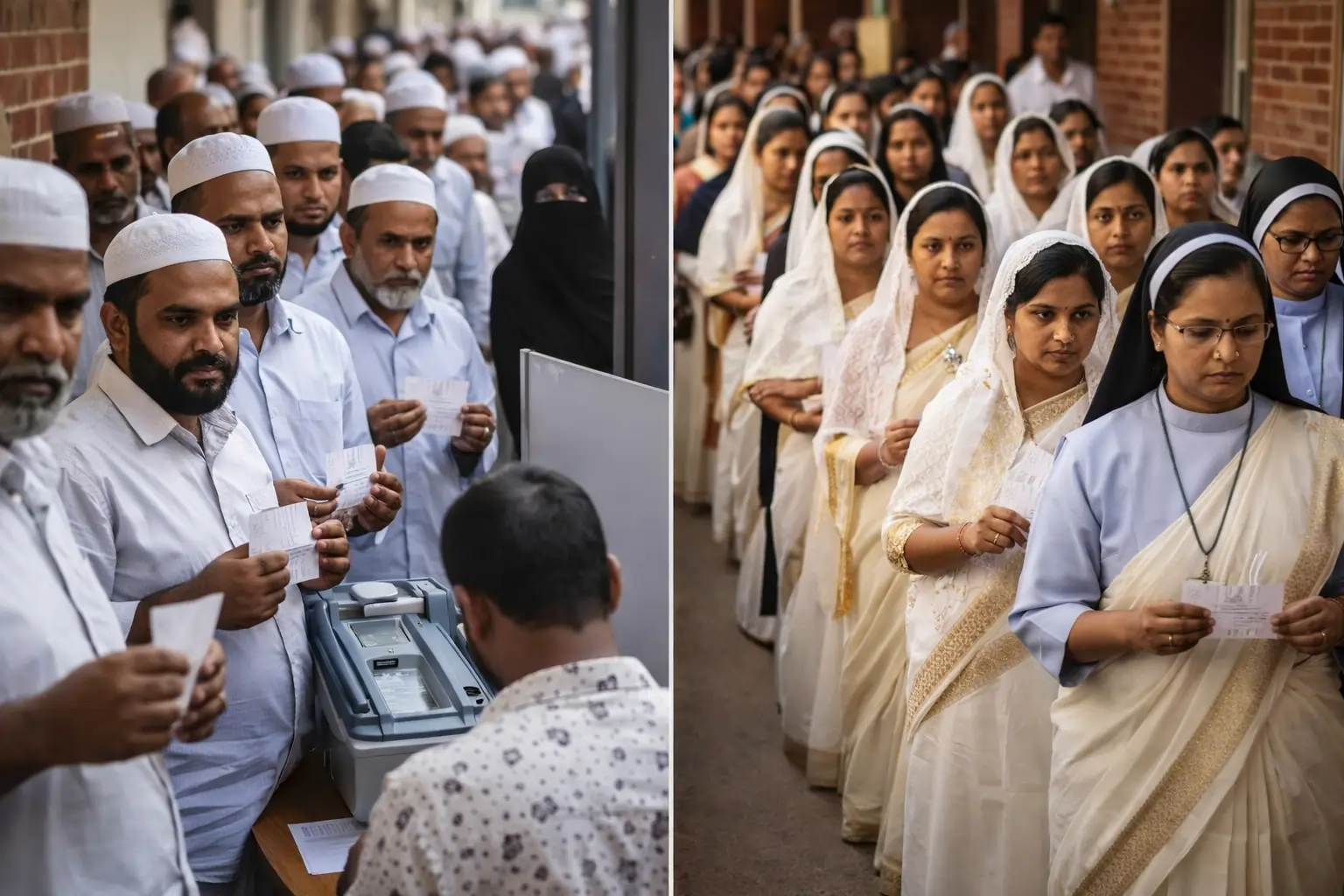
The Muslim and Christian communities accounted for 45% of the total population of Kerala. Their voting pattern was considered consistent in favoring the united democratic front (UDF). However, the pattern changed after the 2025 local body elections. Their political behavior does not define the alliance, but rather by rational political judgment and governance performance. This shows that the election trend is changing from identity-based loyalty to issue-based negotiations.
The 2026 elections are not about politics between majority vs minority politics. Muslim and Christian patrons are becoming more assertive and judging parties on performance and ability to protect the interests of communities. This behavior also further determines how alliances are formed, as well as how things turned out at the constituency level in Kerala.
Local body elections 2025 as a minority coordination test:
The results of the local body elections showed that the UDF was gaining ground at all levels and in all districts. This seems like a comeback before the LDF, when the results of local body elections affected the Assembly elections. Following 2 patterns matter in minority politics:
- Malabar districts, which are predominantly Muslim-dominated, and the election results coverage revealed that the people felt they were left out of the strategic campaign of the CPM elections.
- Central Kerala is constituted of a Christian majority that revealed the formation of voters in an alliance with the UDF party in Ernakulam, Kottayam, Idukki, and Pathanamthitta, making them a center battlefield for the upcoming elections.
Minorities coordination lies in the structural significance and the fact that a strategic coordination of minorities affects the outcome of many cornered contests, particularly when the BJP tries to become a vote splitter.
Institutional politics & conflict between church and government:
Another important factor that influences the political sentiment during the 2025 election is the institutional conflict, not the identity-centric slogan. This emerged after the controversy over school vacancies between the general education minister and the managing bodies of the churches, including the Kerala Catholic Bishops’ Council (KCBC).
It is important because it directly affects the lives of the middle class, their jobs, schools, institutions, and anatomy as well. For that matter, a clear accountability frame offers voters an opportunity to question parties as well as the parties’ courtship.
For instance, if the leadership is under siege, they are likely to welcome overtures from rivals. It does not mean that the church has the power to decide votes’ trend, but this church-state conflict redefines and re-prioritizes the voters in swing districts as their ideology shifted towards issue-driven coalitions.
The “selective openness” impact and the BJP’s Christian campaign
The outreach initiatives of the BJP in Kerala have come to include the realization that reaching out to minorities is no longer optional but a strategic necessity. At the same time, critics argue that the party’s broader electoral approach also relies on polarization tactics, including issues surrounding cow protection and vigilantism, which have generated controversy across the state. A deeper analysis of this trend can be found in Rising cow vigilantism in Kerala: BJP’s new election Strategy
Along with that, the BJP plays a role in fueling the Christian community against other parties during its election campaign. Also, the relationship between the Christian community and the BJP-connected individuals has only served to further fuel the idea that the BJP is reaching out to the Christian community, either through minority rights issues or community-specific grievances.
The electoral calculation for the BJP is not only about winning Christian votes. It’s more about calculation at the micro level between Christian-majority constituencies that likely have a significant impact, targeting UDF or LDF to weaken their influence, especially in central Kerala, given the viability that the BJP has shown following breakthroughs such as Thrissur.
The UDF’s consolidation of Muslim politics, the Jamaat row, and the IUML’s stance:
On the Muslim front, the basis of the UDF’s strength continues to lie in the IUML’s organizational strength, but it also depends on the politics of reputation, who represents secularism, and who delivers polarization.
In recent local body elections, the CM alleged that they had an understanding with Jamaat-e-Islami that threatened secularism in Kerala.
On the other hand, IUML leaders also assert their party’s alignment with secular forces denying charges of moving towards ideological extremes, but also conveying confidence in their bargaining power in seat-sharing talks. In the 2026 elections, it is a contest over legitimacy or a Muslim shift.
It’s deepened in the position of UDF. If the UDF is perceived to be strong and protective of minority interests, then consolidation will happen. If perceived as opportunistic and untrustworthy.
The same is the case with LDF. If it succeeds in regaining minorities’ trust and delivering in the area, they can make a constituency, if not even win from Malabar.
On the Muslim side, the UDF’s strength remains anchored in the IUML’s organizational depth, who represents secularism and enables polarization.
What this produces for 2026 is not a simple Muslim shift but a competition over legitimacy:
If people think the UDF is secure and protects the interests of minorities, the consolidation gets stronger.
Some voters may not want to vote for the UDF if they think it is advantageous or has problems within itself.
If the LDF can restore trust in minority districts, it can make up for lost ground even if it doesn’t “win” Malabar outright.
Impact in 2026: Where the real arenas are in the assembly election
These minorities’ vote bank decide the election result and the future of the state. Based on previous cases, the following major inferences are made.
The Central Kerala region has now become the major “minority swing pathway.” As the Christian sentiment in the Ernakulam-Kottayam-Idukki areas may prove to be more influential than any general ideological campaign in determining the outcome in close contests.
Furthermore, the UDF lead in Malabar will continue to grow as long as UDF coordination is good and IUML mobilization is good. But differences in alliances and campaigns could give the LDF an opportunity to gain more votes, even if they cannot win. As a result, the discipline of the Coalition will decide the margins in Malabar.
Now the BJP grows as a challenger despite having small seats. This is because their strategy in Kerala seems to be to aim to be competitive in more than one constituency. This could change the outcome in certain constituencies because the votes could shift from one party to another.
Future implications:
Whoever wins, 2026 will likely mark an acceleration of a process that has been underway for a very long time; minority politics will negotiate more, and the rules will matter less. For the Muslim community, the networks of community leadership will matter but how good the government is delivering welfare, development and social governance will matter more than secular discourse. For the Christian community, issues that are institutional issues about land, rights, local grievances will continue to matter for the electoral openness. Sometimes this will benefit UDF and other BJP too.
This pattern for the party system in Kerala suggests that instability at the constituency level will continue. Alliances matter but small issues and credibility matter more to the outcome of the election than the statewide assumptions about the vote bank.