




On a humid evening in coastal Andhra, a local party worker put it bluntly: “Votes are not emotional anymore. They are calculated.” He was not dismissing caste. He was describing how it has changed.
- Reddy and Kamma Power Dynamics in Andhra Pradesh
- Kapu Mobilisation and Political Space in Andhra Pradesh
- The BC Factor in Andhra Pradesh Electoral Politics
- Electoral Strategy and Booth-Level Calculations in Andhra Pradesh
- Youth Aspirations and the Future of Andhra Pradesh Politics
- A Politics in Transition Across Andhra Pradesh
In Andhra Pradesh, caste has never been a background detail. It shapes village hierarchies, marriage alliances, business networks, and political access. But the current phase feels different. The loyalties remain. The language has softened. The strategies have become sharper.
To understand why caste remains so deeply embedded in Andhra Pradesh’s political culture, one must revisit the state’s own formation. Andhra was not just another administrative unit; it emerged from a powerful linguistic and regional movement that reshaped Indian federalism. The story of how the state came into being is explored in detail in our article on how India’s first linguistic state was formed from Madras to Andhra.
Reddy and Kamma Power Dynamics in Andhra Pradesh
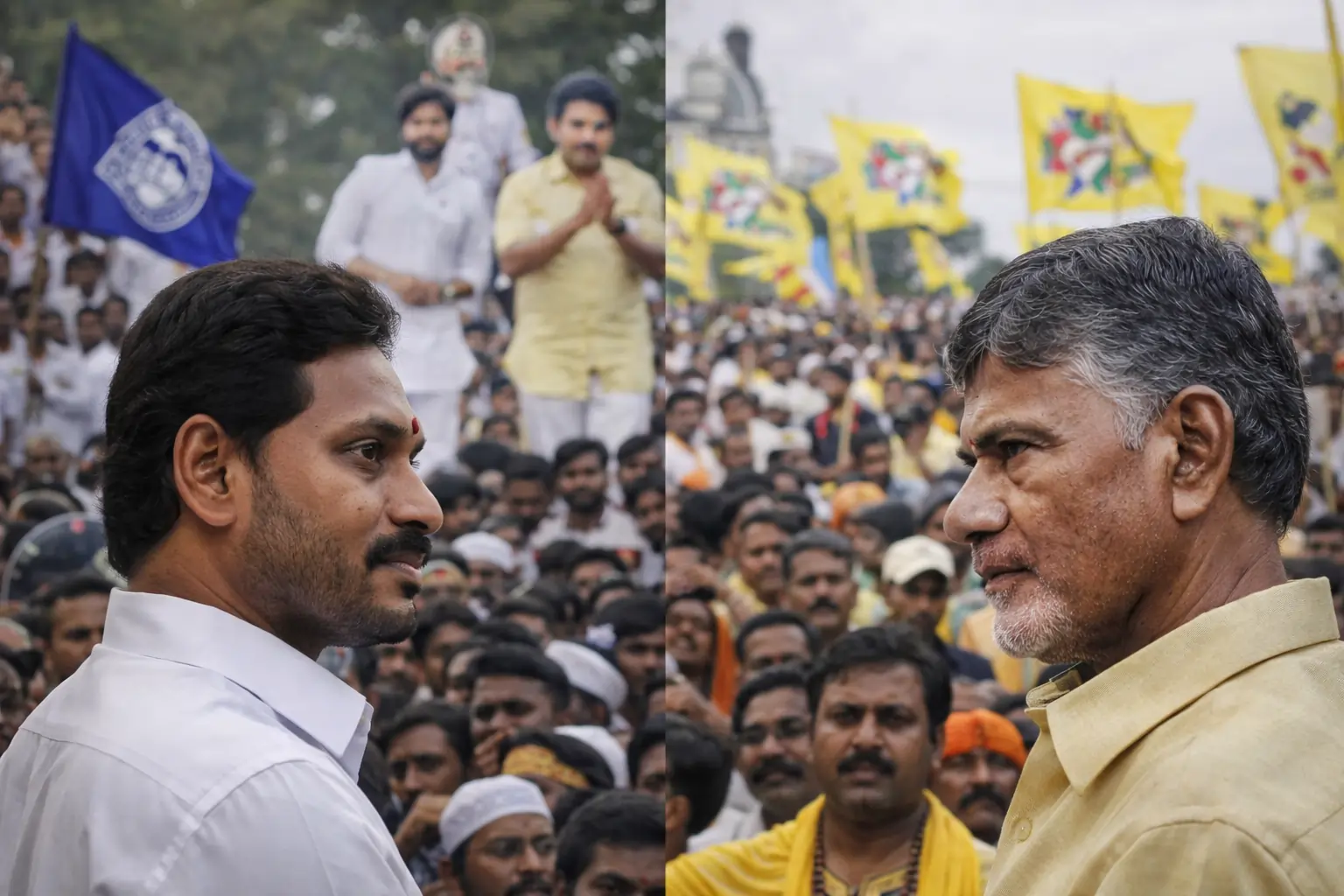
The two main communities in the state, namely the Reddys and Kammas, lead the political discourse within the state that has largely focused on competing camps. The current political rivalry between the two primary representatives of these groups, namely CM Jagan Mohan Reddy (YSR Congress) & N Chandrababu Naidu (TDP), has become symbolic of the historical relational ties between each of these groups’ respective political and economic power and the ability to dominate their region.
CM Jagan Mohan Reddy and N Chandrababu Naidu, beyond just being strictly party leaders, are representative of something significantly greater than two political parties; rather, they are both historical leaders of two of Andhra Pradesh’s most significant communities that have a significant amount of economic resources and power.
Older voters from Rayalaseema tend to view political party affiliations in terms of people (reference families rather than party always). Also, Business people who were successful in Coastal Andhra during previous regimes distinctly recall that time frame as one of significant growth and prosperity and are now seeing the opposite happening currently with more recent administrations.
Younger voters from both communities often speak less about pride and more about returns. What did the government deliver? Which schemes reached their households? Whether roads were built, schools upgraded, or fees reimbursed. Identity still matters. It simply does not stand alone.
Kapu Mobilisation and Political Space in Andhra Pradesh
If the Reddy and Kamma presence forms the traditional axis, the Kapu community adds volatility to the equation.
The Kapus are numerically significant across several coastal districts. For years, sections of the community have demanded greater political representation and reservation benefits. The mobilisation gathered momentum when actor turned politician Pawan Kalyan launched the Jana Sena Party. His appeal cuts across age groups, particularly among youth who see him as a figure of defiance rather than a conventional caste leader.
Yet the Kapu vote is not uniform. Farmers facing rising input costs, small traders navigating economic uncertainty, and urban graduates looking for jobs often prioritise different issues. Some align with larger alliances for strategic reasons. Others respond to welfare outreach.
Political strategists are acutely aware of this fragmentation. A consolidated Kapu vote can swing tight coastal constituencies. A split can reshape alliances overnight.
The BC Factor in Andhra Pradesh Electoral Politics
The most consequential shift may lie with the Backward Classes, often referred to collectively as BCs. They represent a large share of the electorate but are divided into multiple subgroups with distinct local identities.
Historically, this fragmentation limited their bargaining power. Today, both major parties invest heavily in BC outreach. Cabinet berths, nominated posts, targeted welfare schemes, and symbolic gestures are carefully calibrated.
In conversations across districts, BC voters often frame their choices in practical terms. Access to housing schemes. Scholarships for children. Local contracts. Pension continuity. They speak about visibility in power structures but also about daily survival.
If a broader BC consolidation gains traction, it can dilute the dominance of traditional upper agrarian castes in determining outcomes. Parties know this. Candidate selection increasingly reflects micro-level caste arithmetic rather than broad assumptions.
Electoral Strategy and Booth-Level Calculations in Andhra Pradesh
Campaigning in Andhra Pradesh has become granular. Constituency-level caste data is mapped alongside welfare beneficiary lists. Booth committees track turnout patterns street by street.
Caste identity influences ticket distribution. But it is now paired with performance metrics. How many households received benefits? How many government employees feel alienated? Where anti-incumbency is strongest.
Social media has added another layer. Narratives about community dominance or marginalisation circulate widely, especially among urban voters. At the same time, rural voters weigh tangible benefits more heavily than rhetorical claims.
This blend of identity and delivery defines the current moment.
Youth Aspirations and the Future of Andhra Pradesh Politics
There is a generational undercurrent running through this shift. In cities like Visakhapatnam and Vijayawada, young voters talk about migration, private sector jobs, and startup prospects. They question whether caste politics can address employment gaps.
Yet caste networks still shape opportunity. From college admissions to business partnerships, social capital often flows along familiar lines. Even those who reject overt caste rhetoric remain embedded in its structures.
Political leaders attempt to navigate this tension. They invoke social justice while promising infrastructure and investment. They appeal to community pride while advertising development credentials.
A Politics in Transition Across Andhra Pradesh
Andhra Pradesh has not moved beyond caste. It has moved into a more strategic phase of caste politics.
The Reddy and Kamma rivalry continues to influence perceptions of power. Kapu mobilisation injects uncertainty into coalition building. BC outreach has become central to electoral planning. And welfare delivery often decides whether identity solidifies or fractures.
The language is more measured now. The calculations are more precise. Voters weigh identity against benefit, symbolism against delivery.
Caste remains the grammar of politics in Andhra Pradesh. The sentences, however, are being rewritten.