



The South Indian states are not merely geographical units but their actual strength lies in their culture, language, and social habits. Among these, language is a significant element that contribute to the formation of a region’s identity. Therefore, while North India has a common threat in the form of Hindi, the South has strong regional language that is steeped in history.
In this regard, Kerala is distinct in many ways by knowing for its high literacy rate, religious pluralism, and social, at the core of this identity is one single force which is the Cultural Backbone of Kerala.
Malayalam is not merely a language of communication in Kerala only. It is a common emotional and cultural platform that connects and people across caste, religion, and class. Whether Hindu, Muslim, or Christian, people from Kerala share the same linguistic identity.
This linguistic identity has contributed to the development of what call a “Keralite culture.” The culture that emphasizes education, discussion, reform, and awareness. Malayalam is a binding force in a state where diversity is seen as a reality.
Literature as a Reflection of Society
For over a millennium, Malayalam literature has provided a lens through which to view the social and political changes which have taken place in Kerala.
Malayalam has come through various changes from the 12th Century through present day novels; the evolution is epitomized in the poem ‘Ramacharitam’. The writer of these works in past like O.V. Vijayan, or present day though like Vaikom Muhammad Basheer, have written about real life experiences of Keralites in their writing. As an example, many have referred to Basheer simply by calling him the “Sultan of Story-Tellers”, because he wrote about what it was like for the everyday person to live in the culture of Kerala (e.g., “Balyakalasakhi”).
Basheer captured local dialects, village life and the tensions which exist among social classes using humor, irony and love. His literature was never about kings or wealthy people, but rather common citizens. This is how Malayalam became the language of empathy and self-reflection. Thus, Malayalam literature did not only provide entertainment; it has also influenced the way in which Malayali’s view themselves.
Malayalam: a cause for social reforms:
In the beginning of the 20th century, Kerala had strict caste separation and being an Untouchable (having no caste status) was common for many people. At this time there was also an emerging use of the standard language of Malayalam as a tool for social reform.
Poets like Kumaran Asan, a member of the “Great Trio” of Malayalam poets and Kumaran Asan, a member of the “Great Trio” of Malayalam poets, opposed caste oppression, and the caste system and argued for no one to live in a state of degradation.
In their use of Malayalam as a tool for the straightforward communication of important social awareness concepts, these poets provided a vehicle through which the traditional cultural model of social reform could become a movement.
Through the spoken and written language of Malayalam, historical social reforms that occurred, such as the Temple Entry Proclamation (which allowed lower castes to enter a Hindu temple), were greatly affected.
So, the functionality of Malayalam was much more than being passive, it was very much part of the proactivity of creating a new progressive Kerala.
Folk Customs and Ongoing Records of Culture
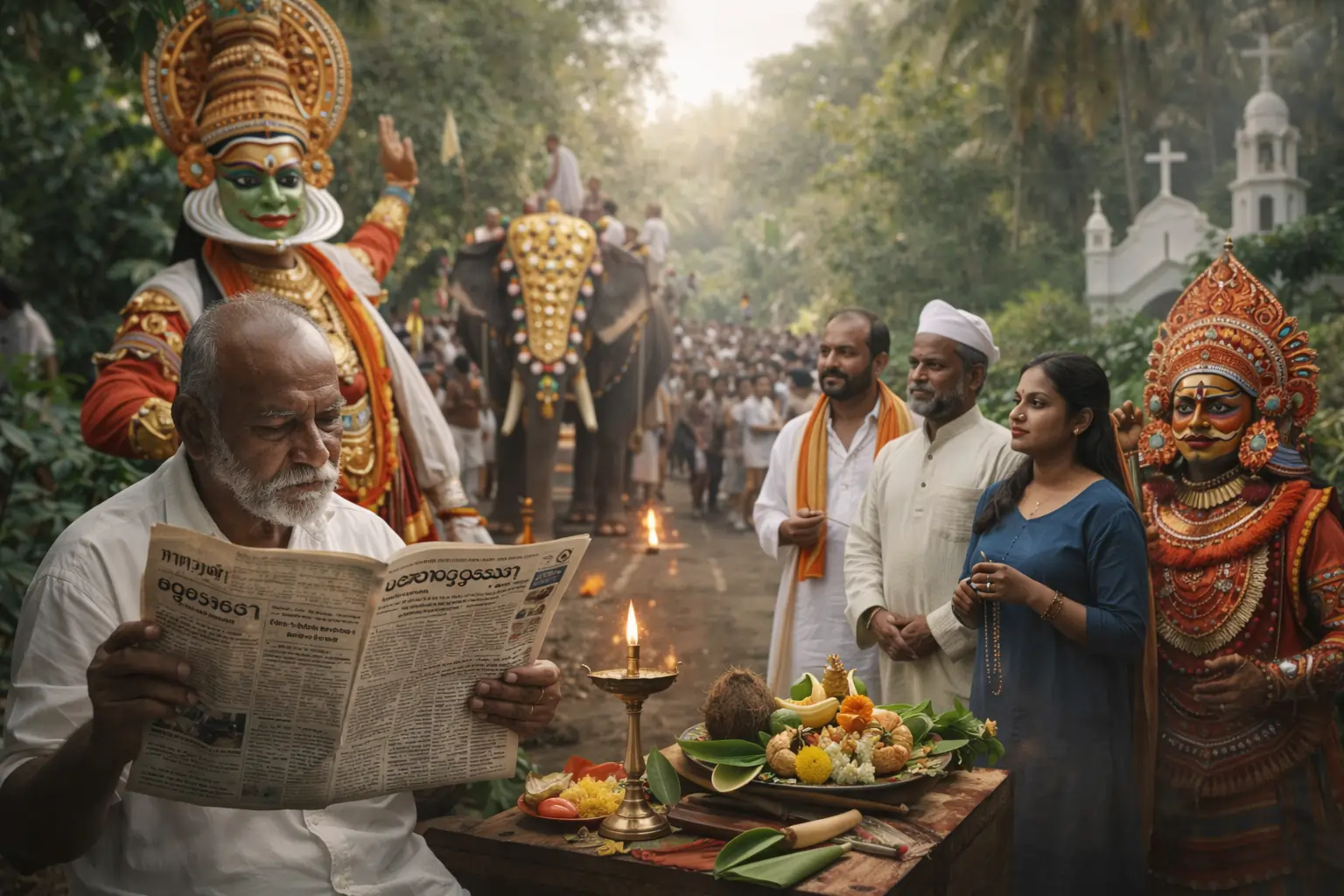
Malayalam is neither a written language nor a spoken language, but instead it offers various means of communicating through performance. In northern Kerala, for example, There are several different way to communicate through performance such as Theyyam which involves a form of storytelling with dance and music all rolled into one performance. In addition, Kerala has a number of different forms of classical performing arts such as Kathakali, which are based on texts written in Malayalam but tell the stories of older legends or myths.
A great deal of moral and cultural values are found in many of Kerala’s folk songs, proverbs, ballads, as well as in temple mural art work. Because the people of Kerala understand Malayalam well, they are able to have similar feelings about and be moved by performance. Malayalam is thus a repository of history, morals and religious beliefs and is an integral part of every person’s life.
There are numerous communities and denominations in Kerala; festivals like Onam, however, spindling religions celebrate them as a holiday. Malayalam music, prayers or greetings generate a single cultural background for these happenings. Malayalam provides a common place for public interaction on a daily basis, including marketplaces, educational institutions, cinema and governmental affairs. Thus, Malayalam contributes to the correct disputed identity of all persons as a whole.
Why Malayalam is important for Kerala:
Global English and digital interaction now dominate global settings, leading young people to choose global languages for their career and mobility. But this has also led to the evolving industry at risk: regional languages will weaken over time.
If Malayalam fades out, Kerala will lose much more than just vocabulary. The interpretation of traditions, relationships, and social changes as viewed through Malayalam cannot be easily replaced. The emotion and memories that go with language are important parts of culture. Cultural continuity, without linguistic means of conveying it, is at risk. Malayalam is spoken by approximately 97% of the people of Kerala, and this widespread usage makes it one of the largest expressions of identity for India.
The Malayalam language connects literature, folk tales, social reform movements, and everyday life besides keeping alive tales of struggle for progress, the advancement of the freedom from oppression right, and the oral history of storytelling. In addition, the preservation of traditions is also an unifying force for people from different backgrounds and allows the state to form a single culture.
Furthermore, the reputation of Kerala as a progressive, educated, socially progressive, and culturally confident community is also a function of Kerala’s language heritage. The Malayalam language influenced public opinion contributed to a high level of social consciousness among people of all races in Kerala and created pride in many different cultures that call Kerala home. It serves as Kerala’s mirror and curator of identity. To preserve Kerala’s past, we must support the preservation of Malayalam to ensure its cultural legacy and future.