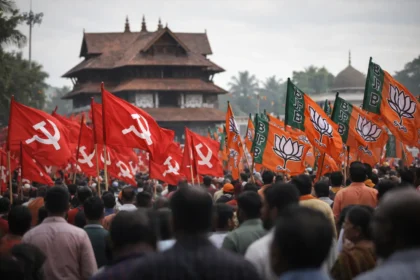



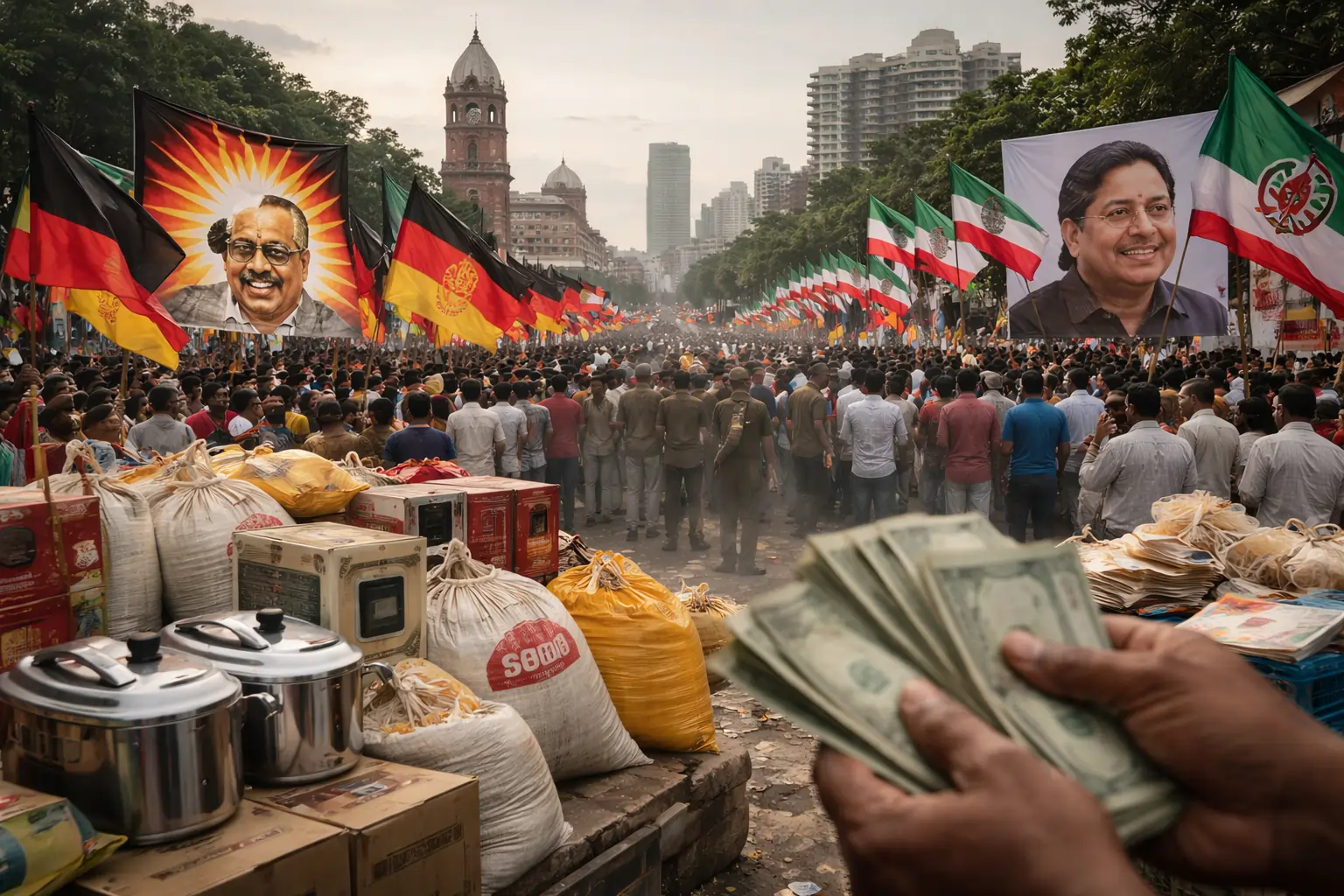

The 2026 Tamil Nadu Assembly Elections have seen a record-breaking surge in election expenditure, with political parties engaged in a bitter bidding war to win voters through cash and freebies. As Tamil Nadu gets ready to go to polls, the underlying question remains: has electoral democracy in southern India been reduced to a barter system, with money changing hands in lieu of votes? The idea of a North-South divide adds another dimension to this complex puzzle, with Tamil Nadu’s welfare model standing starkly apart from the governance failures in northern states.
The Magnitude of the Cash War in Tamil Nadu
The extent of the seizures made in the current electoral cycle is an alarming figure. The Election Commission of India states that the total value of the seizures made as of March 24, 2026, in the current electoral cycle is ₹178.78 crore as part of the ongoing efforts in the state of Tamil Nadu. The total seizures include 34.64 crore in cash, precious items worth 112.37 crore, and freebies worth 24.22 crore. The Hindu
What is alarming is the fact that the seizures are merely the tip of the iceberg, and the actual amount of unaccounted money entering the electoral process is much higher.
The EC has deployed 2,169 flying squads in the state, and they are working around the clock to keep an eye on and curb the electoral process. Moreover, over 1.68 lakh cases of defacement have been removed since the model code was put in place .
The Freebie Culture: A Tradition in Tamil Nadu?
Tamil Nadu is known for its competitive populism, with Dravidian parties traditionally using welfare measures as an electoral strategy. But this election cycle is taking it to unprecedented levels.
The ₹5,000 Cash Transfer Scandal
The ruling DMK government’s announcement of depositing ₹5,000 in the bank accounts of its 1.31 crore women beneficiaries through a combination of monthly honorarium and special grant is an unprecedented escalation.
The Chief Minister’s promise to double the monthly honorarium to ₹2,000 if re-elected and the opposition AIADMK leader’s promise of offering free bus travel for all men is an even more egregious example.
The Fiscal Arithmetic of Populism
The figures involved in this promise point to a rather alarming fiscal situation:
- Present Cost: 15,720 crore for 1,000 monthly allowance to 1.31 crore women
- If this is doubled to ₹2,000 per month: The cost would escalate to over 31,000 crore per annum, almost 9 percent of the State’s total revenue expenditure
- Tamil Nadu’s Total Outstanding Debt: This is set to touch ₹9,29,959 crore by March 31, 2026 Revenue Deficit:
- This is estimated at 41,635 crore for the 2025-26 fiscal year
These figures certainly raise important questions regarding the viability of these welfare measures.
The North-South Divide: A Tale of Two Indias
The freebies debate in TN cannot be understood without a discussion on the backdrop of the North-South divide that has now come to define India. The North-South divide can be understood on various parameters: economic, demographic, and political.
Economic Disparities
The economic disparity between the southern and northern states of India is extremely high, especially after the introduction of neoliberal economic policies. We can draw the following examples to illustrate the situation:
- The multidimensional poverty level is merely 2.2% in Tamil Nadu, according to NITI Aayog
- The poverty level is 23% or higher in Bihar
- The chances of a child surviving are higher in Kerala compared to the United States, while in Uttar Pradesh, the chances are lower than those in Afghanistan
The disparities are structural and not coincidental. The Freight Equalisation Scheme was designed to ensure that mineral-rich states such as Bihar, Jharkhand, and Odisha did not gain from their own resources; rather, these minerals are supplied at subsidised rates to the already developed southern states
Demographic Politics and Delimitation
The most controversial issue contributing to the North-South divide is the upcoming delimitation process, which is based on the outcome of the 2026 census data. The process ensures that each Member of Parliament represents an equal number of voters. The delimitation process was put on hold in 1976 to avoid penalizing states that have succeeded in controlling their populations. The Guardian
In the case where the delimitation process is allowed to take place, the northern states will gain more seats in the country’s Parliament, while the southern states, which have performed better demographically, will lose out. The implications are huge:
- The six largest states in the north have 600 million people, twice the number in the south
- Uttar Pradesh gets more federal revenue than the total amount collected by the five states in the south
- The southern states are likely to be taxed more, represented less, and ignored in the country’s decision-making process
The Fiscal Centralization Challenge
It is argued that the Indian fiscal system is structured in a manner that is biased in favor of the Union government over the states. States have limited powers to tax but bear the bulk of welfare responsibilities, while the Union government has greater powers to tax.
The Goods and Services Tax, a regressive tax system where the poor bear a greater burden than the rich, was introduced through political consensus. While Karnataka’s SGST collections have gone up from €35,000 crore pre-GST to ₹95,000 crore in 2024-25, corporate tax was reduced from 40% to 25% in 2017.
This fiscal system, supported by all political parties, has entrenched inequality in favor of a pan-Indian corporate-capitalist economy at the expense of citizens in both north and south India.
Are Freebies the Answer? Examining the Evidence
The question that Tamil Nadu voters need to answer is: are freebies a form of welfare or a ploy to win elections? The answer, however, is a little more complicated than that.
The Duflo Doctrine and Evidence-Based Welfare
It is no coincidence that Tamil Nadu’s cash transfer policies are a reflection of the research done by two Nobel laureates, Abhijit Banerjee and Esther Duflo. Duflo is a member of the Chief Minister’s Economic Advisory Council, which also includes former RBI Governor Raghuram Rajan and development economist Jean Drèze.
The “poverty economics” research that Banerjee and Duflo have done demonstrates that cash transfers, especially those that are targeted at women, are a game-changer. The research demonstrates that cash is rarely squandered and is often used for better nutrition, healthcare, and educational outcomes, all of which are investments that yield high returns in the future
Do Freebies Guarantee Electoral Victory?
Contrary to the popular perception, empirical facts indicate that “huge freebies” are no guarantee for electoral success:
- The defeat of YSRCP in the 2024 elections in Andhra Pradesh, despite its huge “welfare package” of “Navaratnalu”
- The poor performance of Congress in the 2024 Parliament elections in Karnataka, despite its “Five Guarantees” package worth *52,000 crores
- The facts indicate that people end up voting based on the performance of the government, even if “plied with allurement”
Global Precedents
Tamil Nadu’s welfare model has been influenced by global precedents too. Bolsa Familia in Brazil has reduced extreme poverty and inequality through conditional cash transfers. Similarly, Alaska’s Permanent Fund Dividend distributes a cash share of oil revenues to all Alaska’s
inhabitants, thereby boosting local consumption for decades without undermining the work culture.
The Moral Hazard: Dependency or Dignity?
The freebie debate essentially boils down to different notions of what kind of state we want to be. The argument is that with more and more sops for undeserving populations, we risk creating a dependency culture, which erodes the dignity of labour. The Chief Justice of the Supreme Court recently went so far as to say, “What kind of culture are we fostering if the State provides for every need from cradle to grave?”
But, of course, there is another side to this argument. If direct cash transfers become institutionalised, it creates a floor for dignity. It prevents the “debt poverty trap,” where a medical emergency leads to generations of bonded labour. In the case of TN, it creates a safety net for its most disadvantaged citizens, allowing them to be part of the economy as consumers rather than simply being at its margin.
The Tamil Nadu Model: A Blueprint for the South?
Tamil Nadu’s strategy has given rise to a unique model of development, which differs significantly from the poor governance in the northern
states. The strengths of Tamil Nadu’s strategy include:
Robust tax revenue: Tamil Nadu derives around 75% of its own income from a highly developed manufacturing sector
Manageable debt: The state’s debt-to-GSDP ratio remains steady around 26.12%, much lower than Kerala’s 37% and Andhra Pradesh’s 36%
Strong economic growth: The real GSDP growth rate of 11.19% in 2024- 25 will allow Tamil Nadu to absorb more debt efficiently. The Law
This ‘Dravidian Model’ asserts that welfare and development are not contradictory concepts; rather, a healthy and financially secure Populace is what drives higher tax revenues.
Beyond the Cash War
Tamil Nadu is set to vote in 2026, and the state is clearly at the crossroads. The cash war that is being fought over the state’s elections is, in fact, an outcome of the structural tensions that are inherent in the federal democracy that is being practiced in the country, namely, the tensions between the north and the south, between the welfare state and the need to be prudent, and finally, the tension between short- term electoralism and the need to think long-term.
What is important to note is the fact that the Tamil Nadu state elections are important because they are, in fact, an important test case in the debate on the federal future that is being contemplated in the country. The state’s model, based on the integration of the insights that have been provided by the Nobel Prize-winning economists, is clearly moving towards an evidence-based model.
However, for the people of Tamil Nadu, the choice is not just one of freebies and governance; it is a choice of what kind of society they want to build-one in which cash transfers build a floor of dignity, or one in which competitive populism bankrupts the state’s future. As NTK leader Seeman aptly said, “one who provides employment is a true leader and administrator, and not one who gives ₹4,000 to the unemployed”.
The outcome of the 2026 Tamil Nadu election will send a powerful signal about whether India’s southern model of development can withstand the twin pressures of fiscal populism and centralizing tendencies from the north. For a nation struggling with growing regional disparities, the lessons from this election will be felt far beyond its borders.