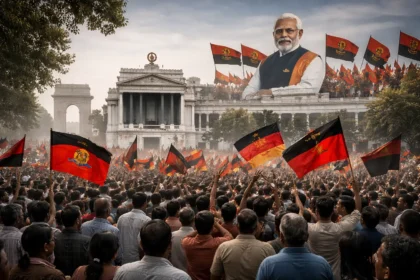



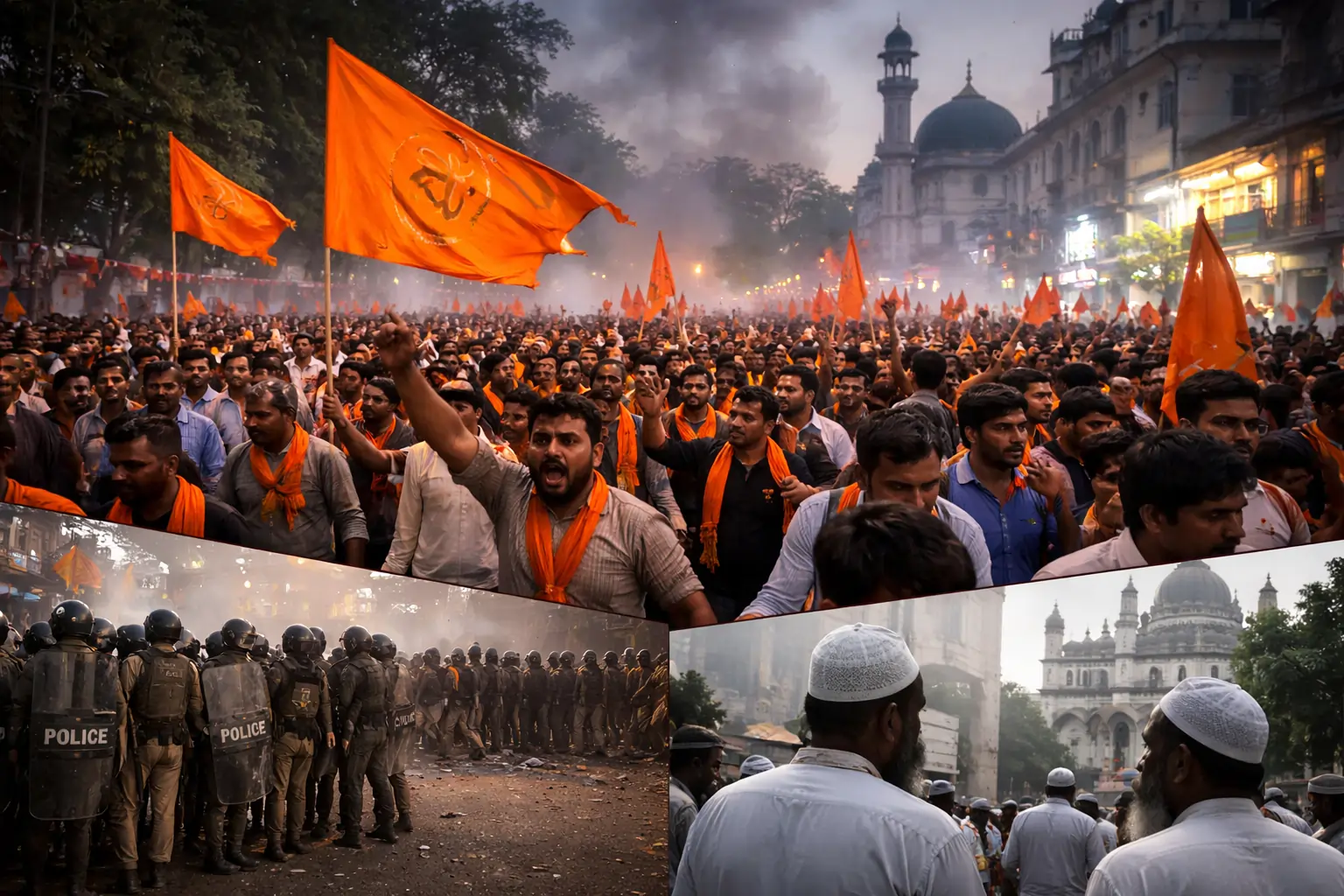

The recent eruption of communal tensions in Telangana, Madhya Pradesh and Karnataka show a disturbing pattern of political motives rather than a mere law and order failure. No doubt police played its role to prevent loss of life in Hyderabad, Bagalkot and Japalpur, but disputes over mosque proximity triggered by the Hindu mobs suggest a deeper, more political strategy. These flares of identity-based conflict and communal violence are used as tools to carve out political space in the complex tapestry of Indian democracy, ultimately failing the traditional governance narratives.
The South Indian Frontier and the BJP’s Strategic Deficit
The Vindhyas have served as a formidable political barrier for the Bharatiya Janata Party (BJP). The BJP dominates the Northern Hindi belt and has a presence closer to none in the Southern states of India. Moreover, the south is a bastion of regional identity and ruled by Congress-led secularism. To gain a political space in the states like Telangana and Karnataka, the BJP cannot rely on the developmental promises, rather it desires to create a communal environment as it used to do in its dominated states. It is observed that when the BJP fails to win on policy then it often pivots toward saffron social engineering. It does this by fostering a sense of Hindu under threat narrative, with its meek objective to consolidate a monolithic Hindu vote bank.
The recent incidents of violence in the Southern states are centered around Shivaji Jayanti as it serves a perfect catalyst. Also, it is a symbol for extremist militant Hindu nationalism that is being exploited by the BJP. Hindu mobs passed slogans such as “Mandir Banayenge” while passing near a mosque during ramazan. It is a predictable outcome used to frame Muslims as a barrier to Hindu cultural and political expression.
Polarization as an Electoral Multiplier
The Graduate Institute of International and Development Studies has established a link between communal riots and the BJP’s vote bank. Whenever, the BJP opted the path of communal violence, its vote share increased by 2.9% to 4.4% in subsequent elections. In states like Karnataka and Telangana, such a margin is the only difference between being the opposition or forming the government. While using its hawkish rhetoric of Hindu-Muslim divide , the BJP can easily turn the tide from inflation and unemployment to religious honor and national security.
The Death of Secularism and the Rise of the Monolith
The ultimate victim of the BJP’s political maneuvers is secularism. The transition from Mahatma Gandhi and Dr Ambedkar’s secular thought to Savarkar’s Hindutva extremism, the state is being achieved through these instances of communal violence.
The goal of the BJP is to render secularism from the South while exploiting Dalits, OBCs and minorities. They are trying to dismantle the regional power structures by forcing a choice between religious identity and civic identity.