



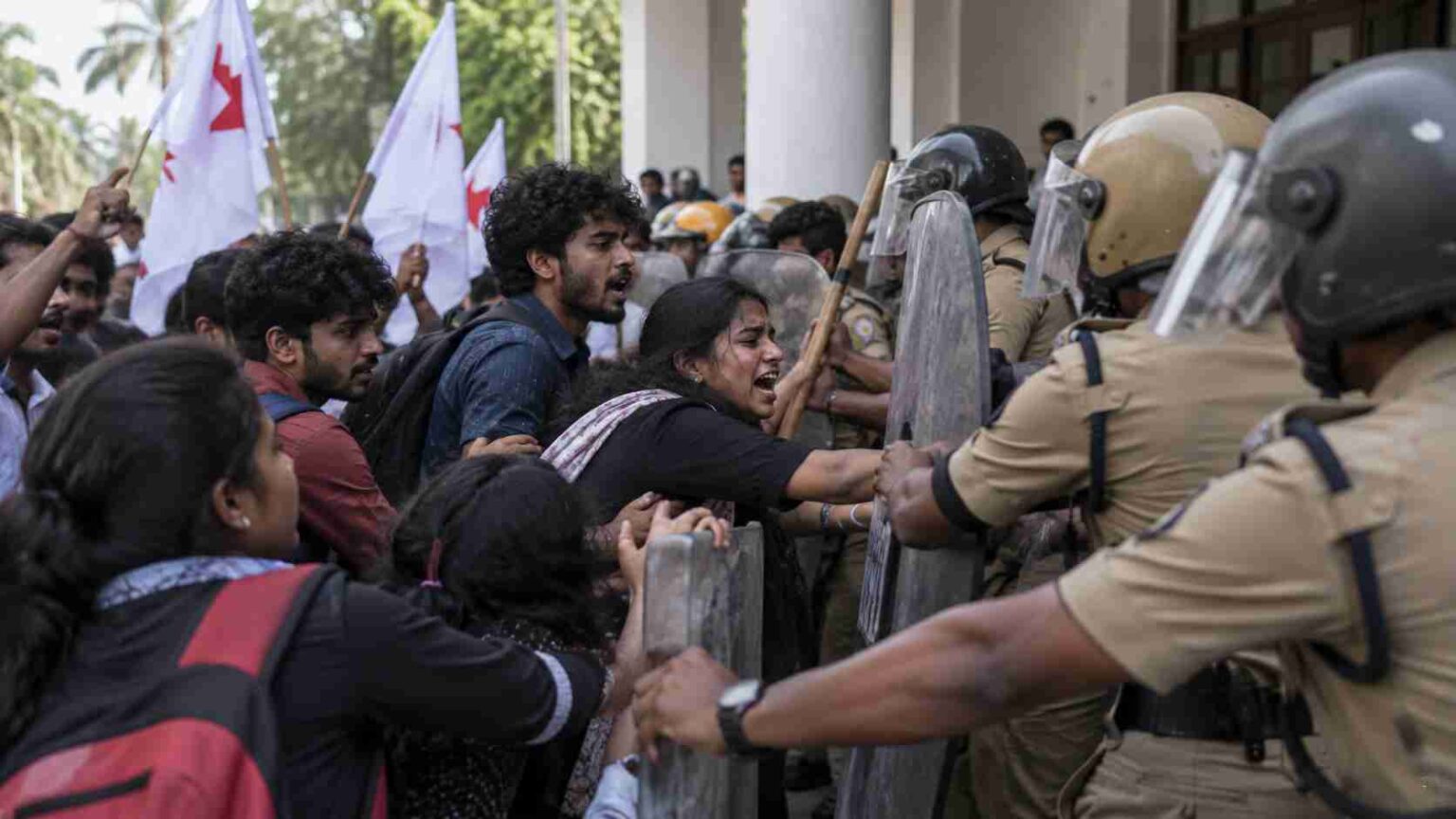

Nobody plans to get hurt on a Tuesday afternoon over a seminar invitation. That is still what happened in Kasaragod.
On 6 October, students at the Central University of Kerala walked toward a hall where a two-day programme was marking 150 years of Vande Mataram. Sahitya Akademi was on the banner. So was Akhil Bharatiya Sahitya Parishad. So was the university. Inside, the keynote was to be given by J. Nandakumar of Prajna Pravah, a body tied to the RSS. Outside, students from SFI, AISF, NSUI and MSF shouted “RSS go back.” They said the campus was being used. Police stopped them at the door. In the crush, four students were injured.
If you have studied in a place like that, the scene is not hard to picture. Notices go up. A famous song is named. The speaker’s other address is left in smaller print, or not mentioned at all. By the time the chairs are set, the argument has already been decided for you. Some students sit through it. Some stay away. Some decide the only honest reply is to show up and say the name everyone else is stepping around.
The chant was rough. Campus chants usually are. It did not say the song should be dropped from the country’s memory. It said an RSS-linked speaker should not be the person explaining that memory on their campus. Those are different sentences. Later, the protest was retold as an attack on Vande Mataram itself. That retelling is convenient. It turns a quarrel about a guest list into a quarrel about loyalty, and once loyalty is the charge, the bruises matter less.
They should matter. Four students went home hurt. The programme, from what has been reported, went on. A university can defend its invitation. It can argue that Prajna Pravah has a right to be heard, that Sahitya Akademi’s name keeps the event within bounds, that protest must stop at the door. All of that can be said in a calm voice. What cannot be said honestly is that the students were fighting a song, or that their anger came from nowhere.
Most of them will be back in class. The banners will come down. The speaker will have spoken. What remains is the ordinary feeling that the hall was never really open to them, only open in front of them. People do not always put that feeling into careful prose. Sometimes they put it into a shout, and then into a shove, and then someone gets injured and the story hardens around the shout.
The fairer version is smaller. They knew the song. They did not accept the company. They paid for saying so with a police line and, for four of them, with injuries. A campus that cannot hear that without renaming it treason has already chosen a side.
