



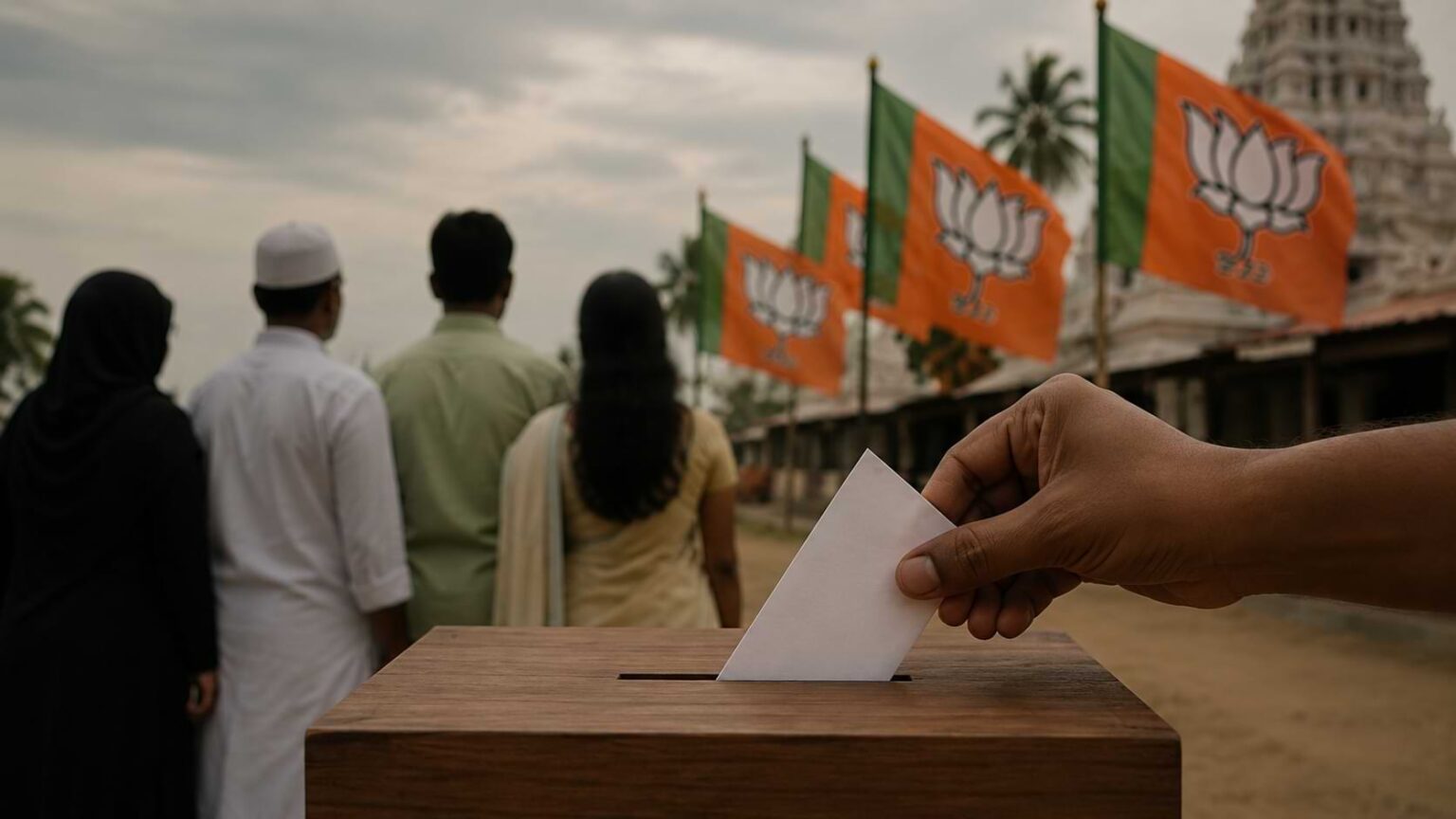

The presence of high literacy rate and cohesive culture has made Kerala non-responsive to the majoritarian politics witnessed in the rest of India. Yet, the BJP keeps on pursuing its soft Hindutva strategy through cultural nationalism, temple politics, and alliances with the aim of consolidating the Hindu votes without totally alienating the other sections of the population. In the view of its critics, such strategies have been counterproductive for marginalizing the minorities and failing to woo the Hindu voters in Kerala.
BDJS Alliance: A Failed Strategy of Harnessing Hindu Unity.
The strategy used by BJP in Kerala state is that it attempts to affiliate itself with Bharath Dharma Jana Sena (BDJS), which is a Hindu caste known as Ezhavas.
Proponents see this as a sensible strategy. Critics argue that this is nothing but a strategy of exploiting the Hindu caste system through the guise of promoting “Hindu unity.” The BDJS alliance hasn’t been particularly successful either. Some leaders of BDJS have shown themselves to be independent of the BJP, and the Ezhava community itself is highly splintered. There are many who vote for LDF or UDF.
Instead of forming a solid Hindu front, the alliance has served to bring to light the differences within. This is because in a state where the Hindu population forms 55% but are fragmented in terms of caste and ideology, such an attempt has not succeeded in translating their cultural appeal into political success. The BJP vote share remains between 11-12% in assembly elections.
Islamophobic Constructs and Minorities’ Social Marginalization
The opposition claims the rhetoric and stories propagated by certain members of BJP contradict the pluralism of Kerala in terms of promoting Islamophobic constructs which include increased propaganda of ‘love jihad’, demography manipulation stories, and appeals such as the one for “Elect Hindu MLA.” In Guruvayur, a prominent temple city, BJP candidate B. Gopalakrishnan was accused of being subjected to criticism owing to his flex boards and messages emphasizing that there is no “Hindu MLA” in recent decades and requesting people to elect a Hindu MLA.
This type of discourse, according to its detractors, paints Muslims as dangerous or “other”, a trend that is common to the nation, yet finds few takers in the educated and cosmopolitan society of Kerala. Muslims (who constitute about 27 percent of the state population) and Christians (about 18 percent) constitute significant vote banks which have traditionally voted for the UDF or LDF out of a sense of security and well-being, and due to their secular governance. When BJP goes down the road of using this rhetoric during election campaigns, it runs the risk of uniting minority voters against it.
Kerala’s Pluralistic Society: An Unfitting Environment for Hindutva Experimentation
The very nature of Kerala’s social environment – one molded by its history of trade, reform movements, education and communal existence – is one that makes the imposition of external Hindutva models difficult. While in other states religious divisions prove more profitable for electoral gain, in Kerala, overt communalist politics often leads to voter backlash.
Hindu communal experimentations in a state that has been historically known for its strong communist ideology focusing on class and caste rather than religion and has had a long history of composite festival celebrations, has proved to be futile and problematic. Such experiments have only served to further alienate the minority population and, instead of helping to build a stronger base for the BJP, have led to the strengthening of the already existing preference of minorities towards the UDF.
Kerala Assembly Elections of 2026 & “Elect Hindu MLA” Campaign
The Kerala Legislative Assembly Elections of 2026 offer a classic example of this phenomenon. As it turned out, during the election campaign some BJP candidates, particularly those campaigning in Guruvayur, used “Elect Hindu MLA” campaign slogans as well as religious symbolism. It met heavy criticism for politicizing a community-oriented society by using the terms of communal division. Legal complaints were filed, and this topic was extensively covered by the media.
Despite the fact that the BJP managed to win some support from the part of Hindu community, overall results indicated that minorities, as well as secular-minded Hindus, consolidated around the UDF. So, it seems that such a campaign strategy had the opposite effect.
A Strategy in Need of Rethinking
The efforts by BJP to pursue soft Hindutva in Kerala through the formation of the BDJS as well as cultural and linguistic mobilizations have resulted in some organizational success and sporadic electoral successes for the party. At the same time, it appears that it is both isolating the minority groups and failing to achieve full consolidation of Hindus.The strategies pursued in a region famous for its pluralistic nature have the danger of inviting backlash in the long run. For sustainable growth, a shift towards development and governance issues might be necessary.
