


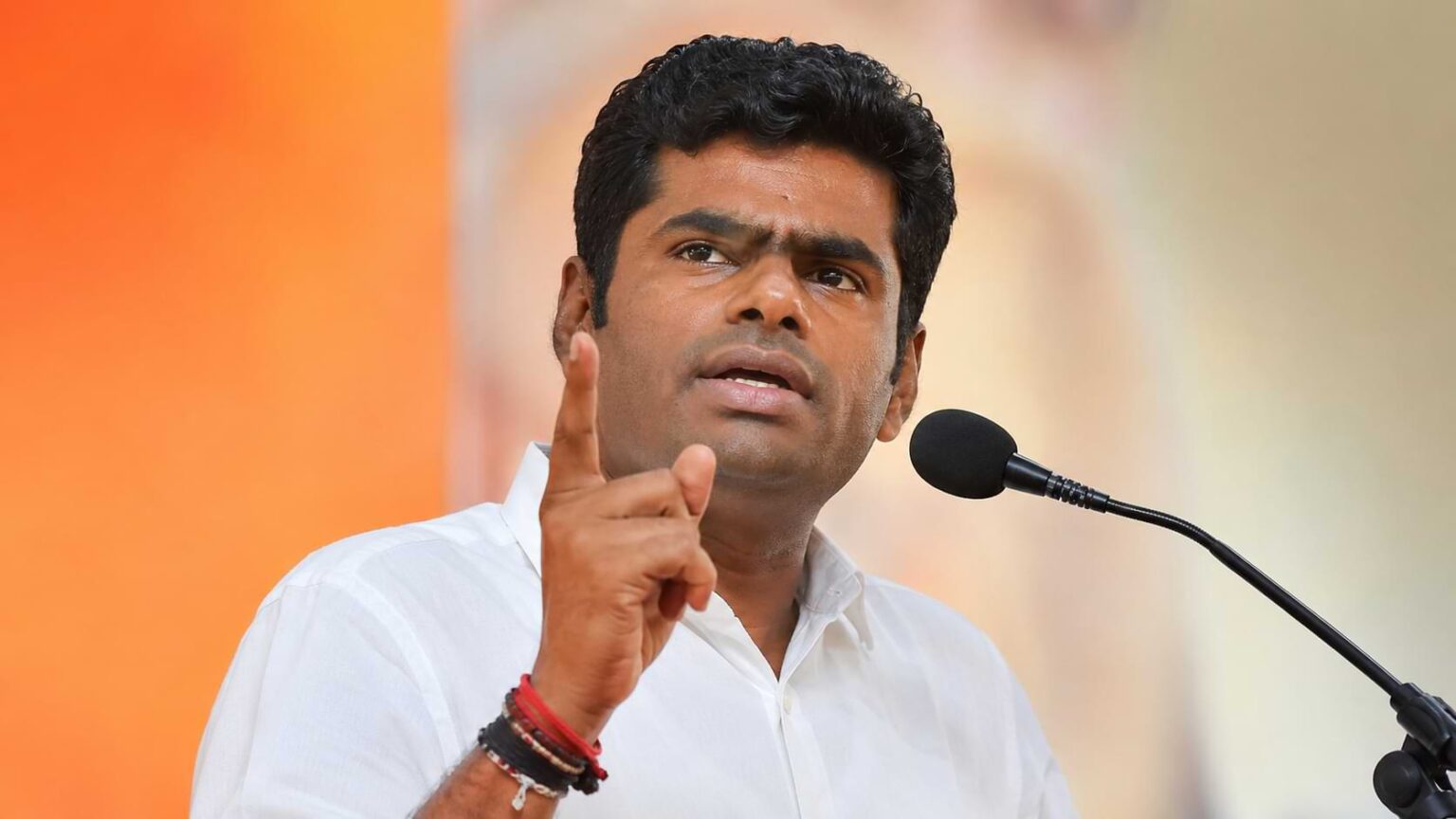

K. Annamalai’s defection from BJP has rattled the political landscape of Tamil Nadu. Is he starting a new party or a people’s movement? Discuss the implications for the future of Tamil Nadu’s politics.
The state of Tamil Nadu has witnessed a political earthquake. Tamil Nadu has experienced a political earthquake. Tamil Nadu’s politics could well be undergoing the biggest change in years. Rumors have been swirling around in the state regarding the former chief of the BJP in Tamil Nadu, K. Annamalai, who is allegedly planning to quit the BJP and form a new political party or a mass movement.
Annamalai was considered to be the BJP’s most prominent face in Tamil Nadu for years. He was widely seen as the party’s long-term bet on a state where the BJP has not been able to make a dent in the polls, and is noted for his direct approach and aggressive campaigning.
Questions are now being raised on political platforms: Does his next step have the potential to change the political landscape in Tamil Nadu?
The BJP-AIADMK Alliance: The Turning Point?
According to multiple sources, there was some friction following the BJP’s return to politics with the AIADMK in advance of the 2026 Assembly polls in Tamil Nadu.
Annamalai was in the process of carving a niche as an alternative option to both DMK and AIADMK for years. His political identity centered on opposition to the traditional parties of the Dravidian movement in the state. Thus, the BJP’s focus on alliance politics reportedly caused disagreements on strategy, leadership autonomy and direction of the party in the state of Tamil Nadu. Political watchers believe that the partnership could have eroded some of Annamalai’s room to build an independent political brand.
Was Annamalai Sidelined?
After a number of developments, the speculation became more widespread:
1. He was replaced by the Tamil Nadu BJP president.
2.He was not included in the BJP’s candidates’ list for the Assembly elections held in 2026.
3.He left his poll duty in important seats.
4.Advertisements advocating him for political future started cropping in Tamil Nadu.
Though BJP leaders have refuted the existence of any significant rift in the party, many party supporters have taken these developments as proof that Annamalai’s clout was waning in the party. For many young supporters, Annamalai was a politics that was neither coalition-based nor a politics based on the mobilisation of the masses.
Is this a new party or new people’s movement?
The most interesting part of the going political drama is that Annamalai might not even start a political party now. He may have been able to first build a people’s movement that could later lead to people being mobilized around issues of governance, anti-corruption, youth involvement and the Tamil identity, before eventually being succeeded by a formal political party.
This approach would let him gain traction at the grassroots level and without the urgency of a national election. Assuming this is the case, it would be following the pattern of political experiments that have succeeded elsewhere in India where social movements have become full-fledged political parties.
The Vijay Factor: A New Political Reality
Actor-politician Vijay is also one of the major reasons for the shift in the political equation. Vijay’s rise to a popular status has shown Tamil Nadu citizens are eager for other choices apart from the DMK-AIADMK equation.
Annamalai may feel that the political atmosphere in the state is changing, and new leaders and political directions are getting space. His success in the rise of new political factions may have motivated him to pursue an independent route.
Is it possible for Annamalai to overcome the Dravidian giants?
This is still the largest question. It’s simpler to build a movement than a statewide political machine. Political parties in Tamil Nadu are very old and have established their organizational roots for many years.
But Annamalai has several advantages:
•
Strong name recognition.
• A devoted following of young people.
• Administration credibility having been a former IPS officer.
• A major social media presence.
The election of the first non-white President has resonated with first-time voters who are looking for alternatives. The challenge will be to turn popularity into something more sustainable i.e. a political organisation that can challenge elections across Tamil Nadu. National media political reporting and election analyses.
The conclusion is that the beginning of the next political chapter in Tamil Nadu is beginning. What is becoming more clear in Tamil Nadu politics is that of a transition period, be it a new political party or a people’s movement that K. Annamalai is hoping for to launch.
The contest was for years a battle between the entrenched Dravidian groups. New actors, new stories, new dreams are changing the debate today. Amid his projected move, 2026 could be considered not just an electoral year, but the year that marked the start of a new political era in Tamil Nadu. Over the next few weeks, Annamalai may turn out to be yet another rebel or the leader of the next major political wave in the state of Tamil Nadu.
