



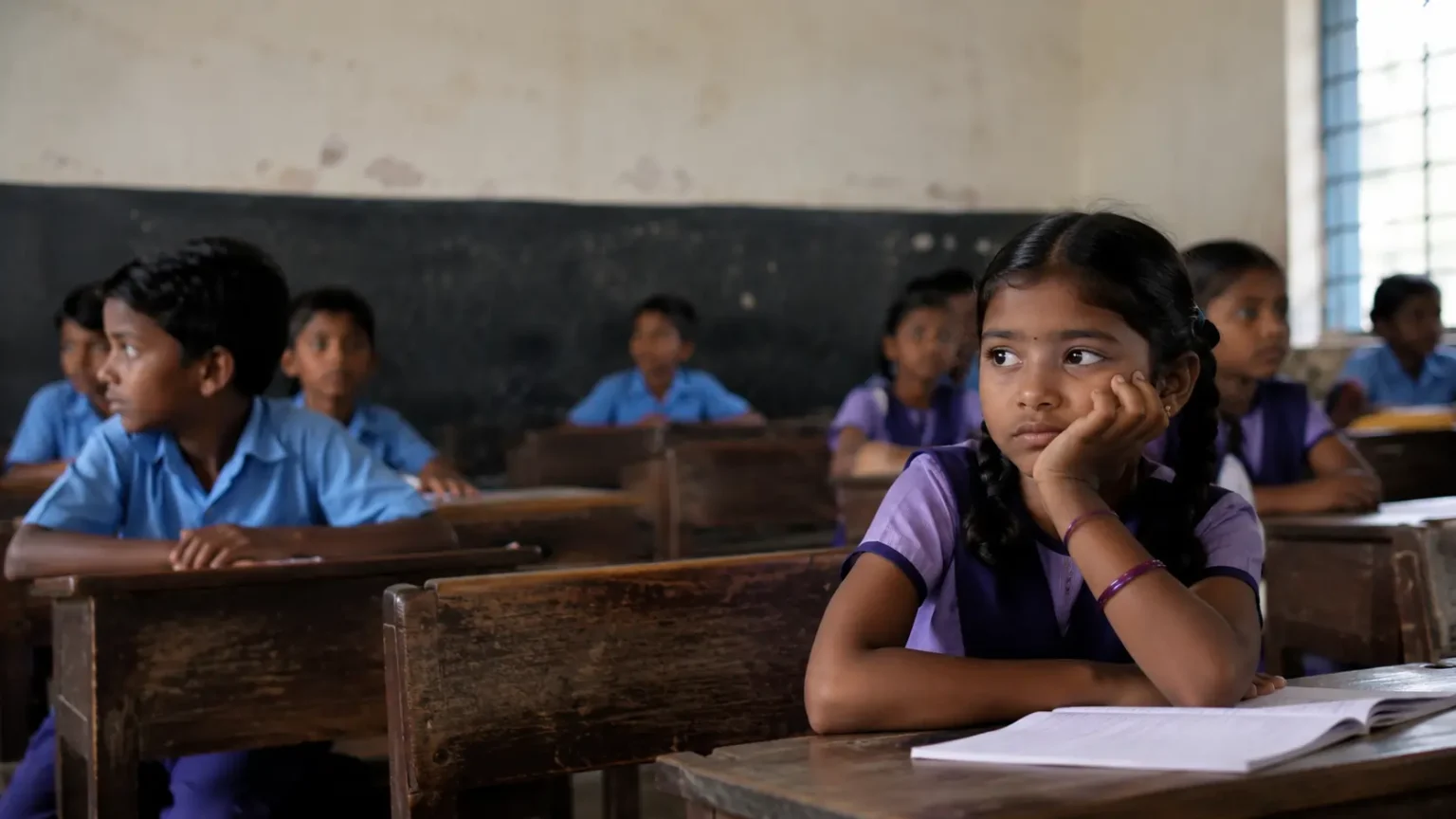

For years, Andhra Pradesh’s government schools carried the dreams of poor families. They produced engineers, teachers, civil servants, and first-generation graduates. In many villages, the government school was not just a building. It was the only bridge between poverty and mobility.
- That bridge is now weakening.
- This belief has become politically powerful.
- But the real issue goes deeper than language.
- The result is visible in classrooms across the state.
- This is not the fault of students.
- In tribal and interior regions, the situation becomes even more serious.
- Technology cannot replace educational stability.
- The gap is widening every year.
- This divide becomes visible after Class 10.
- The emotional impact is rarely discussed.
- Teachers also face pressure from every direction.
- Policy inconsistency adds another problem.
- Students become subjects of political experimentation.
- The irony is painful.
- The consequences are now visible.
- This perception may become the biggest crisis of all.
- That creates a dangerous cycle.
That bridge is now weakening.
Across Andhra Pradesh, government schools face a slow but deep crisis. Enrollment is falling in many areas. Teacher shortages continue to grow. Rural schools struggle with basic infrastructure. At the same time, political battles over English-medium education have changed the debate around public schooling itself.
The problem is no longer hidden. But it is rarely discussed with honesty.
The biggest shift is happening in public perception. Many parents no longer trust government schools to secure their children’s future. This fear is changing the education system from the ground up.
Private schools are expanding aggressively across Andhra Pradesh. Even low-income families now prefer budget private schools over nearby government institutions. Parents often pay fees they cannot afford. Some take loans. Others cut household spending. But they still send children to private schools because they believe English education guarantees opportunity.
This belief has become politically powerful.
In recent years, Andhra Pradesh saw intense debates over English-medium education in government schools. The state government argued that poor children deserve English education just like rich children. Supporters called it a progressive reform. Critics accused the government of weakening Telugu language identity.
But the real issue goes deeper than language.
English-medium instruction alone cannot fix structural problems inside public education. A classroom changes little if teachers remain overworked, undertrained, or absent. A school does not improve simply because the signboard changes from Telugu to English.
In many rural schools, teachers themselves struggle to teach advanced subjects in English. Students often memorize sentences without understanding concepts. This creates another layer of inequality. Urban children with private tuition adapt faster. Rural children fall behind silently.
The result is visible in classrooms across the state.
Children can read English words. But many cannot fully understand what they read. Teachers rush through lessons. Students depend on memorization. Real comprehension weakens.
This is not the fault of students.
It is the outcome of an education system trying to deliver rapid transformation without enough preparation.
Teacher shortages have made the crisis worse. Many government schools operate with limited staff. One teacher may handle multiple classes. Subject specialists are often missing in smaller schools. Science and mathematics education suffer heavily because trained teachers avoid remote postings whenever possible.
In tribal and interior regions, the situation becomes even more serious.
Some schools lack proper toilets. Others face poor internet access despite promises of digital learning. During monsoon seasons, attendance drops sharply in remote villages because transport becomes difficult. Girls are affected the most. Many eventually leave school altogether.
Yet official narratives often focus only on infrastructure announcements and tablet distribution schemes.
Technology cannot replace educational stability.
A smart classroom means little if students lack basic reading skills. Tablets do not solve the deeper issue of learning inequality between rural and urban Andhra Pradesh.
The gap is widening every year.
Urban students increasingly access coaching centers, online resources, English-speaking environments, and private mentorship. Rural government school students compete in the same exams without those advantages. The education system claims to offer equal opportunity. In practice, the outcomes are deeply unequal.
This divide becomes visible after Class 10.
Students from elite private institutions dominate engineering admissions, medical entrances, and national-level competitive exams. Government school students remain underrepresented despite welfare programs and reservation policies.
The emotional impact is rarely discussed.
Many children from government schools grow up believing they are already behind. They enter colleges with weaker communication skills and less confidence. The system quietly teaches them that quality education belongs to somebody else.
Teachers also face pressure from every direction.
Government teachers are frequently assigned non-academic duties. Election work, surveys, welfare verification, and administrative tasks reduce classroom focus. At the same time, teachers face growing public scrutiny and political pressure.
Some still work with extraordinary dedication. In several villages, individual teachers continue to transform lives despite weak systems. But education cannot survive on personal sacrifice forever.
Policy inconsistency adds another problem.
Every new government introduces new schemes, new slogans, and new educational priorities. One administration pushes digital classrooms. Another focuses on language reform. Another restructures schools. Long-term continuity disappears.
Students become subjects of political experimentation.
Meanwhile, Telugu language education itself has entered a strange phase. Parents increasingly see Telugu-medium education as economically limiting. English has become associated with status, mobility, and modernity. This creates cultural anxiety across the state.
The irony is painful.
A generation is slowly losing confidence in its own language while still struggling to master English fluently.
The debate should never have been Telugu versus English. Successful education systems across the world protect native language learning while also teaching strong English skills. Andhra Pradesh turned the issue into a political battlefield instead of an educational strategy.
The consequences are now visible.
Government schools are no longer seen as aspirational spaces. For many families, they are treated as a last option.
This perception may become the biggest crisis of all.
Once public trust collapses, rebuilding it becomes extremely difficult. Middle-class families leave first. Then political accountability weakens because influential groups no longer depend on government education. Public schools slowly become institutions only for the poorest citizens.
That creates a dangerous cycle.
When the rich and middle class abandon public education, investment quality often declines further. Inequality hardens across generations.
Andhra Pradesh still has time to reverse this trend. But reforms must move beyond slogans.
Schools need stable staffing. Teachers need training and institutional support. Rural infrastructure needs long-term investment. Learning outcomes must matter more than publicity campaigns. Language policy should focus on bilingual competence instead of ideological battles.
Most importantly, the state must restore dignity to government education.
Because when public schools weaken, social mobility weakens with them.
And when education stops functioning as an equalizer, inequality stops being temporary. It becomes permanent.
