



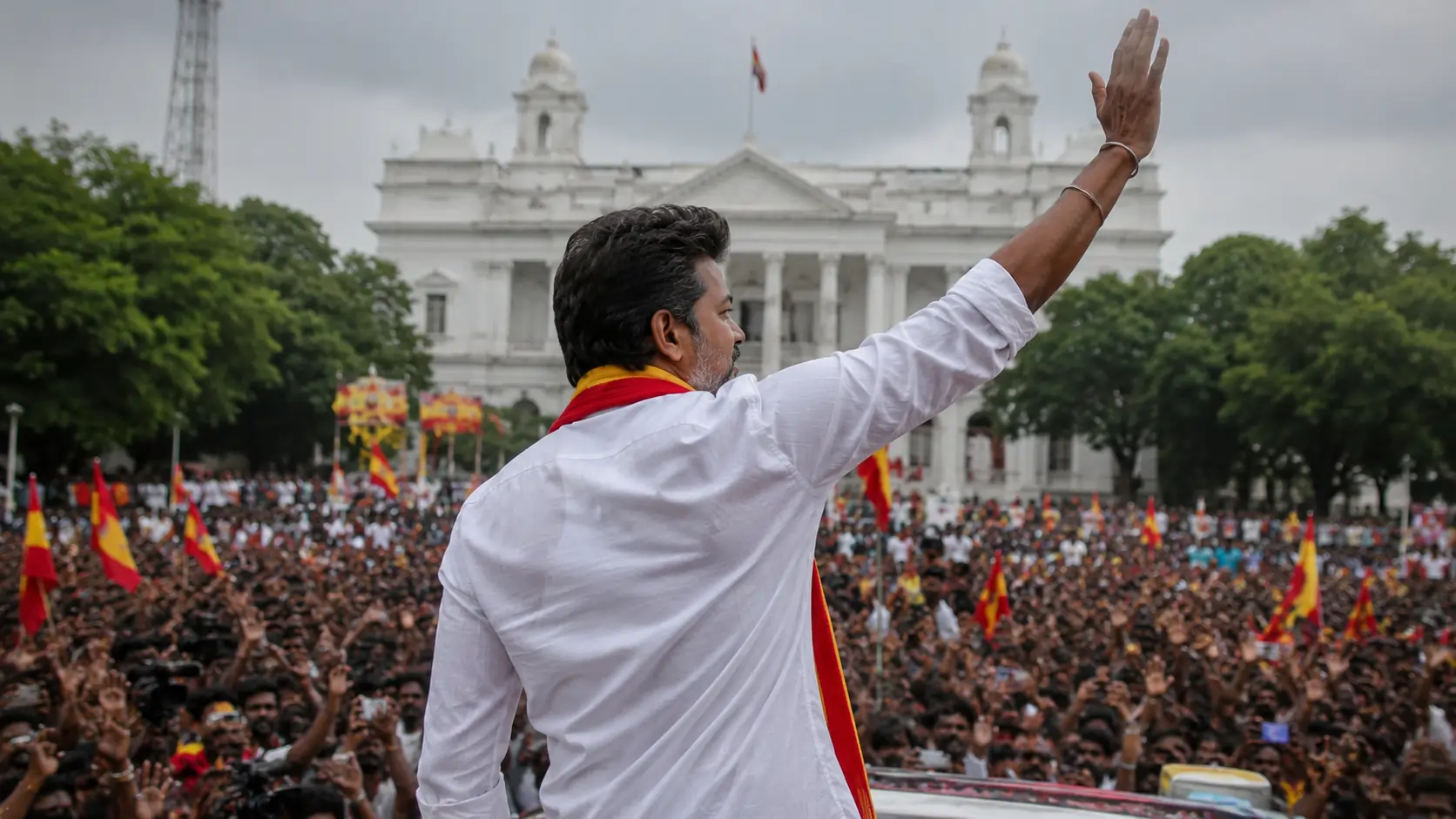

As the counting commenced on May 4, 2026, across South India, the story that became clear was that of the saffron surge of BJP being stopped dead at the feet of Vindhyans. Early results from Tamil Nadu indicate a clear victory for Vijay TVK with a tally of ninety seats; the DMK government remaining untouched, while the BJP supported AIADMK is left humiliated. Congress-led UDF is clear in its majority in Kerala. In Tamil Nadu, a staggering turnout of 85.1% was reported-a record turnout for assembly polls. This high participation was not due to BJP’s fan base in Tamil Nadu; rather, it was the people of Tamil Nadu coming out in numbers to vote against all that the Modi-Shah government stands for.
Three Rejections of Tamil Nadu
Tamil Nadu elections of 2026 went beyond being a competition between DMK and AIADMK; it turned out to be a vote for accepting or not BJP’s conception of India. Early reports about TVK’s victory in 101+ seats speak of much more than new political player’s success. The ideology of Vijay’s party was formulated explicitly as being ideologically against the BJP and called the saffron party an “ideological opponent,” contrasting it to DMK that was described as merely a “political opponent.” During the Vikravandi conference of October 2024, where eighty thousand people took part, Vijay declared the ideology of the party to include secular social justice, support for a two-language policy, egalitarianism, and democracy, positioning TVK as centre-leftist party inspired by the ideology of Ambedkar, Periyar, and Kamaraj. TVK rejected any form of right-wing policies. Vijay’s call for abolition of NEET and restoration of education back to
State List in July 2024 was not an election strategy but the voice of Tamil Nadu against centralized rule that was destroying Tamil youth by exam- induced suicide. His allegation of BJP encroaching upon state rights and insulting Tamil people’s self-respect was an echo of 75 years of Tamil struggle against North Indian dominance. His refusal of BJP’s offer of 90 seats and Chief Ministerial post proves that in Tamil Nadu saffron equal’s political suicide.
Ideological Support for Tamil Culture
The TVK party’s impressive performance in initial trends is not only due to celebrity power. The emergence of new political groups indicates that even in its ideological transformation, Tamil Nadu requires them to identify as the guardians of Tamil culture and identity against the centralization of power by the Indian capital. As Prof. K John Sundar put it: “This election will test how well the Dravidian model survives, gauge the extent of BJP’s reach in Tamil Nadu, and measure the electoral success of star power in governance.”
The answer seems pretty obvious – the politics of linguistic pride, social justice, and anti-Hindi sentiment are intrinsic to Tamil Nadu. Vijay won because he successfully fit into that paradigm – as a guarantor of Tamil identity against BJP’s aggression. He used his Tamil identity and administration without taking on AIADMK to avoid offending Dravidian voters while simultaneously standing strong against BJP.
There is ideological sophistication in Tamil Nadu regarding issues like social justice, centre-state politics, linguistic and cultural identity, etc. Both DMK and AIADMK have their political ideology and are regarded as Dravidian parties representing the legacy of the movements that opposed discrimination against low-caste people, fought for reforms, and refused to be governed by the North Indian parties who brought Hindi language and upper-caste Hindu culture to South India.
Pattern in South India
BJP’s rejection in Tamil Nadu is not an exception but South India’s continuing saffron defiance. In Kerala, UDF dominates with BJP having no relevance to speak of after decades of organizational efforts. In Karnataka, where BJP had once won elections, there is growing disenchantment. BJP is marginal in Telangana and Andhra Pradesh as well.
The common factor is contribution vs. representation. South India contributes around 31% of GDP with just 20% of its population. Tamil Nadu accounts for 8.93% of India’s GDP, pays Rs 89,000 crore as GST, and gets Rs 45,000 crore as rebate (50%). Uttar Pradesh paid GST of Rs 55,000 crore but received Rs 1.1 lakh crore (200%), Bihar paid Rs 18,000 crore and got Rs 54,000 crore (300%) rebate. South Indians finance the failures of the North via GST and subsequently see BJP’s delimitation plan cutting their representation as a punishment for their population control. For example, Tamil Nadu will lose its representation in Lok Sabha from 7.18% to 5.6% and 13-14 MPs; whereas, UP will get 63 more seats. This economic and political dynamic is the reason why South India rejects BJP.
Hindi Imperialism Never Dies
Modi government accused by Stalin for denying financial assistance to Tamil Nadu, making elections into a contest between Tamil Nadu and New Delhi by exploiting the nerves of Tamil Nadu-the most sensitive one of all-the agitations of 1965 against Hindi-resulting in 70 deaths and several immolations. This agitation gave birth to the supremacy of Dravidian politics that continues to this day. Announcing Hindi as the unifying language, giving preference to forms in Hindi, addressing in Hindi belt rallies, the message to Tamilians is clear-linguistic imperialism.
TVK’s explicit declaration about supporting the two languages-Tamil and English but not Hindi-fit right into the identity of Tamil Nadu. Vijay understood something that Palaniswamy did not-the defense of Tamil language is neither a political choice but an obligation. Vandalizing Metro Hindi signs on May 17 was nothing but an expression of sovereignty.
The Verdict Given by People of South India
As the count progresses May 4, the trend is clear. South India said “no” to BJP’s ideology-the hegemony of Hindi language, North’s burgeoning population gaining clout, fiscal wealth shifting from South to North, educational policies that kill children, Governor’s sabotage of government initiatives, and homogenization that destroys distinctiveness.
With 85.1% voting turnout, TVK bagging ninety seats, DMK retaining seats, humiliating defeat of AIADMK-BJP alliance, Tamil Nadu showed that when economic powerhouses have to choose between fiscal independence and ideological subjugation, linguistic superiority versus imposition of Hindi, regional distinctiveness versus saffron homogenization, they would go for defiance. They opt for Tamil identity in preference to Hindutva, federalism over centralization.
While BJP increased their tally from 20 to 27 in Tamil Nadu, expansion was meaningless in terms of irrelevance of the party whose politics was dominated by the North, whose attitude toward contribution of South was patronizing, and whose attack on linguistic- cultural diversity was soundly defeated. May 4, 2026-South India reaffirmed its 74 year-old message- saffron politics ends at the Vindhyas, and nothing can replace ideological commitment with organizational muscle.
