



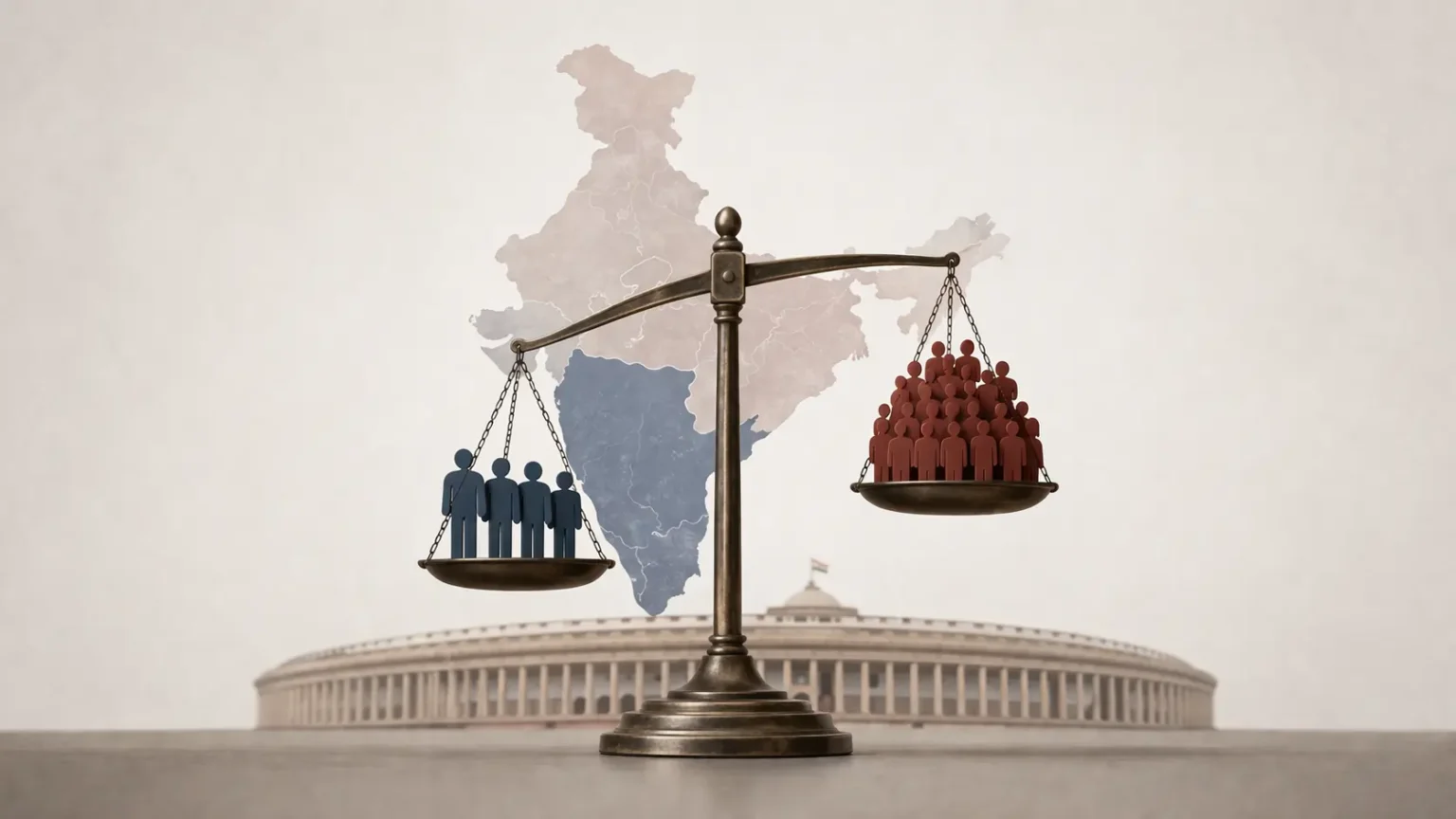

The exercise of delimitation appears to be a purely technical one that attempts to match up representation in Parliament with population demographics. This might seem like a rational process on the surface. But in truth, the upcoming controversy over the issue of delimitation marks out perhaps the biggest rift in the Indian democracy, where states which did their job of governing well, keeping population growth in check, and spending on public welfare will be politically marginalized precisely because they did the right thing.
That is why the concerns in South India about the situation are very real and not mere provincial paranoia.
Over many years, the southern states of Tamil Nadu, Kerala, Karnataka, and undivided Andhra had been focusing on health care, female literacy, family planning, and overall social development to a greater degree. These accomplishments did not occur by accident. It was policy making and successful administration. The fact is, if the process of delimitation today takes place primarily according to the criterion of population, then the tragic irony will be evident: those states which reacted better to the objectives of national development may lose their political clout, whereas states that traditionally have had a higher population growth rate will benefit.
It is not just demographic mathematics. It is political retribution for success in governance.
The crux of the problem lies in the distinction between equality and justice. Any number-counting approach to redistricting can argue that it reflects the democratic value of “one person, one vote.” India is not only a democracy of masses; it is also a federal union of states. It cannot be assumed that representation is about mere numbers when the historical experiences of those numbers in matters of governance, development, statehood, and adherence to national imperatives vary so greatly. When the South, which has had decades of comparative success in the realms of education, healthcare, economic contributions, and demography, is made to have less say in national affairs, it is clear what is being said: if you govern well, you weaken your standing in the country.
That idea has serious political consequences.
In the age of Narendra Modi, BJP’s political, administrative, and symbolic centralization has become the norm. In this context, delimitation is no longer a mere constitutional exercise in the South. It is part of a broader long-term political game. The worry among those opposed to the move is that the population-based reallocation of seats to the Lok Sabha might serve the purpose of benefiting geographical areas from where BJP can gain further ground, whereas southern states which have been traditionally hostile to the party’s political and ideological agenda would be at a disadvantage.
It is beside the point whether the government openly accepts such intentions or not. Perception is all important in politics, and that is precisely what is happening in the South now.
It is important because there is an existing sense of inequality among the southern states within the Indian Union. The southern states feel like they pay more taxes than others, are ahead of others in terms of developmental indices, but do not get their due consideration in the Centre politically and fiscally. These complaints have little to do with languages or culture; it is really a matter of recognition. If the southern states are ahead in all these parameters, then why should they have lesser political clout within the Indian democracy?
Constitutional procedures alone are insufficient answers for addressing the question raised above.
A federation cannot merely take all states to be mere statistical entities. There is much more to legitimacy than just representation. To create an atmosphere for cooperative federalism, the Centre must carry all regions with grace and pride. If delimitation results in a scenario in which the Centre feels systematically outnumbered and politically disadvantaged, the consequences will extend well beyond seats.
And once such trust erodes, the effects will be severe. The parliamentary majority may well persist, but democratic belonging will erode at the same time. Citizens from the South can come to feel like subjects in a democracy whose influence wanes not because they did poorly, but rather because they succeeded too well.
Indeed, the question is never going to be about whether delimitation should occur in some capacity or another. The question should always be one of what kind of delimitation India wants. Will India base the allocation of political seats on demography alone, or will it consider outcomes of good governance and the preservation of federal harmony and national unity?
Thus, what is most significant about the criticism of the Modi administration regarding delimitation is not its effect on the composition of parliament. What is important here is what the process means for the evolution of democracy in India as a whole. Has reform been employed to encourage inclusiveness and federal trust, or is it reinforcing majoritarian dominance?
Delimitation, if it turns out to be the mechanism whereby the South is reduced politically even as it gains administrative strength, will not be remembered as a process of reform. Rather, it will be a cautionary tale about how the redistribution of power in modern-day India is no longer about justice, but about control.
Alternatively, here’s the same idea turned into a shorter opinion piece for a news outlet.
