



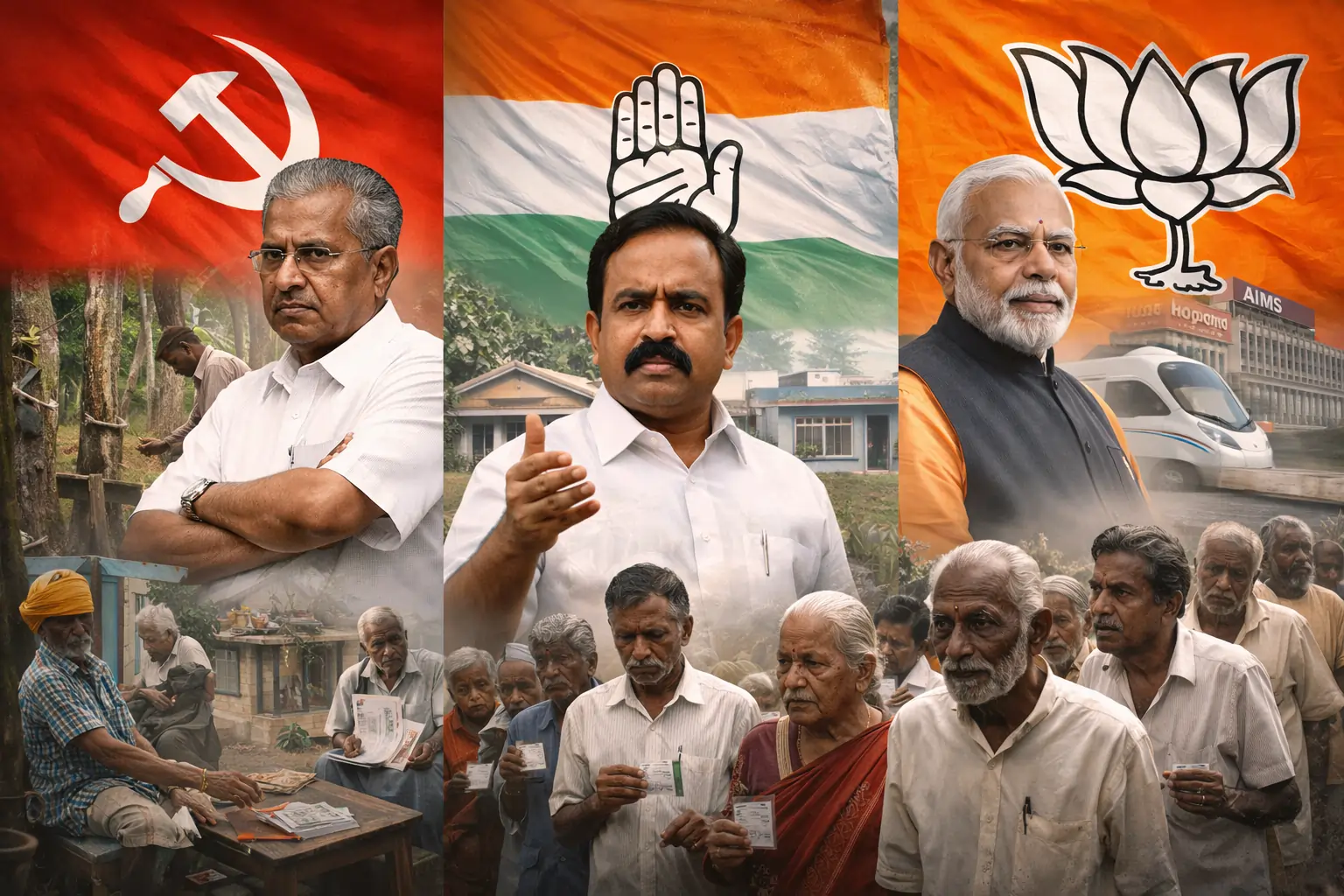

The State elections due on April 9, 2026, brought about a controversy that could spark off a vision conflict in 2026. While NDA, which is led by the BJP, strives to implement its vision of change through the traditional political coalition between LDF and UDF, its national vision contradicts the regional facts that include pension issues, rubber farmers, and poverty.
Universal Increases or Targeted Promises and Welfare Pensions:
NDA committed higher payments for pension, indicating that the elderly voters played an important role in Kerala.
- Increasing welfare pensions to Rs. 3,000 per month for over 60 lakh people. Eradicating poverty by identifying 5 lakh poorest families will increase the pensions with their NYAY scheme, providing additional ₹6,000 per month for the poorest Below Poverty Line families. These measures are described as “Indira Guarantees.“
- NDA will increase pensions to ₹3,000 per month only for women who head poor households, widows, and senior citizens above 70 years. They also plan to provide free water, two LPG cylinders per year, and medical cards. This also reflects that one part of society benefits.
In terms of numbers, these seem similar, but the execution is critical. Others depend on the state-run system. NDA depends heavily on the central government, which is accused of imposing political pressure while providing funds. The literacy rate and social model in Kerala require a consistent and universal approach.
Government Intervention or Patchwork Solutions
Rubber is essential to thousands of farmers in Kerala. The manifestos are worlds apart. LDF and UDF promise a minimum price of ₹300 per kg for rubber. But NDA promises a price of ₹250 per kg with a 5% annual increment by suggesting the conversion of some parts of the rubber cultivation land into tropical fruit cultivation.
Farmers engaged in rubber production have shown their dissent against poor pricing in Kottayam and Pathanamthitta districts over the years. The past assurance resulted in a loss of credibility. The UDF has offered better solutions. The NDA’s proposal of ₹250 per kilogram plus some increment is not sufficient in view of the current market scenario.
Poverty Alleviation and Schemes Against Fiscal Prudence.
LDF bases its manifesto on eliminating absolute poverty through specially designed schemes and affordable housing under the Life Mission 2.0 initiative. UDF focuses on cash transfers to poor households through specially designed plans targeting Antyodaya card holders. But NDA blames the “dysfunctional duopoly” for debt and insufficient capital expenditures. NDA aims at Vikasita Keralam, reducing public sector interference, increasing privatizations, and aligning with centrally funded initiatives like superfast trains and AIIMS hospital.
The emphasis of NDA on anti-corruption politics and developmental initiatives sounds promising. However, the policies seem alien in the context of a welfare-oriented state such as Kerala, despite an increasing level of public debt under the LDF government and restrictions on borrowing by the central government. Despite the BJP’s emphasis on change but also downplays the fact that it is duopoly politics within the region that have created high human development indices of the region.
But there is a considerable number of elderly people in Kerala. LDF’s recent increase in pension from Rs. 1,600 to Rs. 2,000 has earned some credibility, although there have been delays in implementation. The UDF campaign of timely payments and senior citizen departments seems plausible.
The Problem with the Narrative of ‘Change’ :
Rhetoric on change by politicians from the BJP in Kerala always emphasizes the corruption and inefficiency of the political merry-go-round in the LDF and UDF regimes. Infrastructure development, such as a speedy rail service between Thiruvananthapuram and Kannur, is included among other steps taken against corruption. Such initiatives have been tried successfully elsewhere in the nation.
Yet their opponents claim that they bring in foreign notions. For the citizens of Kerala, welfare and health services are valued more than privatization and identity politics. Indeed, the NDA manifesto talks about fiscal prudence and less government interference at great length. There is no doubt that this will appeal to certain sections of people, but it is risky in a state like Kerala.
In short, when LDF and UDF compete in a battle of welfare promises and similar policies, the message of change put forward by NDA seems out of place. Benefits of ₹3,000 pensions, rubber schemes, and poverty alleviation programs dominate the agenda of the region. If the BJP fails to reformulate its message, then it is destined to obscurity in the political arena of Kerala.
