



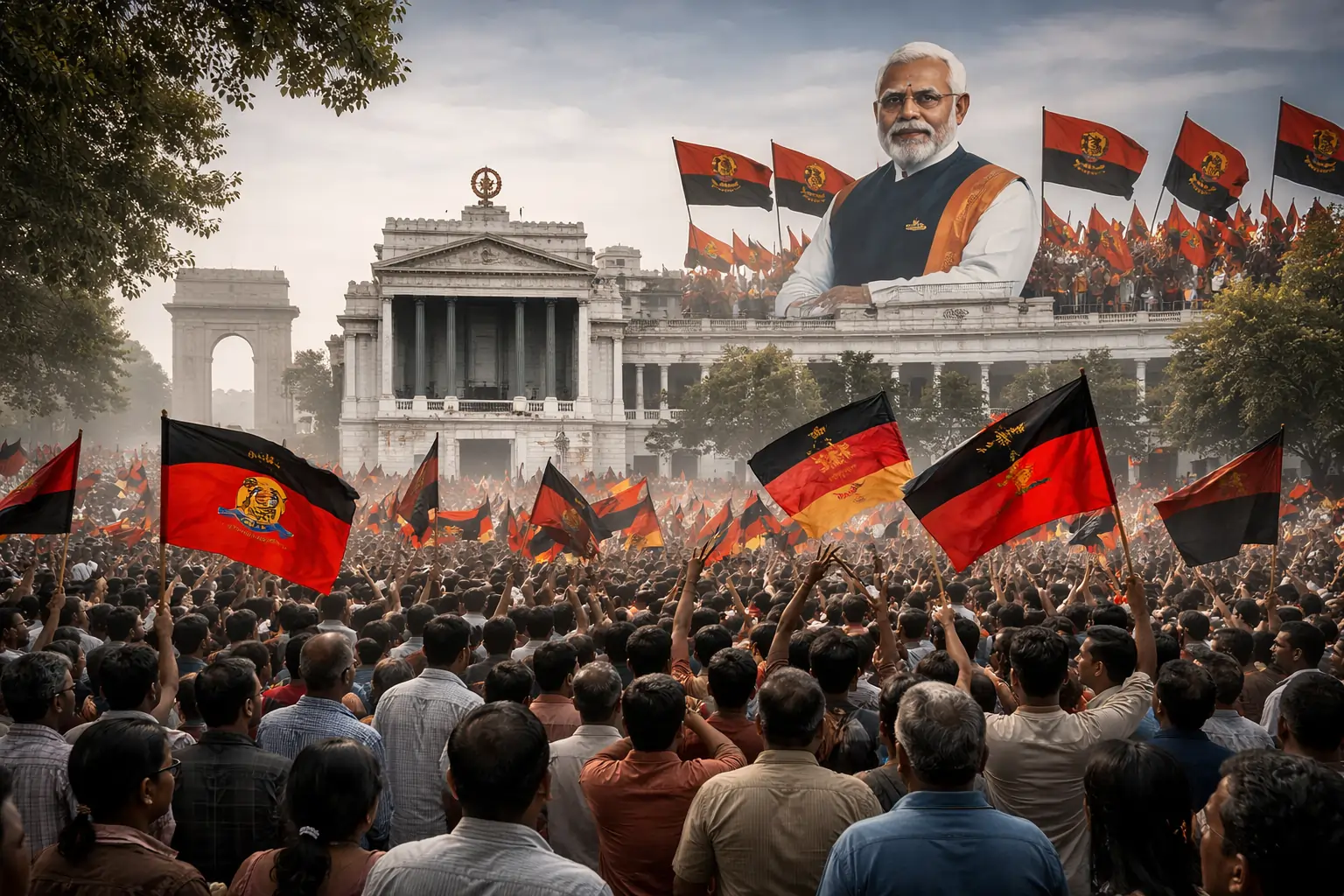

It appears that there lies a certain anomaly at the center of the BJP’s strategy for Southern India. The very party which has managed to capture 303 seats in the 2019 elections and won again in 2024 has been unable to gain even a single seat from India’s sixth largest state according to its GDP. In fact, Tamil Nadu an educated, industrialized, and culturally unique state has shown its disapproval towards the BJP not once, but repeatedly over decades, especially as the 2026 Assembly Elections approach.
This narrative is not only about numbers; it’s much deeper than that.
Numbers Do Not Lie
BJP failed in the 2024 Lok Sabha election contest against the prediction of exit polls that anticipated its winning of 3-5 seats. The INDIA front, led by the DMK, won all 39 seats from the state of Tamil Nadu. Business Today
While BJP’s vote percentage jumped from a mere 3.66 percent in the 2019 Lok Sabha polls to 11.24 percent in 2024, it has still ended up losing deposits in ten seats. A political party claiming to represent all of India fails miserably to win over even the bare minimum voters in a state of 77 million.
K Annamalai, who heads the BJP in the state, had boasted that BJP will get 25 percent of the votes. But in actuality, it punctured a big hole in BJP’s argument that it has emerged as an alternative to the DMK. Senior BJP leaders, including Union Minister L Murugan, ex-Union Minister Pon Radhakrishnan, and ex-Governor Tamilisai Soundararajan, were defeated. The very face of the BJP, Annamalai himself, lost in Coimbatore to an unknown DMK candidate by over 1.18 lakh votes. The result was not even close; it was a demolition.
The Language War: Culture War Wrapped Up as Policy
There is no question that, when it comes to the Tamil Nadu state’s dislike of the BJP, language takes center stage.
According to the government of Tamil Nadu led by the DMK, the Modi government has been holding back over Rs 2,000 crore designated for the state after the latter refused to implement the three-language model suggested in the NEP. Newslaundry According to the central government, funding will only be provided once the policy is put into effect. Tamil Nadu describes this as blackmail, and most of India ignores it.
CM MK Stalin lashed out at the remarks made by Union Education Minister Dharmendra Pradhan in an uncharacteristic retort, calling him “utterly irresponsible,” as he had accused the Centre of “weaponising” educational grants and withholding illegally Rs 2,200 crore from the Samagra Shiksha initiative. This is no new injury. Tamil Nadu’s opposition to Hindi imposition can be traced back to 1937, when compulsory Hindi education sparked widespread agitation against Hindi led by EV Ramasamy Periyar and his party, Justice Party. It seems like the BJP has not learned anything from this past. On the contrary, it is repeating itself but with money replacing law.
It is far more than a linguistic divide. Under the BJP, there have been new political dichotomies created: nationalists vs. antinationalist’s, Hindi vs. Dravidian, Brahmins vs. Non-Brahmins – all of which pose an existential challenge to Tamil Nadu’s proud history of social justice.
Delimitation: Punishing Success
This second point of contention is no less incendiary in nature perhaps even more so.
Tamil Nadu brought down the fertility rates, made robust institutional gains, and fueled the industry through growth. But all of these will now earn them punishment. Speaking during the joint opposition discussion on delimitation, Kerala CM Pinarayi Vijayan pointed out that the process will result in a big surge in seats for northern states, along with a considerable reduction in the representation in parliament of the southern states which the BJP finds to their advantage since they have more sway in the north. India TV News
The expansion will result in 40 extra seats for Uttar Pradesh (from 80 to 120 seats), but only 63-66 extra seats for five southern states combined, as against 128-131 seats for seven BJP-led northern states.
The mathematics is clear: states that managed their population, educated their people, and made contributions to the government treasury are receiving recognition in the form of reduced political power. To Tamil Nadu, which makes an extraordinary contribution to India’s gross domestic product, it is not democracy but demography that rules.
Federal Squeeze: Delhi Gains, Tamil Nadu Pays the Price
There is also the issue of fiscal federalism. Finance Minister of Tamil Nadu Thangam Thennarasu pointed out that the government had been undermining the fiscal sovereignty of Tamil Nadu by imposing policies that were discriminatory against the state, especially its with holding Rs 2,152 crore from the Samagra Shiksha Abhiyan programme, money associated with Tamil Nadu’s non-adoption of the Ideologically, there is little scope left for the DMK to negotiate with the BJP-RSS to combine. The BJP’s hostile stance towards the DMK, Stalin, and Tamil supremacy will only turn voters away
2026: The Year Of Confrontation For BJP
With Tamil Nadu Assembly elections slated for 2026, the BJP will find it tough to increase its vote share above the current 11 per cent mark and win even the Scheduled Caste votes which have been traditionally untouched by the BJP despite several efforts. Swarajya
The launch of Vijay’s new party, Tamilaga Vettri Kazhagam, introduces an element of uncertainty for the 2026 elections, but the language angle may well prove to be the DMK’s ace in the hole. BJP’s northern strategy that has worked so well till now is ill-fitted for Tamil Nadu centralization, cultural homogeneity.
Till New Delhi starts listening first, before it makes laws, Tamil Nadu will always give the same answer in the ballot box. That would be a decisive ‘zero’.
