



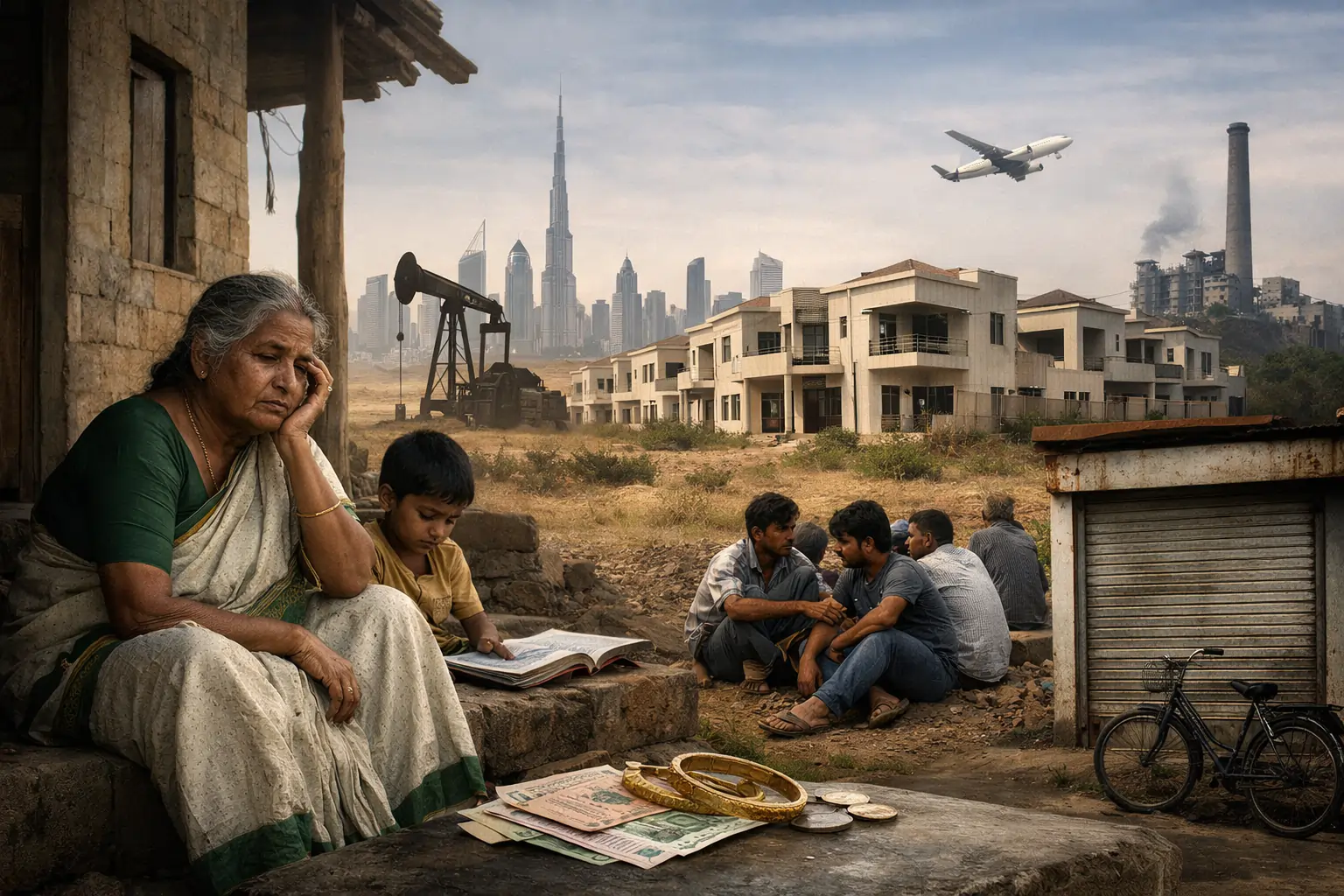

Several million South Indian laborers in Gulf nations like the UAE, Saudi Arabia, and Qatar remit a colossal amount of their earnings to South India each year. In other words, this “remittance money” has become an important part of the day-to-day living and economy of South India. The implications could be dire for South India if there is a reduction in remittances due to reduced oil prices, tightening of immigration rules in Gulf nations, advancements in technology, and wars.
The Scale of Dependence
South India accounts for a substantial portion of all remittances flowing into the country. For example, Kerala alone receives close to 20% of all inward remittances. Remittances account for about 20% of the gross state domestic product of Kerala in recent times. Tamil Nadu receives about 10%, while Andhra Pradesh receives about 4-5%. These resources finance the construction of houses, retail stores, educational institutions, and even basic requirements. Remittances have brought millions out of poverty and stimulated the housing industry and small enterprises. However, dependence has increased on employment elsewhere.
Risks if Remittances Become Less
Should Gulf countries lose their jobs, there would be reduced income among families. There will be reduced sales and construction activities. The real estate industry, whose costs are very high due to remittance cash, may collapse completely. The educated youth will find it hard to secure employment due to the lack of industries created by economic inefficiency. States could experience increased unemployment, rural poverty, and other social challenges, including domestic issues within the country. Even a reduction of just 10-20% would cause a loss of millions of dollars in the area.
The Remittance Conundrum in Kerala
Kerala provides the best instance. Following the oil bonanza in the 1970s, thousands of Malayali migrated to the Gulf countries. Remittances have escalated beyond ₹2 lakh crore in recent years, and even managed to reduce 70% of the state’s debt within a single year. Nevertheless, owing to the coronavirus pandemic, most of them were forced to come back home. There was a sharp fall in remittance flows. The economy of the state has slowed down, and unemployment has risen. Gulf-financed houses remained vacant, and consumption fell. Even today, despite the state’s high literacy rate, the region hasn’t transformed its educated youth into factories or technology centers but awaits the next remittance wave from the Gulf countries.
Rural Dependence on Remittances in Tamil Nadu
Tamil Nadu also contributes significantly to the number of workers who go abroad for construction work and services in the Gulf region. The income generated by this flow goes into maintaining coastal and rural villages with poor agricultural earnings. Over the last decade, Tamil Nadu’s contribution to India’s total remittances has remained significant; however, due to a preference shown to citizens of Gulf states by employers there, the number of blue-collar workers migrating there has declined.
Whenever there was a drop in oil prices or delays in construction work, individuals from areas like Ramanathapuram and Toothukudi faced a reduction in their income levels, forcing them to close up shop and either move to cities or engage in low-income jobs. Unlike Kerala, Tamil Nadu does have industries. However, they cannot compensate for a fall in Gulf flows.
Consequences:
The impact will affect not only financial resources but also aspirations.
- Children’s education, marriages, and healthcare will be affected.
- State requirements for central assistance may become common, leading to increased expenditure pressure on the Indian budget.
- In the long run, it highlights that South India has lost an opportunity to invest in remittance earnings towards genuine economic development and skill-building initiatives.
Modi govt’s short-sighted policies leave the south at risk:
The Modi administration cannot absolve itself of all responsibilities here. It has prioritized diplomatic engagements and rescue efforts whenever any crisis has arisen, but lacked any concrete long-term approach towards the welfare of the expatriate workers. No concrete policy exists for skill training of Gulf-bound workers and the creation of employment opportunities at home to reduce migration. Manufacturing facilities and ease of business within the Southern states are inadequate due to regulatory bottlenecks and union conflicts.
Despite having successful foreign policies with Gulf nations, which have resulted in commercial ventures, the Modi-led government did nothing to ensure safety against any job loss, and “Saudization” laws faced by the expatriates. Rather than pressuring states to utilize remittances to generate industrial and entrepreneurial units, the Centre is looking at this as a temporary source of revenue generation.
The remittances from the Gulf have been very beneficial for South India, but a high degree of dependency could be quite perilous. Action is required immediately from the states and the central government to generate employment opportunities locally, enhance skill development, and decrease dependency on external sources.
