



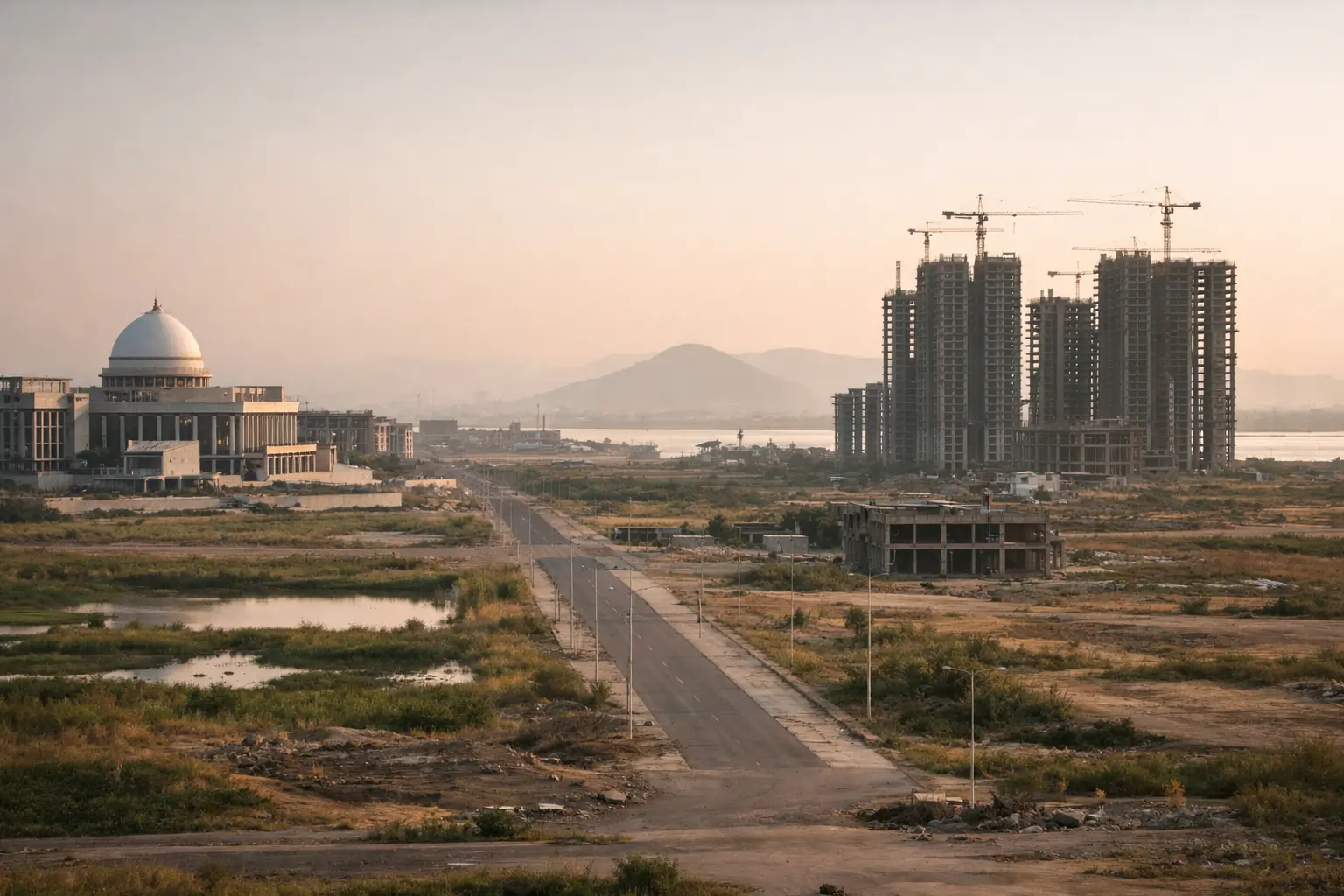

When Andhra Pradesh was divided in 2014, the state lost Hyderabad. Hyderabad was not just a city. It was an economic engine. It had IT companies, universities, industries, and jobs. After bifurcation, Andhra Pradesh needed a new capital. The government chose Amaravati. What followed was one of the biggest political and economic stories in modern South India.
AMARAVATI was a very ambitious project. The idea was to create a “global city” on the Krishna River with great infrastructure (similar to Singapore) that included clean roads, government buildings, universities, IT parks, and financial districts. They encouraged farmers to give up their land for this dream.
Instead of deciding to develop dormant land, thousands of farmers agreed to give up their productive, high-quality agricultural land through a land pooling scheme. Much of the land they turned over was the best agriculture in Andhra Pradesh, and they did so because of their trust in the government. They believe that building a capital city will increase their land’s value and provide job opportunities for their children. Many of these families have made the decision to stop farming while they wait for urban development to occur.
Then politics changed.
A new regime assumed position in power in 2019, which opted to reject the existing support provided for the Amaravati plan and create a new plan for the development of 3 capitals. The new plan established Visakhapatnam as the executive capital, Amaravati as the legislative capital and Kurnool as the judicial Capital. This shift in government led to significant changes in building activity in Amaravati.
Construction activities were reduced to as low as possible. There are several projects that have ceased to exist completely and are only partially completed or not built at all. In some locations, roads end at the edge of a construction site or building that is not completed, no longer has a purpose and is no longer usable. Farmers who had turned over their land in August of 2017 began protesting immediately after the government announced it was abandoning plans to build Amaravati.
The Amaravati issue is not just about one city. It is about political instability. Every time the government changes in Andhra Pradesh, major projects change. Long term planning becomes difficult. Investors become nervous. They do not want to invest in a state where policies change every five years.
Amaravati also shows the deep regional divisions inside Andhra Pradesh. Coastal Andhra supported Amaravati because it is located there. Rayalaseema leaders supported Kurnool as judicial capital because they wanted development in their region. Visakhapatnam leaders supported Vizag as executive capital because it is already a large city. The capital issue became a regional issue, not just a development issue.
This is the politics of regional balance. Every region wants institutions, jobs, and infrastructure. But building three capitals is expensive. Andhra Pradesh is not a rich state. It is already in debt. Building one capital is expensive. Building three administrative centers is even more expensive. This created a debate about financial responsibility.
Supporters of Amaravati say the state already invested a lot of money there. They argue that stopping Amaravati wastes public money. They also say Amaravati had a clear long term plan. Supporters of Visakhapatnam say Vizag already has infrastructure and does not need to be built from zero. They say it is cheaper and more practical.
So the capital debate became a political debate. It also became a caste debate. It also became a regional debate. In Andhra Pradesh, land, caste, and politics are closely connected. Many people believe Amaravati represents certain dominant caste interests. Others believe shifting the capital is political revenge. These perceptions made the issue more emotional and more complicated.
Meanwhile, ordinary farmers are stuck in the middle. Many Amaravati farmers cannot farm because their land is now part of the capital region. But the city is not fully built either. So they lost farming income and they did not gain urban income. This is why Amaravati protests continued for years. Farmers were not protesting for politics. They were protesting for economic survival.
Amaravati also shows a bigger problem in Indian politics. Governments announce mega projects. New governments cancel or change them. There is no continuity. There is no policy stability. Development becomes political, not economic. Cities are built or abandoned depending on which party is in power.
Compare this with cities like Hyderabad, Bangalore, or Chennai. These cities developed over many decades. Different governments came and went. But the city’s growth continued. In Andhra Pradesh, the capital city itself became a political project. That is why Amaravati is still incomplete.
The story of Amaravati is also the story of bifurcation. After losing Hyderabad, Andhra Pradesh needed a strong economic center. That has still not fully happened. Visakhapatnam is growing, but it is not Hyderabad yet. Amaravati was supposed to become that symbol of a new Andhra Pradesh. A planned capital. A modern capital. A global capital. That vision is now uncertain.
Today, Amaravati stands as a half built capital. Some government buildings exist. Some roads exist. But the grand vision is not complete. For some people, Amaravati represents a broken promise. For others, it represents a bad financial decision. For many politicians, it is still a political tool.
This is why Amaravati is not just a city story. It is a story about trust. Can citizens trust governments when they announce mega projects. Can investors trust long term policies. Can farmers trust land pooling schemes. These questions are still unanswered.
The capital that was supposed to define Andhra Pradesh’s future is still under debate. Amaravati is not fully alive, but it is not fully dead either. It exists in between. Between two governments. Between two visions. Between development and politics.
That is why Amaravati can be called the capital that never was. Not because nothing was built. But because the idea of Amaravati was never allowed to fully become reality. And in Andhra Pradesh, the fight over the capital is really a fight over power, region, caste, and the future of the state itself.
