



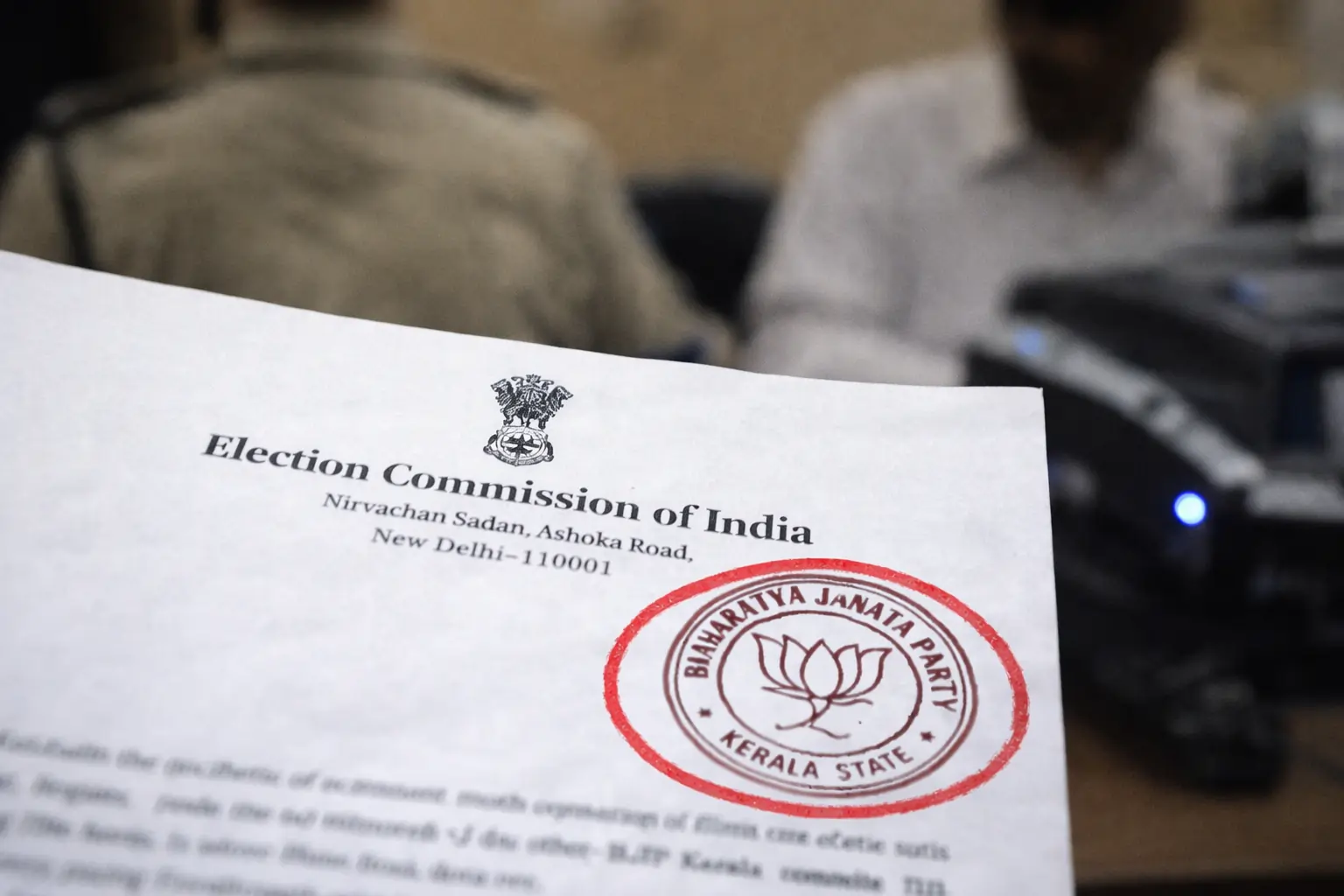

On March 21, 2026, Kerala’s Chief Electoral Officer dispatched a routine email to political parties. The subject matter of the letter was related to guidelines on criminal antecedents of candidates. Nothing unusual, except for the glaring fact that the official document of the poll panel bore the seal of the Bharatiya Janata Party’s Kerala unit.
What the poll panel dismissed as a “clerical error” sparked a political firestorm that stretched from Thiruvananthapuram to Kolkata, with uncomfortable questions about institutional integrity just weeks ahead of the Kerala Assembly polls slated for April 9, 2026.
The Document That Questioned Democracy in Kerala
The CPI(M) Kerala unit was the first to raise the issue on Monday afternoon, posting a screenshot of an email sent on March 21, along with an affidavit sent on March 19, 2019, which had the BJP seal and was sent from an Election Commission official
The visual was damaging. The constitutional authority for elections in India was sending out official communications with the ruling party’s logo.
The Official Explanation: Error or Design?
CEO Dr. Ratan U. Kelkar went into overdrive to mitigate the situation. The explanation offered by the office was that the BJP Kerala had forwarded a photocopy of the 2019 directive bearing their seal to the CEO’s office. This was “inadvertently” forwarded to other political parties as part of the clarification process.
The sequence of events:
- BJP seeks clarification on 2019 guidelines issued
- BJP sends a photocopy of the guidelines bearing their seal
- CEO’s office “does not notice” the BJP seal on the document
- CEO’s office “inadvertently” sends the document bearing the BJP seal to all the parties
“Immediate” action taken upon the “error” being detected
On the 21st of March, the Deputy CEO issued a formal withdrawal to all the parties and officials. The Assistant Section Officer responsible for the matter was suspended from duty pending an investigation. In a clever move, a junior officer was scapegoated while the senior leadership escaped unharmed.
National Political Explosion
However, the scandal did not remain confined to the state of Kerala; rather, it went national.
Mamata Banerjee before West Bengal polls: “The Election Commission is not impartial. That’s why their notification has the BJP’s vote symbol,” questioning whether it “was a clerical mistake or an attempt to fulfill political objectives”
Congress’s Supriya Shrinate termed this “proof of BJP-LDF collusion,” claiming Kerala Police were acting at the behest of the EC, calling the EC a “BJP Puppet” Business Standard.
CPI(M) Kerala: “Have all pretences been dropped by the BJP? It is no secret that the same power center controls both the Election”Commission and the BJP. Yet, at least the decency to maintain the facade of two separate desks?”
However, the irony was brutal: “Voters are disqualified for discrepancies much less serious than the presence of a party symbol on the Commission’s communication”
Censorship Over Transparency
Transparency was not an option for them. Instead, they chose suppression. The Kerala Police asked X to remove the posts, which included journalists like Arvind Gunasekar and Piyush Rai Business Standard.
Imagine a constitutional body committing an embarrassing blunder, and the solution is silencing journalists who point this out.
Journalist Piyush Rai sarcastically tweeted after receiving a notification from the police: “I have full respect for the election commission, which is the most impartial constitutional body.
Why South India Should Worry
In states like Kerala, Tamil Nadu, and Karnataka, which felt central government interference, this was a turning point for their deeper fears of central government overreach. Now, these states had visual proof of central government institutional takeover.
Kerala elections scheduled for April 9, 2026, with political fronts intensifying campaigns amid ongoing electoral scrutiny. If the referee is wearing the colors of one of the teams, even accidentally, it undermines the integrity of the game.
The Credibility Chasm
How does a body entrusted with microscopic examination of electoral processes manage to overlook a political party’s seal on documents being circulated?
The EC asked people and media not to jump to conclusions, reassuring that their processes are foolproof.
How foolproof is a system that fails to spot a ruling party’s seal on constitutional communication?
Pattern or Coincidence?
Kerala has seen:
- Midnight release of supplementary voter lists
- Last-minute officer postings before elections
- Allegations of disproportionate voter deletion in opposition areas
Mamata had raised officer reshuffling before elections and midnight release of voter lists: “Why midnight? The list hasn’t been displayed anywhere in booth, block, or district”
For the South Indian opposition, the BJP seal is not just a symbol; it is a symptom.
Trust Lost, Democracy Weakened
BJP’s Amit Malviya dismissed it: “This is fake news. The document is from 2019, available on CEO Kerala website. Congress spreads misinformation”
But the document wasn’t “fake” it was real, official, and BJP-stamped. That’s the problem.
Whether incompetence or design, the EC distributed partisan-stamped documents during the election. The suspension of a junior officer does not address the question: How did the BJP’s stamp end up on the letterhead of the ECI?
For South India-where regional parties are the last bastion against the rise of a single-party system-this “clerical error” only confirmed their worst fears: the electoral umpire in India may no longer be impartial.
The seal has been removed from the letter. The question is: Has the stain been removed from the credibility of the EC?
