



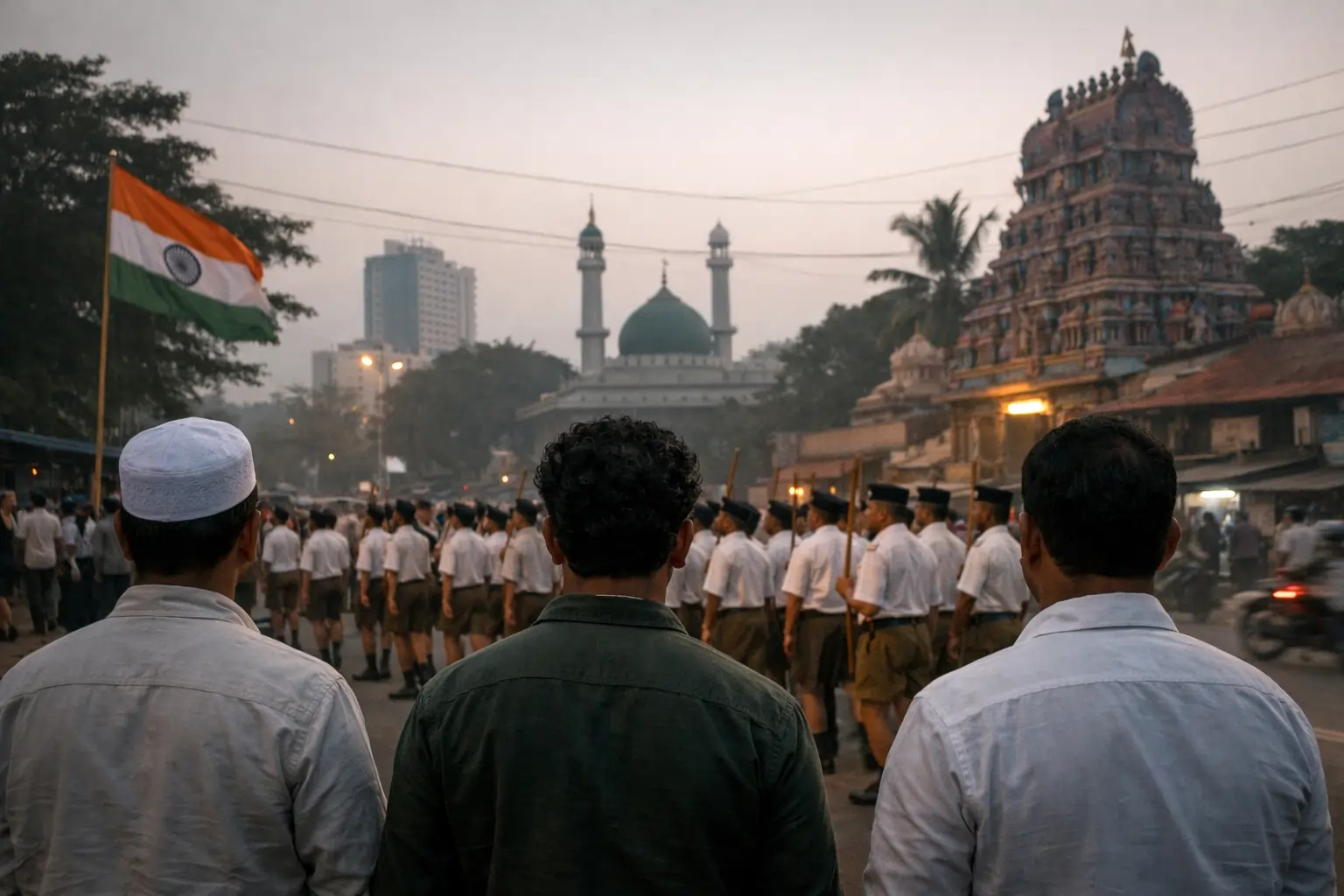

The U.S. Commission on International Religious Freedom (USCIRF) has issued their 2026 bombshell: sanctions on RSS, including asset freezes and U.S. entry bans for “severe violations of religious freedom.”
For South Indian states like Tamil Nadu, Kerala, and Karnataka, who have resisted RSS inroads for decades, this is no vindication. This is a validation. What regional parties and minorities have documented for decades-systematic violations of religious freedom by RSS-America now officially names.
USCIRF has recommended targeting sanctions against RSS. They have urged the U.S. government to impose asset freezes and entry bans for “responsibility and tolerance of severe violations of religious freedom”
But as America bars RSS leaders from entry into their territory, South Indian people confront RSS in their schools, their shakhas, their government offices.
The Evidence America Documented
USCIRF’s report asserted that “the religious freedom situation in India continued to deteriorate in 2025 as the Indian government began to enact laws targeting religious minorities and condone vigilante attacks.” USCIRF’s report cited the incidents in Karnataka and UP, where Hindu nationalists allegedly murdered a Muslim employee at a Hindu-owned restaurant
For South Indian minorities, especially in coastal Karnataka where Bajrang Dal and RSS-affiliated Hindu nationalists terrorize Muslims and Christians, this international recognition of their plight will not surprise state governments or national media outlets.
RSS in South India: The Ground Reality
While USCIRF sanctions RSS globally, RSS is flourishing in South India. Research by Peoples Democracy reveals that in Tamil Nadu, there are as many as 76 RSS organizations, while Karnataka has 174, and Kerala has 212, indicating “more recent priorities” as RSS aims at states “where RSS does not have much influence”
As of 2016, Tamil Nadu had as many as 2,060 RSS Shakhas, while Kerala had 6,845 RSS Shakhas. RSS has been expanding, and in the past year, it has opened as many as 5,600 new RSS Shakhas, taking the overall count to over 88,000, and it aims at reaching the figure of one lakh by the year 2026, as revealed by Goodreturns. This is not growth; this is just the beginning. The focus is in the South.
The Educational Infiltration
The most insidious of the RSS strategies has been education. Vidya Bharati, it was revealed by Caravan, has different names in different regions: “in Tamil Nadu it is the Vivekananda Kendra”. Unaware parents of South India are unwittingly enrolling their kids in institutions run by an organization that should be sanctioned in the U.S. for religious freedom abuses. While the U.S. freezes assets of RSS abroad, kids in RSS-funded schools in South India learn RSS ideology that espouses Hindutva and has no room for regional identities.
Why South Should Celebrate
USCIRF’s sanctions mark a watershed. For a while now, critics of the RSS have been labeled “anti-national” or “divisive.” An independent commission in the US has formally recommended sanctions against the RSS.
Hindus for Human Rights said: “For years, we who have been speaking out against the rise of Hindutva have been accused of overreacting. This attack on religious freedom is structural, ideological, and sustained.” South India’s secular heritage, from Kerala’s communist resistance to Tamil Nadu’s Dravidian rationalism, and Karnataka’s progressive tradition have all seen the RSS as an outfit that cannot coexist. USCIRF corroborates this too.
But Vigilance Is Critical
USCIRF’s role is to make recommendations. These aren’t automatically implemented. Even if they were, sanctions against RSS leaders outside India wouldn’t prevent expansion in Madurai, Kochi, or Mysuru. The fight isn’t in Washington. It’s in the towns of South India where the RSS operates in secret to establish shakhas, schools, and cultural institutions. It’s in state capitals where anti-conversion laws are enacted. It’s in WhatsApp groups where communal propaganda circulates. It’s in schools where children are taught that Hinduism means being aligned to Hindutva ideology.
In its own reports, the RSS proudly declares: “In Kerala, around 55,000 Muslim families and 54,000 Christian families were contacted”
What South India Must Do
First, use the report politically. Opposition parties in Tamil Nadu’s 2026 election, Kerala’s struggles, and Karnataka’s governance issues must use this report to condemn the RSS. Now, the BJP’s RSS links have been documented in a U.S. report that calls for sanctions to be imposed against the group.
Second, seek transparency. If the U.S. has deemed the RSS dangerous enough to freeze their assets, why can’t the governments of South Indian states do the same to discover the sources of funding of these hundreds of organizations?
Third, build up secular education. The answer to RSS schools is not to shut them down, but to build better ones that are deeply rooted in regional cultures and rationalist beliefs.
Fourth, protect minorities. USCIRF has documented what minorities in South India must go through. Governments in the region must use this international validation to beef up their protection of minorities.
The Bottom Line
USCIRF calling RSS a threat is not news to South India; it’s merely confirmation of what we’ve known all along, thanks to church attacks in Karnataka, attempts at saffronizing Tamil education, and communal mobilizations in Kerala.
The only change we’ve witnessed is that this threat has finally been acknowledged on the global stage. The only constant remains that the RSS continues to expand its operations in South India, running schools, conducting shakhas, and building its ranks, methodically working towards the transformation of the secular states of South India into Hindu laboratory states.
Celebrate the bravery of USCIRF, by all means. However, don’t be fooled by this international censure; the organization that US authorities deem so dangerous that they ban its members at US immigration does not hesitate to walk freely on the streets of Chennai. Bengaluru, and Thiruvananthapuram-and it’s not doing so by choice!
South India, your call to action remains the same: take this as an opportunity to strengthen your resistance or let the RSS make its operations here what the US has condemned as severe religious freedom violations.
