



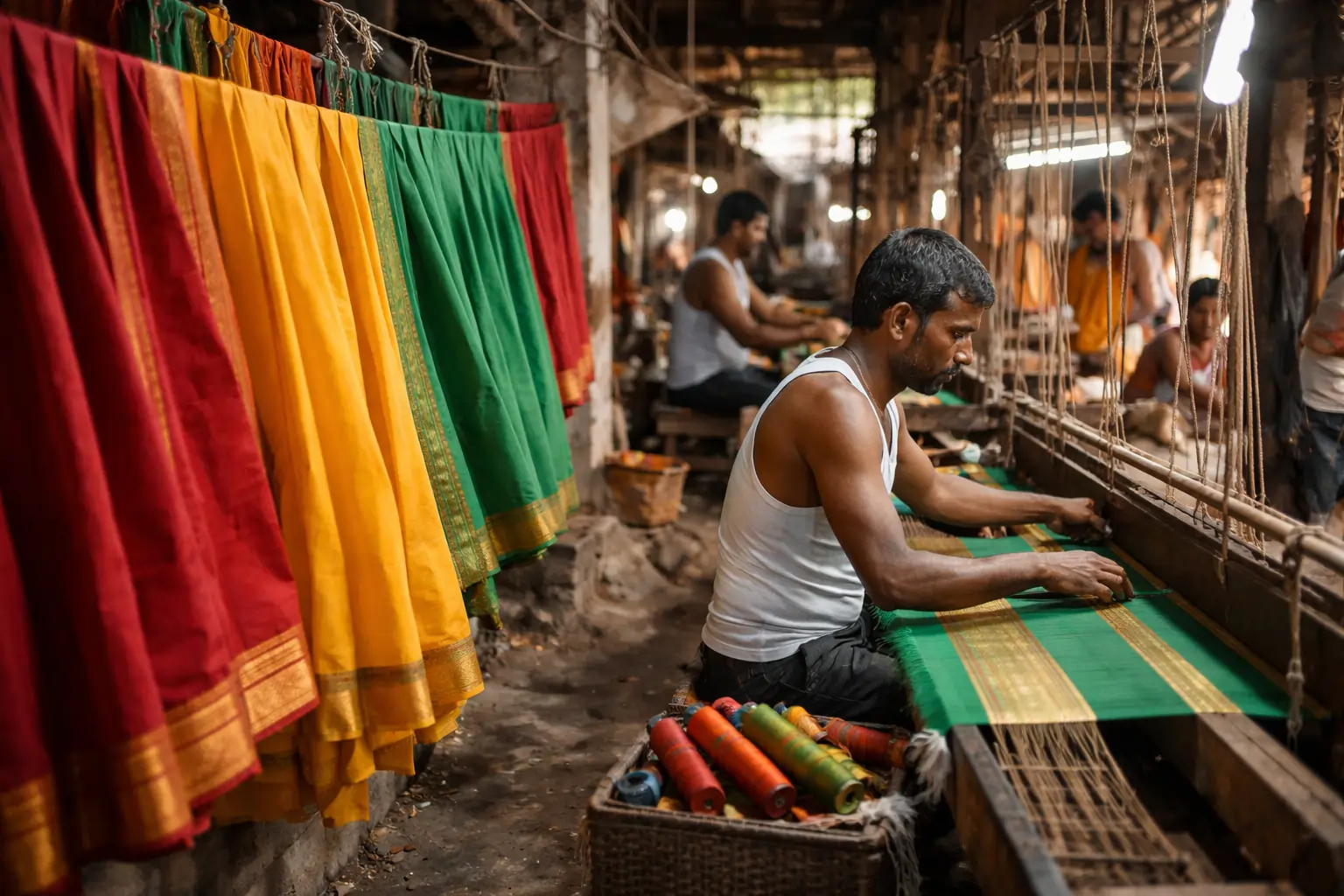

If you arrive in Mangalagiri at an early hour, you will notice this town before you see it by a long distance because you will hear the looms clanging away beautifully to each other before the tea shops open up or the temple bells ring or most people begin to get out of bed. The clanking noise which is loud and clear, as the sun rises over the streets of Mangalagiri, will stay in your mind for a while after hearing it, and so will this story.
Mangalagiri is approximately 12 kilometres south of Vijayawada, but if you are unaware what to look for, chances are you would easily miss this place as you drive through Mangalagiri without realising you ever did so, due to the lack of anything overly impressive about this little mundane town. Even though Mangalagiri is a relatively small town, it is referred to as one of the best places to produce cotton in India and the cloth made from the cotton produced by the looms of Mangalact dating back to the 1800’s is woven into the daily lives of all Telugus. In reality, despite being worn by many Telugus today, very few of them would ever think to ask where their cloth came from, even though many have done so throughout their lives.
An Everyday Fabric
The majority of Indian textiles are made for occasions. For instance, the Kanjivaram saree you will wear to a wedding and the Banarasi saree you will wear to a celebration. The Mangalagiri cotton saree will not work in the same respect — it is just something you wear in the morning when going to the market, during the day at work, or on a Sunday when you want to relax or do not have anything planned. For many years, Telugu women wore these sarees not only to the temple and out to lunch, but all over town; not because they had to, but because they are simply made well; they are soft, lightweight, etc., and they do not pretend to be something else.
The quality of this weaver is not rare. That is a true characteristic of this artist.
The method of weaving is accomplished using pit looms, so the weaver will sit with their legs down in a hole (or pit) and work the foot treadles. It looks uncomfortable to the viewer from the outside of the loom. The weaver does not appear to care whether it feels uncomfortable or not. The structure of the nizam fabric gives a tight interlocking weave, which provides the fabric with its distinctive weight, initially stiff and over time becoming more and more comfortable with each wash cycle, so it eventually transforms into your favourite piece of clothing.
The Gold on the Edge
When speaking to people familiar with this kind of textile, you will hear about a border within 30 seconds. The border contains a broad band of zari (silver or gold) yarn running vertically along the edges of women’s garments including sarees. The zari border provides a stunning view of the cloth, which is usually very brightly coloured compared to the deep, saturated colours associated with Andhra Pradesh, except that they are in bright green, turmeric yellow or a deep red colour (similar to a red traditionally found in temples).
The zari borders look fancy and showy without appearing overly done. There is a huge difference between the two.
The gold wire used to create the borders is the real thing, and they are manufactured from gold imported from other countries and made by skilled artisans who have learned how to work with it over many years. Nowadays, many garments have some blend of real and synthetic zari in the borders in order to make them less expensive and more affordable for consumers, while still maintaining some of the craft of Indian artisans. Although the patterns in the borders have not changed much, (you will find stripes, some simple geometric designs, and maybe a peacock if you are lucky) the type of designs that fashion designers have to offer, because the quality of the cloth is so high, it is too much of a design challenge to create something that would take away from the extraordinary quality of the product.
The Weavers of Mangalagiri
In Mangalagiri, many families that engage in weaving are from the Padmasali community; weaving is not a choice as much as a predetermined profession; in Mangalagiri, children learn to weave alongside their parents at the loom as soon as they are able to understand; in most cases, the learning takes place before there is agreement between child and parent that this will take place.
Many years ago, the weaving community of Mangalagiri displayed a variety of finished cloths hanging out to dry at the street’s side as they were brought to the Krishna River for drying from the looms in Mangalagiri, creating a picturesque scene. There was a phenomenal number of handlooms working synchronously; that situation no longer exists. Instead, we have large factories with power looms that can produce ten times the output of a handloom operating at a fraction of the cost, and the result of this competitive advantage has led to an exodus of the younger generation to cities due to the ability of factory jobs to generate the same financial reward and a better standard of living than handlooms; after all, they are not at fault for doing what they can.
The weavers who remained, however, are not weak or timid about their decision to stay; many of them had opportunities to improve their quality of life and chose not to, they sometimes have a difficult time saying why they made the choice to stay; thus, the fact that they are struggling to provide an answer is in itself an answer.
How to Spot the Real Thing
Mangalagiri cotton has a GI tag now, which means the name is legally protected. In practice that hasn’t stopped markets across Andhra from selling machine-made fabric under the same label. If you know what to look for you can tell the difference. Real handwoven cloth has a slight unevenness to it when you look closely, not a flaw exactly, more like a fingerprint. The way it hangs is different too. And unlike the imitations, it gets better the more you wash it.
If you want to be sure, go to Mangalagiri. The weaver cooperatives and family workshops on the main road will sell you the genuine article. You can watch it being made if you want. You can ask questions. You leave with a piece of cloth that someone actually made, which sounds like a small thing until you think about how rarely that’s true anymore.
Telugu culture has given the world remarkable things, temples and literature and music and dance forms that took centuries to develop. But culture also lives in smaller places than that. In the food people cook without thinking about it. In the words they use when they’re not being careful. In what they wear on an ordinary Tuesday. Mangalagiri cotton is that kind of thing. Nothing showy about it. Just good, and real, and still here.
