



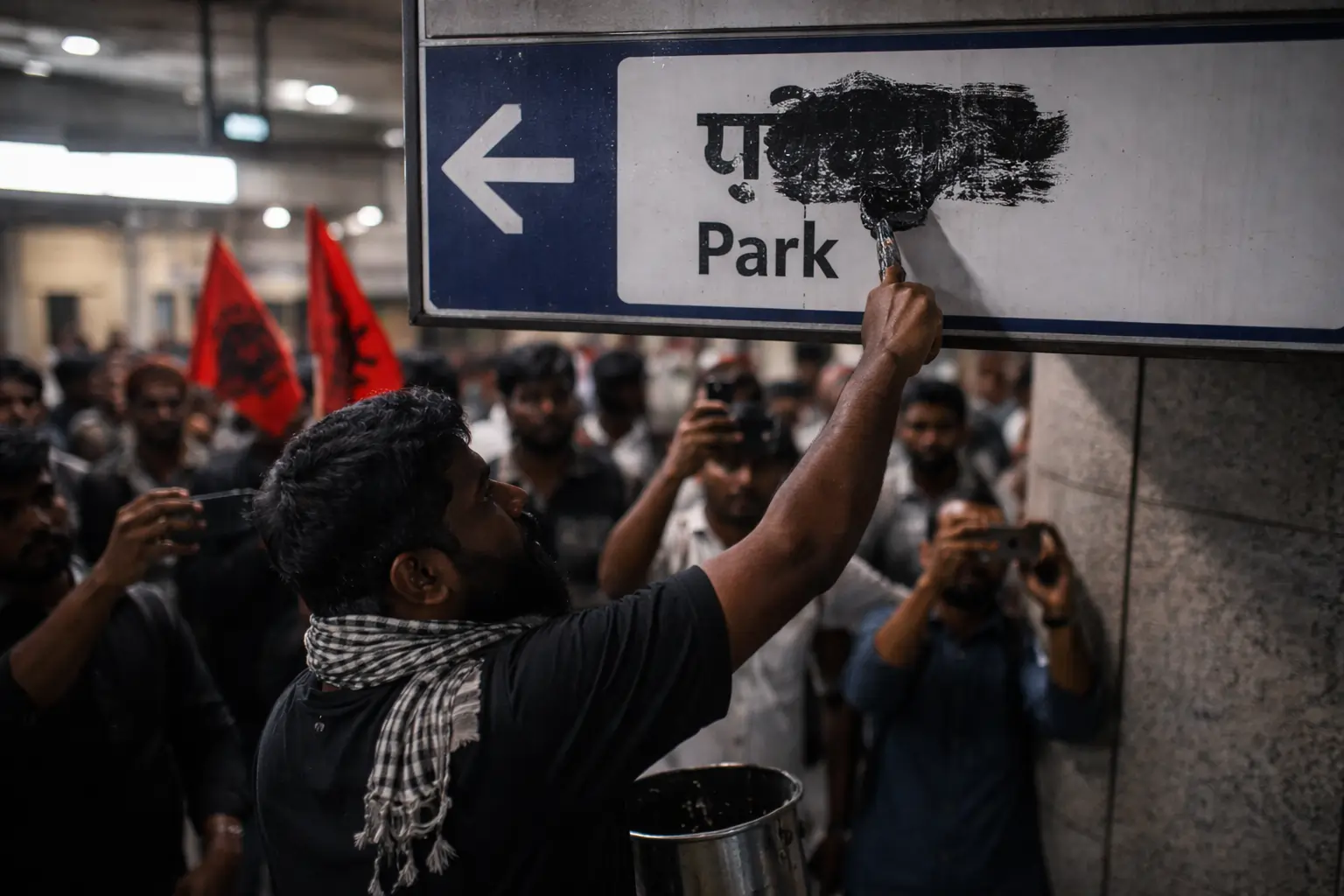

The act of Thirumurugan Gandhi and May 17 Movement activists painting over Hindi signs at Chennai Park Metro Station was labeled an act of vandalism by the mainstream media. However, for people in Tamil Nadu, whose language is their only source of identification, it is not an act of vandalism but one of defiance. It is an act of continuing a 89-year-old fight against linguistic imperialism.
The May 17 Movement is a Tamil nationalist organization formed in 2009. While fighting for justice for Eelam Tamil genocide, the movement has also grown to fight for Tamil sovereignty against North Indian cultural invasion
The Historical Wound: 1965
To understand the significance of painting over Hindi, you need to understand 1965-when Tamil students chose to set themselves on fire rather than be forced to learn Hindi.
The South First writes: “On January 25, 1965, Keelapalur Chinnasami became the first man in the world to immolate himself for the cause of language rights. His last words were: ‘I am dying so that Tamil may live.’ He was not alone. On March 2, 1965, Peelamedu Thandapani immolated himself for the Tamil cause. His last words were: ‘My life for Tamil, my body for the soil.’ Mayiladuthurai Sarangapani immolated himself for Tamil with the words: “Long live Tamil.”
Government estimates suggest that 70 people died during the 1965 protest against Hindi imposition. The violence was so severe that two central ministers from Tamil Nadu resigned in protest.
The protest was successful. The PM, Lal Bahadur Shastri, promised English would be an associate language indefinitely. The 1967 Official Languages Amendment made it so. The DMK came to power in 1967. No party can hope to rule Tamil Nadu unless they are against Hindi imposition.
Tamil Nadu’s Two-Language Stand
According to The News Minute: “When DMK came to power in 1967, the then CM CN Annadurai introduced the Two-Language Policy in 1968 – Tamil and English – Rejecting the three-language formula proposed by the Centre.” Not stubbornness; it was a matter of survival. For if Hindi was made the official language, then ” We will be third-rate citizens. If Hindi becomes the official language, Hindi-speaking people will govern us.”
Tamil Nadu has refused to make Hindi compulsory in any of its schools for nearly six decades now. It’s a position that all governments – DMK or AIADMK – have taken because autonomy on this issue is not negotiable.
Why Hindi Signage Isn’t “Harmless”
When the Chennai Metro uses Hindi, Tamil, and English, objections to Hindi by Tamils are dismissed as an “overreaction” by apologists who say it is “helping migrants” or “promoting national integration.”
But it is not. Business Standard quotes the reason for the opposition to Hindi as the “perception that Hindi threatens regional autonomy in education and administration.”
Hindi on public signs is not harmless. It is a declaration of intent. This language is at home. Learn it or perish.
For Tamils whose grandparents died fighting Hindi in 1965, every Hindi sign is an invitation to fight. Hindi is stealth colonization-what wasn’t achieved by bullets is now sought by bureaucracy.
May 17 Movement: Uncompromising Tamil Nationalism
Thirumurugan Gandhi has been arrested many times for his activities under the Goondas Act in 2017, for charges of sedition, and even for the use of Pegasus spyware against him, as stated by The Caravan.
The government fears Thirumurugan Gandhi because he stands for uncompromising Tamil nationalism against the cultural hegemony of Delhi.
When May 17 activists protest the imposition of Hindi by blacking it out, they are asserting their space against encroachment. They are saying: In Tamil Nadu, Tamil comes first. Always.
The Pattern of Imposition
This is not an isolated case. The Federal government records some of the recent attempts:
- Union govt. posting on social media only in Hindi
- Central govt. job notifications favoring those proficient in Hindi
- NEET exam favoring those whose medium of study is Hindi
- Railway announcements favoring those who know Hindi
- Official documents being published mainly in Hindi & English
All of this is eroding the 1967 promise of not imposing Hindi, English to stay, and regional languages to flourish.
Federal Principles at Stake
Tamil Nadu’s resistance is not a matter of parochialism; it is a matter of upholding federal principles in our Constitution.
Article 343 makes Hindi the official language, and Article 345 gives states the right to their own languages. The promise: Hindi for the Union, regional languages for states, and English as a bridge.
When Hindi is used on state infrastructure like Chennai Metro, which is partly funded by Tamil Nadu’s own state budget, it is a breach of federal principles, imposing Hindi where Tamil should be dominant. As The News Minute puts it, “Language is how we see the world and how the world sees us.”
For Tamils, acquiescing in Hindi signage means acquiescing in second- class citizenship in their own state. It means acquiescing in relegating their own language, with 2,000+ years of continuous literary record, to second class in favor of a language that became “official” based on political strength, not cultural importance
The Uncomfortable Question
If you are for linguistic diversity, federalism, and pluralism, what justification does Tamil Nadu have for Hindi signage that serves no constitutional purpose and violates the two-language policy in effect for 57 years?
North Indians live in Bengaluru, Chennai, Hyderabad without any effort to learn the local languages, assuming that English will do. But they demand Hindi signage for migrants. What a double standard!
Resistance, Not Vandalism
When Thirumurugan Gandhi blacks out the word ‘Hindi,’ he is not vandalizing public property. He is carrying forward the legacy of Chinnasami. He is paying tribute to the 70 who lost their lives in 1965. He is reminding Delhi that linguistic sovereignty in Tamil Nadu is not negotiable. The anti-Hindi agitations in Tamil Nadu in 1937-1940 and 1965 were not merely about the language policy.
They were a reminder that no party can hope to capture power in Tamil Nadu unless and until they acknowledge Tamil Nadu’s pride. The actions of the May 17 Movement serve as a reminder that linguistic colonization will be resisted. Every time. Everywhere. With black paint if need be. Tamil Nadu has fought too hard and won too convincingly in 1965 to let linguistic space be encroached upon now. The signboards can be repainted. Tamil Nadu’s resolve cannot. Linguistic sovereignty is non- negotiable. The South will not be colonized. Not in 1965. Not in 2026. Not ever.
