



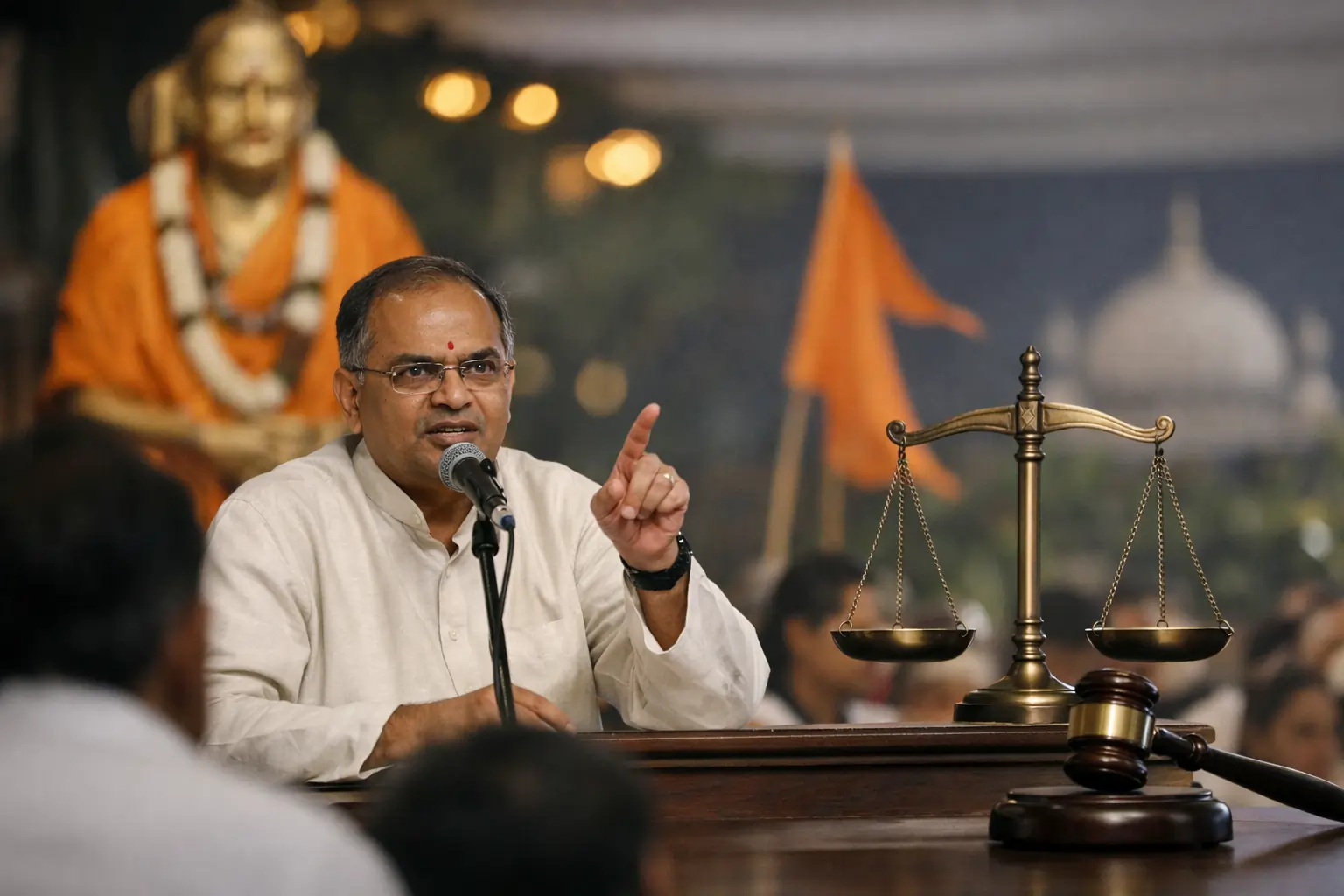

Latest Controversial Statement Sparks Outrage Justice G.R. Swaminathan of the Madras High Court referred to rationalists as “rascals, fools, and barbarians” during a spiritual gathering in Hosur on February 23, 2026. His justification for this? They ridicule people who worship spiritual gurus.
This is not only controversial, but it’s also career-ending. The judge is already facing an impeachment motion from more than 100 MPs. However, rather than showing restraint, he continues to make statements that raise questions about his impartiality as a judge.
- What Justice Swaminathan actually said at the Hosur Event
- Impeachment Motion: The December 2025 Karthigai Deepam Case
- Tamil Nadu’s Rationalist Movement: Why This Resonates
- Judicial impartiality vs Personal Beliefs: where’s the Line?
- 50+ Former Judges Support Swaminathan
- Can Justice Swaminathan Be Impeached?
- The Real Question: Can He Judge Fairly Now?
- Why This controversy Damages India’s Judiciary
What Justice Swaminathan actually said at the Hosur Event
Addressing the Guru Vandana Utsava in Tamil, Justice Swaminathan turned the tables. “Those who call us guru worshipers are the actual scoundrels, fools, and barbarians,” he said. He went on to talk about the “auras” of spirituality, told the audience how “Gurunatha” chanting had helped him in a car trouble situation, and promised to strive “courageously” for Dharma in the next four and a half years of his service.
Such statements are unprecedented for a constitutional functionary who is expected to maintain a neutral stand.
Impeachment Motion: The December 2025 Karthigai Deepam Case
Justice Swaminathan directs the lighting of the Karthigai Deepam lamp at the Thirupparankundram hill, near a historic dargah. The Tamil Nadu government protests on law and order issues. He sends contempt notices to the Chief Secretary and top police officials.
100+ MPs of the INDIA bloc introduce an impeachment motion against the CJI for showing preference, communal favour, secular bias,
and ruling based on political ideology.
Despite clearing an impressive 1.26lakh cases during his tenure, Justice Swaminathan is now accused of displaying behavior unbefitting a judge.
Tamil Nadu’s Rationalist Movement: Why This Resonates
Tamil Nadu is not an ordinary state when it comes to rationalism.
The Dravidian party, which has been ruling the state for 50+ years, was founded on rationalist ideals by leaders such as Periyar E.V. Ramasamy. The Self-Respect Movement was a challenge to caste and religious orthodoxy. This is no ancient history; it influences the politics of Tamil Nadu to this day. A High Court judge who mocks rationalists is attacking the progressive past of the state. Former judge of the Madras High Court, K. Chandru, directly said “Justice Swaminathan behaves as if he is the propaganda secretary of the RSS. He has betrayed his oath to the Constitution”.
Judicial impartiality vs Personal Beliefs: where’s the Line?
Judges enjoy freedom of speech. They can have personal beliefs, participate in religious functions, and display their faith. Nothing wrong with that. However, they also take an oath to abide by the Constitution “without fear or favour, affection or ill-will.” India is a secular state, and it is so by virtue of its constitution. The freedom of conscience is guaranteed by Article 25 for believers and non-believers alike.
The line is drawn here: When a judge holds rationalists-persons exercising their constitutional right not to believe-to be inferior by using derogatory terms, he is not displaying his personal faith. He is implying the superiority of his worldview. That’s where faith turns into misconduct. Justice Swaminathan has been consistently crossing the line. He has addressed RSS meetings, terming the Constitution as “copied” from colonial legislation. He has issued orders that give preference to Hindu rituals over governance concerns. Now, he has mocked rationalism itself.
This is not the first time constitutional principles have been overshadowed by political or ideological action. A similar constitutional controversy unfolded during Hyderabad’s 1948 integration, where questions of legality and state power remain debated even today. Read our detailed analysis here: Hyderabad’s Forced Integration: A Forgotten Violation of International Law
50+ Former Judges Support Swaminathan
The Other Side More than 50 former Supreme Court and High Court judges have disapproved of the impeachment motion. The Supreme Court has ordered Tamil Nadu police to take action against people who are using abusive language against him on social media sites. Memoranda were submitted by Madurai advocates, pointing out his record of disposing of cases. There is definitely support from the establishment. His efficiency in court is incontestable. However, efficiency does not justify actions that affect the judge’s impartiality. A judge may dispose of a million cases, but he will still have failed the most basic test of appearing impartial.
Can Justice Swaminathan Be Impeached?
The Political Reality Impeaching a judge needs 100 MP signatures (done), Speaker approval (pending), findings of the investigative committee, and two-thirds majority in both Houses. Only one judge has been successfully impeached in Indian history- Justice V. Ramaswami in 1993, who resigned before completion. Given NDA’s parliamentary majority, this motion has a tough time ahead of it. Lok Sabha Speaker Om Birla has not recognized it yet. Experts forecast that it might get stuck at the stage of initial scrutiny. Politics will surely save Justice Swaminathan. However, this does not mean that his behavior is justified.
The Real Question: Can He Judge Fairly Now?
Can a judge who refers to rationalists as “barbarians” judge cases related to rationalist bodies or atheist bodies impartially?
Can a judge who says that he will bear Sanatana Dharma in his heart for the rest of his term judge religious cases impartially?
The answer is important because perception is reality in the judiciary. Even valid judicial orders will suffer if the judge is perceived to be biased. Public confidence will collapse
Why This controversy Damages India’s Judiciary
The impeachment motion will fail politically. But the harm is already done. Every controversial utterance, every dubious order, every public appearance that confuses personal belief with judicial duty chips away at public trust. That is the true expense not of Justice Swaminathan, but of the judiciary as a whole. Justice Swaminathan’s 1.26 lakh case disposal is praiseworthy. But being a judge is not merely a matter of signing off files. It is a matter of representing the constitutional ideals of equality, secularism, and justice for all-irrespective of their beliefs or non-beliefs.
When you find yourself on a public podium as a judge of the High Court and declare rationalists to be “rascals, fools and barbarians,” you are not defending your faith. You are compromising the very foundation of the constitution you are sworn to uphold. That is why this controversy is important. And that is why, irrespective of parliamentary math, Justice Swaminathan has overstepped a line that judges simply cannot overstep
