



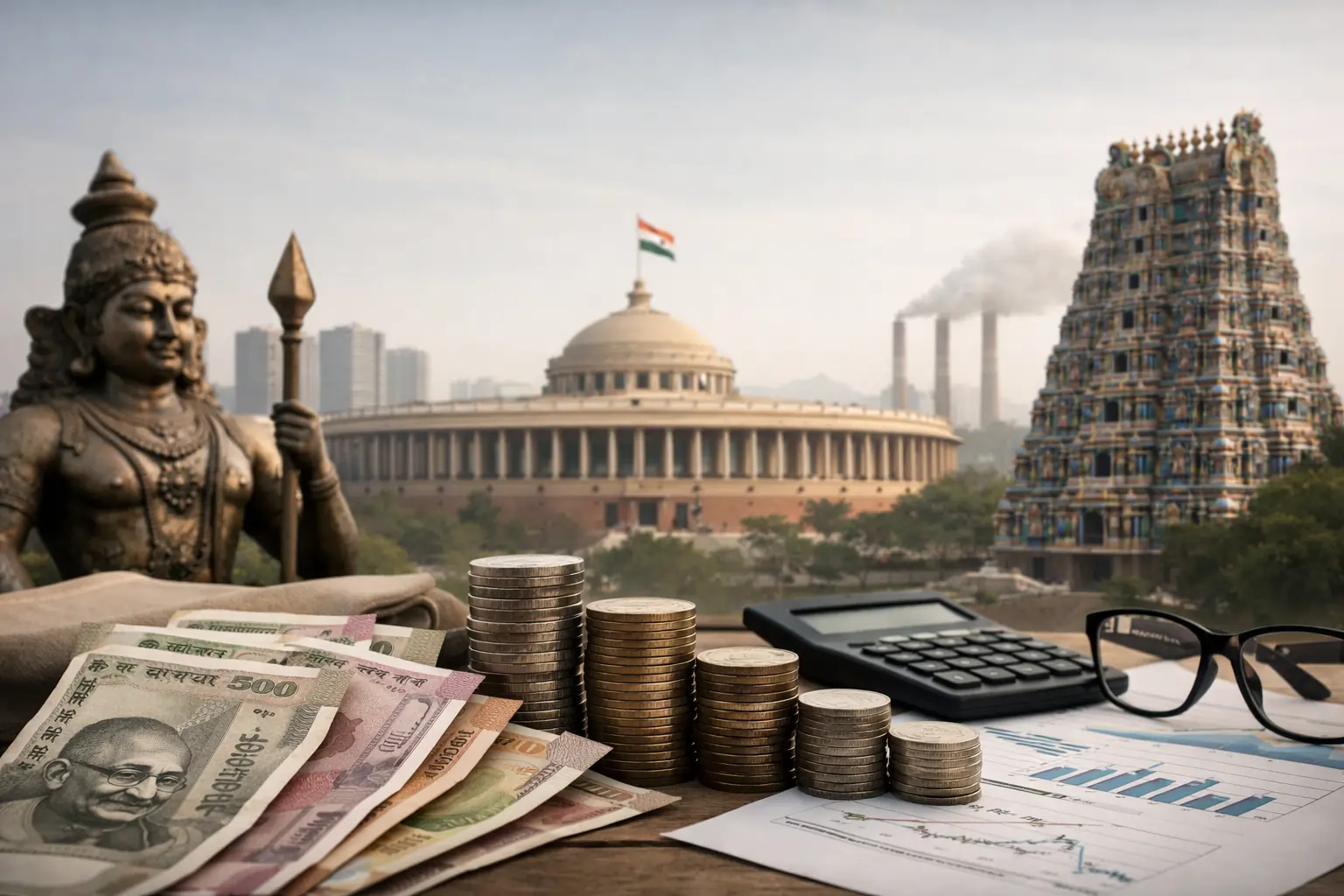

When the verdict of the 16th Finance Commission finally came out on February 1, 2026, South Indian states had mixed reactions to it. The figures indicated an increase, but the question that still lingers in our minds is: did we really win or is this another compromise that left us short changed?
What’s Changed?
The share of all five southern states has gone up. Karnataka’s share has gone from 3.65% to 4.13%, Kerala from 1.93% to 2.38%, Andhra Pradesh from 4.05% to 4.22%, Telangana from 2.10% to 2.17%, and Tamil Nadu’s share has marginally gone up from 4.08% to 4.10%.
At first, it seemed like a positive development. Karnataka alone will get an additional Rs 7,387 crore every year. Kerala’s share has gone up by a whopping 24%. These are no small gains. The part that stings is how the funds are allocated. The Commission has brought in a new factor called “contribution to GDP” with a weightage of 10%. That seems just, doesn’t it? South accounts for 30-35% of India’s GDP. The trouble is, they also slashed the weightage for demographic performance from 12.5% to a mere 10%.
Why is this important?
Southern states have managed their population effectively. The fertility rate in Tamil Nadu is 1.8, in Kerala 1.6. That’s below the replacement rate of 2.1. Look at Bihar, which has a fertility rate of 3.0, or Uttar Pradesh, which has a fertility rate of 2.7. We have done what the country asked us to do, and now we’re being punished for it.
The Population Trap
The Commission is still using the 2011 Census to allocate funds to each state. Consider what has happened since 2011. The Southern states have had much slower growth in population. UP and Bihar? Their population has ballooned. Kerala already has 20% of its population above 60 years – almost three times the national average of 7%. The number of school-going children in Kerala has reduced from 600,000 to 300,000. We require more funds for old-age social security, geriatric care, and healthcare. But this reality is not factored into the formula.
It’s like participating in a marathon where the finishing post is constantly moving away from you.
Where We Actually Lost
The Commission abolished Revenue Deficit Grants altogether. Kerala used to get a lot of money through this. Now, they have nothing to do. Zilch. They also cut the importance of “income distance” – the difference between rich and poor states – from 45% to 42.5%. This was supposed to help poorer states catch up. But now, Bihar and UP will lose too, and the system doesn’t really reward performing well either.
Tamil Nadu’s share remained almost the same – just 0.02 percentage points. This is an insult to a state that contributes so much to manufacturing and has the highest road density in the country.
The Bitter Truth About Taxes
This is one issue that does not receive enough attention. The Southern states alone contribute more than 25% of the total direct taxes in India and 28.5% of the GST. But we receive only 15% of the divisible pool of taxes from the Centre.
And this “divisible pool” is steadily reducing in size. The Centre imposes cesses and surcharges on taxes, which are not shared with the states, at an average of 15%. The Commission recommends that this be restricted to 10%. But will it happen? Experience has shown us that recommendations and reality are two different things.
The GST was meant to be equalizer. But it has reduced us to a position where we have lost the ability to levy taxes on our own. We have contributed 52% of our taxes to the GST while the Centre has contributed only 29%. We are now at the mercy of the Centre for our share of the GST.
What About Local Bodies?
The Commission has allocated Rs 7.91 lakh crore to rural and urban local bodies over a period of five years. It sounds very impressive. Karnataka will get funds for its urban bodies, Kerala’s panchayats will get assistance, and Tamil Nadu’s municipalities will get some grants. But there is a catch here as well. Half of the basic grants are allocated for specific purposes such as sanitation and water management. The states do not get the flexibility to allocate their own priorities. It is like getting pocket money with a list of approved expenses from your parents.
Looking Forward
The 16th Finance Commission has attempted to strike a balance between equity and efficiency. They have brought in GDP contribution as a new criterion. They have recognized that states require fiscal responsibility. These are moving in the right direction.
However, true fiscal federalism would be to treat the states as equals, not as wards. It would be to modify the formula to keep pace with demographic changes – old populations require different handling than young populations. It would be to safeguard the divisible pool against the depletion of cesses and surcharges.
Most of all, it would be to understand that when Karnataka develops IT parks, when Tamil Nadu produces automobiles, when Kerala sustains high human development ratios, we are not merely doing ourselves a favor – we are propelling India ahead.
The verdict of the 16th Finance Commission is neither a victory nor a defeat for South India. It is a reminder that in a federal state like India, the Southern states will have to continue fighting for their rightful share, not because they are greedy, but because they have earned it.
