




Pakistan and India came into being after the partition of British India in 1947, while leaving over 560 princely states to decide their future. Hyderabad state was one of the most significant. Ruled by Mir Osman Ali Khan, Hyderabad Deccan sought to remain independent despite being geographically surrounded by India. Moreover, it was predominated by Hindu population and governed by a Muslim ruler.
The Nizam of Hyderabad declared that Hyderabad would not become part of either India or Pakistan on 11 June 1947. Shortly, he sought for the dominion status of the state from Britian, an effort that faced unimaginable political and logistical barriers. The state’s army was comprised of over 24000 men only. These vulnerabilities, combined with India’s geostrategic position and power, forced the ruler of Hyderabad to sign a Standstill Agreement on 29 November 1947 while intended to preserve the status quo of the state for one year.
The Government of India rejected independence of the Hyderabad, despite the agreement, and prepared for military intervention. On 21 August 1948, Nizam appealed to the United Nations Security Council (UNSC) warning that India’s hegemonic designs threatened international peace, under Article 35(2) of the UN Charter. He also sought help from the British government and the British Crown; unfortunately, he only received limited sympathy from political figures like Winston Churchill.
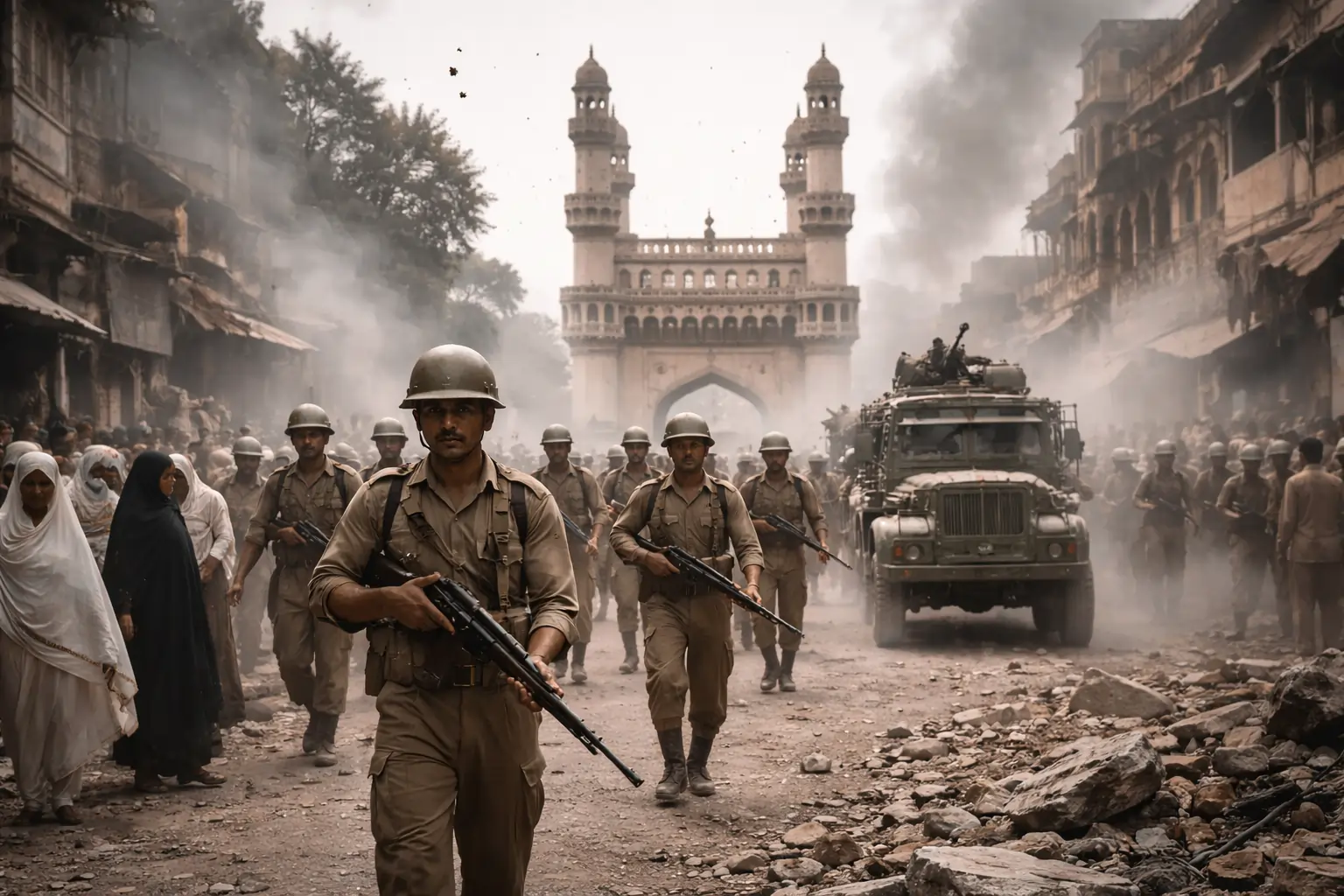
In the early hours of 13 September 1948, India launched its invasion on Hyderabad with the code name of Operation Polo, while advancing from multiple directions. The Nizam of Hyderabad immediately notified the UN about hawkish aggression of Indian military, and the UNSC took notice of it. The representatives of the Hyderabad state argued about the India’s violation of the Standstill Agreement, as the agreement explicitly prohibited military intervention for internal security.
But there was no option left for the Nizam, and he surrendered by 17 September, formally absorbed into India, bringing an end to the centuries old Nizam rule. Muslim of Hyderabad emphasized on the illegality of the invasion, but the Hindus welcomed the integration. It is being estimated in the records that over 100,000 Muslims got killed in this campaign, triggering large scale migration to Pakistan, where a substantial number of Hyderabad Muhajir community lives.
From the lens of international law, India’s annexation of Hyderabad raises serious concerns under Article 2(4), which obliges states to resolve disputes peacefully. Furthermore, it prohibits the threat or use of force against another state. India’s annexation of the state of Hyderabad constituted a clear use of force. India labeled its operation as a police action does not alter its legal character; such actions require explicit authorization from the UNSC under articles 42 or 53.
Therefore, the annihilation of Hyderabad represents a stark violation of the UN Charter. The submissive response of the UN compounded the injustice. While history can never be undone, international organizations could at least investigate the widespread killings and looting under Operation Polo.
