



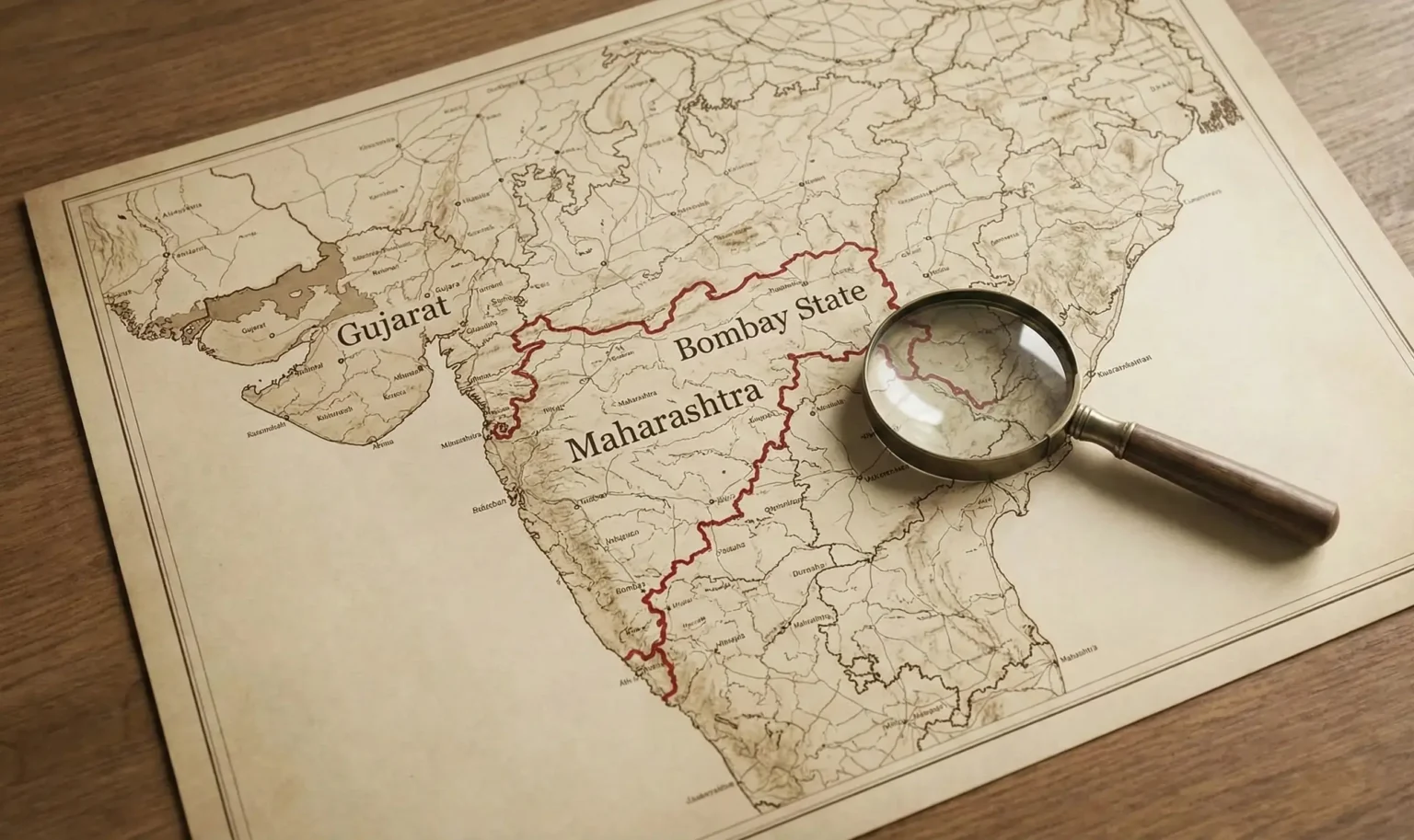

the Bombay state So let’s go back to the year 1661. During this year, Princess Catherine of Portugal was married to King Charles II of England. Since dowry was still prevalent during that time, the family of Princess Catherine had to give something to the English royalty as a part of this marriage. And what did they give as dowry? The islands of Bombay, which were then owned by the Portuguese!
When the English got control of the islands of Bombay, they realized that it was not profitable to manage them They thought it to be more profitable to lease it to a company- the company was the East India Company So on 27th March, 1668, King Charles II declared that the control of Bombay would be under the EIC for an annual rent of less than a thousand rupees, according to the current exchange rates. Thus, the Bombay Presidency was established
After the Sepoy Mutiny in 1857, the British decided that the control of India should be under the British Crown and not the English East India Company With that, the Bombay Presidency was transferred back to the British Crown
Over the next 60-70 years, the size of the Bombay Presidency kept increasing because many other parts were included in it- parts of modern day Maharashtra, Gujarat, Northern Karnataka, Sindh in Pakistan and you won’t believe- even present-day parts of Yemen!
Now this was the time when the restructuring of Bombay started. In 1935, Yemen was the first one to go from the Bombay Presidency. Along with that, there were several other changes as well Sindh was later separated in 1936 to form a separate province
At this time, Bombay was a truly multi-cultural city When Bombay was under the control of EIC, their main aim was to develop Bombay city as the centre of trade and commerce. For that, they had encouraged the trading communities in Gujarat, such as the Parsis, Vaniyas (Banias) and Bohras, to move to Bombay. It was because the British already had very good business relationships with these communities
The reason for this was that the headquarters of Western India was Surat before Bombay. These Gujarati communities had a very solid business network and the Britishers believed that they can develop Bombay with the help of these networks Gujaratis had their own reputation of being trustworthy within the markets And Gujaratis had solidified this trust of Britishers by helping them expand trade in African and South-East Asian countries
So whereas in Bombay, Gujaratis were the business elite, a lot of the labourers were Marathi One reason being that the Marathi society had relatively lower literacy rate as compared to Gujaratis.
At a time when the Gujarati elites were moving to Bombay, a few kilometers away, Jawaharlal Nehru and Vallabh bhai Patel were deciding about the future of India Both of them were against the idea of dividing states on the basis of linguistic lines because they thought that it could lead to instability in our country
But in the Marathi speaking regions of Bombay, there was an organization called the Samyukt Maharashtra Parishad They had started demanding a ‘United Maharashtra with Bombay as its capital’
“Rioting breaks out in Bombay . The Marathas are one of the main racial groups in this huge cosmopolitan city. They want Bombay included in the new Maharashtra state.”
On contrast, there was hardly any movement from the Gujarati communities demanding a separate state of Gujarat. There were some who were talking about a concept of ‘Maha Gujarat’ , but there wasn’t a huge demand
This was because, by this time Gujarati elites had developed an attachment with the city of Bombay. The city of Bombay was important for their activities and they didn’t want to lose claim over it.
But the demands for the creation of states on linguistic lines had gained momentum in the other parts of the country, especially after Odisha was separated from Bihar on the basis of language in 1936. And even popular leaders like Mahatma Gandhi and Bal Gangadhar Tilak were in favour of states reorganized on linguistic basis.
Mahatma Gandhi believed that if the states were formed on the basis of language, the message of the Congress would reach everyone in their own language.
So, the Indian government appointed a commission headed by S.K. Dhar in 1948 The commission was tasked with the job of reorganization of states on linguistic lines.
So the committee started discussion around Bombay. Many people wanted the state of Maharashtra, but did not want Bombay to be separated from it B.R. Ambedkar argued that Maharashtra and Bombay were ‘one and integral’ The Samyukt Maharashtra Parishad also said the same
And on the other hand, Gujarati, Parsi and Kutchhi businessmen who had their trading activities based in Bombay said that Bombay City must be made a separate province administered by the centre. They emphasized that the growth of the city of Bombay was largely due to businessmen like them
They said that the Marathi-speaking population in the city was actually only 36 % and the dominant trade language of the city was Gujarati.
The committee on the linguistic reorganization of states under S K Dhar gathered all this information and submitted its report in 1948 to the Constituent Assembly Wherein it said that the reorganization of states on linguistic lines was not desirable. So Bombay state remained undivided
I want to tell you that you shouldn’t get too confused between Bombay city and Bombay state in this video Because both of them are different
But in 1953, something happened that rose the demand for linguistic states again. He is Potti Sriramulu, who tarted a fasted until death demanding a separate Andhra.
As a result, Nehru was forced to give the Telugu people what they wanted – which was a separate new state of Andhra Pradesh carved out from the state of Madras.
After the division of Andhra Pradesh, the demand for linguistic states grew in Bombay and other states. You can look at this cartoon to understand the pressure on Nehru to form such states You can clearly see that deciding upon the future of India about whether India should have linguistic states or not was a very controversial debate This was an issue on which Jawaharlal Nehru and Sardar Vallabh bhai Patel had a consensus on
Due to this pressure, he made another States Reorganization Committee The Samyukt Maharashtra Parishad again wanted Maharashtra to be created with Bombay as the capital
but Bombay Citizens’ Committee (BCC), which included leading figures like Purshottamdas Thakurdas, J.R.D. Tata and Rameshwardas Birla, said that Bombay should not be a part of the state of Maharashtra
They were afraid that, if Bombay were to go to Maharashtra, the Samyukt Maharashtra Parishad would utilize the resources of the Bombay city to develop other parts of Maharashtra which would harm their industries
The government committee submitted a report in 1955 which proposed that Bombay would be a bilingual state where both Marathi and Gujarati speaking regions would be included
The boundaries of the state was expanded to include the Marathi speaking Marathwada region and the Gujarati speaking Saurashtra and Kutch. It had also proposed a separate state for the Marathi speaking ‘Vidarbha’ region, but this proposal angered the Marathi people due to which the Congress rejected the idea and on November 1955, came up with its own solution which proposed – wherein Maharashtra would be a state with Vidarbha, a Gujarat state
with Saurashtra and Kutch and the city of Bombay would be centrally administered This was received an even stronger backlash from the Samyukt Maharashtra movement The Movement accused that Morarji Desai, who was the then Bombay CM, and who supported this plan, was being partial because he himself was a Gujarati. The then finance minister, C.D. Deshmukh resigned from the government and accused Nehru of falling for the rich people of Bombay.
This led to violent protests and police open firing. Basically, a fight broke out for the city of Bombay between ‘Marathi masses’ and ‘Gujarati capitalists’. During these protests, houses and shops of Gujaratis were torched Several Gujaratis started fleeing in ships to Kutch in Gujarat While the Bombay CM Morarji Desai, blamed the Samyukt Maharashtra Movement the Samyukt Maharashtra Movement blamed Desai for the violence in the city Due to these protests, the center decided to not divide the Bombay state So Bombay state included Vidarbha, Marathwada, Saurashtra and Kutch regions But this led to disturbances
in Gujarati speaking regions, especially in Ahmedabad. Some months later, Congress realized that the bifurcation of Bombay was necessary especially when Congress did not do well in both the Lok Sabha and the Assembly elections in 1957. By this time, the Maha Gujarat Janta Parishad (MGJP), spearheaded the movement for a separate state of Gujarat. When riots began in the Gujarat region of Bombay state it led to immediate retaliatory violence in Marathi-speaking areas in Bombay state against the Gujaratis More importantly, the Gujaratis that were demanding for a separate state of Gujarat realized that if they wanted a separate state of Gujarat, then it would be difficult for them to demand the city of Bombay as well The SMP and the MGJP started negotiations on issues The Gujarati side accepted the claim that Bombay city be included in Maharashtra. This was because majority of the people in Bombay were Marathi and also geographically too, it was
contiguous with Maharashtra. But they also demanded that there should be no discrimination on a linguistic basis in the city of Bombay
And on May 1,1960 Bombay state was bifurcated to form Gujarat and Maharashtra Some parts of the border areas that were claimed both by the states, for instance, the Dangs district, were included in Gujarat so that it would compensate for the loss of Bombay city It was also decided that Maharashtra would provide financial support to Gujarat to develop its new capital. Not all Gujaratis were happy about this because they felt that they had poured their heart and soul in building the Bombay city. Both states today celebrate May 1 as their state day with enthusiasm. In Gujarat parades take place at Sabarmati waterfall while in Maharashtra they place at Shivaji park in Dadar And even now, Gujarati people continue to live in Mumbai. Infact, it is the city which has the fifth largest Gujarati population And we should keep in mind that Bombay is the product of Gujarati capital and Maharashtrian labour. The real question is – What did we get after the division of Gujarat and Maharashtra into two states?
Was the separation necessary?
The answer is yes, it did help Ramchandra Guha writes in his article that the formation of linguistic states has boosted the unity of India and this has allowed India to escape what happened in places like Sri Lanka in Sri Lanka civil war started between the Tamils and Sinhalese when Sinhala was declared as the nation’s only official language by the government
Ramchandra Guha says that if the Bombay state remained undivided, then it would be difficult to negotiate what the Gujarati and Marathi sentiments were and who would rule these communities
Today, we see that both Maharashtra and Gujarat have seen development and have grown as the financial pillars of the country today.
